



| HEADLINE |

|

'AB Party was founded to build a Bangladesh of people’s expectations'
Published : Friday, 21 August, 2026 at 2:24 PM
Shahman Abir


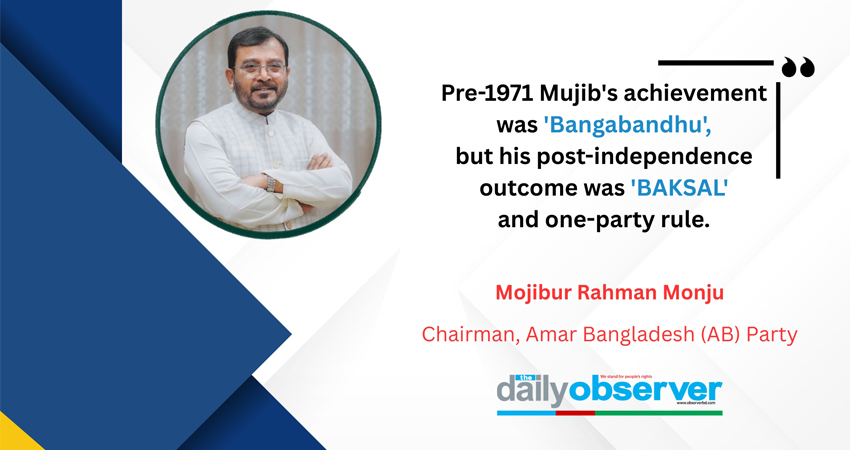
Mojibur Rahman Manju, leader of the Amar Bangladesh Party (AB Party), felt the need to form a new political entity after his expulsion from Jamaat-e-Islami. He took the initiative to build a new political platform while reflecting on the limitations of ideological politics. His core objective was to build a "Bangladesh of people's expectations."
A prominent journalist, cultural activist, and businessman, Manju is a former Executive Director of Diganta TV. He is also a former central president of Bangladesh Islami Chhatra Shibir and a former leader of Jamaat-e-Islami.
In an exclusive interview to The Daily Observer, he spoke about leaving Jamaat, the political stance of the AB Party, allegations of being called Jamaat's "B-team," the achievements of the July mass uprising, Awami League's politics, BNP's role, and the necessity of national unity.
The Daily Observer (TDO): Why did you leave Jamaat and form the AB Party?
Mojibur Rahman Manju: Jamaat expelled me by showing various reasons. Though there was an opportunity to apply for reconsideration after expulsion, I chose not to do so. I was a student of Political Science. As I reflected on the potential flaws of ideological politics, the idea of forming a new party came to mind. The AB Party was founded primarily to build a Bangladesh of people's expectations.
TDO: Critics often label the AB Party as Jamaat’s 'B-team'. How do you respond to this?
Mojibur Rahman Manju: I faced various forms of criticism after leaving Jamaat. Many alleged that propaganda was being run to break and weaken Jamaat. However, the new party was not established to split Jamaat, but because my views conflicted with their ideological politics.
Regarding our current presence in an 11-party alliance with Jamaat, it is strictly an electoral alliance. While the alliance was supposed to dissolve after elections, it remains intact due to the government's indifference toward implementing the July Charter. The current government appears indifferent to implementing the July Charter. If the BNP continues to oppose the July Charter, the younger generation will not accept it.
TDO: How do you evaluate the achievements and role of the AB Party in the July mass uprising?
Mojibur Rahman Manju: The most direct gain of July was the fall of the Awami League and Sheikh Hasina. Following the 1990 mass uprising, Ershad fell, but his political party later got the opportunity to participate in elections. However, a different situation has emerged regarding Awami League's politics following Sheikh Hasina's fall. People launched the movement because they were tired of government oppression. They want change.
Yet, a change of government was not the sole goal of July. Things have not changed much even after the BNP government came to power. We must move away from terrorism and anti-democratic practices to ensure good governance and democratic rights. July happened for real change.
TDO: What is the core ideology of the AB Party?
Mojibur Rahman Manju: Desired economic liberation did not come for the people after independence or after the 1990 uprising. Our ideological foundation stands on two pillars - establishing good governance and ensuring the proper implementation of the July Charter.
TDO: What is your stance on future political relations with the Awami League?
Mojibur Rahman Manju: Awami League is a major political party in the country. I have no intention of taking revenge against them. We want to break free from the cycle of vengeful politics.
However, Awami League's current stance is concerning. They have not apologized. Instead, they want to confront us through further threats and intimidation. While I do not want to take revenge, it becomes difficult to remain neutral if my adversary remains vengeful.
TDO: How do you view Sheikh Mujibur Rahman’s political legacy?
Mojibur Rahman Manju: There is a distinct difference between Sheikh Mujibur Rahman's pre-liberation and post-independence eras. Pre-liberation Sheikh Mujib led a struggling life. Prison, fines, and oppression could not hold him back.
However, his regime after independence warrants criticism. Post-independence Sheikh Mujib established BAKSAL. The Rakkhi Bahini unleashed anarchy across the country. Pre-1971 Mujib's achievement was 'Bangabandhu', but his post-independence outcome was 'BAKSAL' and one-party rule.
TDO: How do you view Ziaur Rahman’s historical contribution to the Liberation War?
Mojibur Rahman Manju: Ziaur Rahman's declaration of independence was suppressed during the Awami League regime. The army fought the Liberation War, and common people participated after taking training. Martyr President Ziaur Rahman gave a new dimension to the Liberation War by dividing it into sectors. Under the previous government, he was even branded as a 'Razakar'.
TDO: What is required to secure the nation's political future?
Mojibur Rahman Manju: Key political parties must play an active role in establishing national unity. Both the BNP and Awami League - everyone must contribute to national unity. Moving beyond political vengeance, we must shape the country's future by prioritizing good governance, democratic rights, and economic liberation for the people.
-SC/SA

Loading...
Loading...


Editor : Iqbal Sobhan Chowdhury
Published by the Editor on behalf of the Observer Ltd. from Globe Printers, 24/A, New Eskaton Road, Ramna, Dhaka.
Editorial, News and Commercial Offices : Aziz Bhaban (2nd floor), 93, Motijheel C/A, Dhaka-1000.
Phone: PABX- 41053001-06; Advertisement: 41053012; 01793317829, 01550707291, E-mail: [email protected], [email protected] Online: email: [email protected] 41053014; 01550707297 Advertisement: 01550707296
Published by the Editor on behalf of the Observer Ltd. from Globe Printers, 24/A, New Eskaton Road, Ramna, Dhaka.
Editorial, News and Commercial Offices : Aziz Bhaban (2nd floor), 93, Motijheel C/A, Dhaka-1000.
Phone: PABX- 41053001-06; Advertisement: 41053012; 01793317829, 01550707291, E-mail: [email protected], [email protected] Online: email: [email protected] 41053014; 01550707297 Advertisement: 01550707296


