



| HEADLINE |

|

Navigating rising costs and shifting consumer tastes: Igloo CEO on Bangladesh's food sector
Published : Wednesday, 9 September, 2026 at 4:19 PM
Shahman Abir


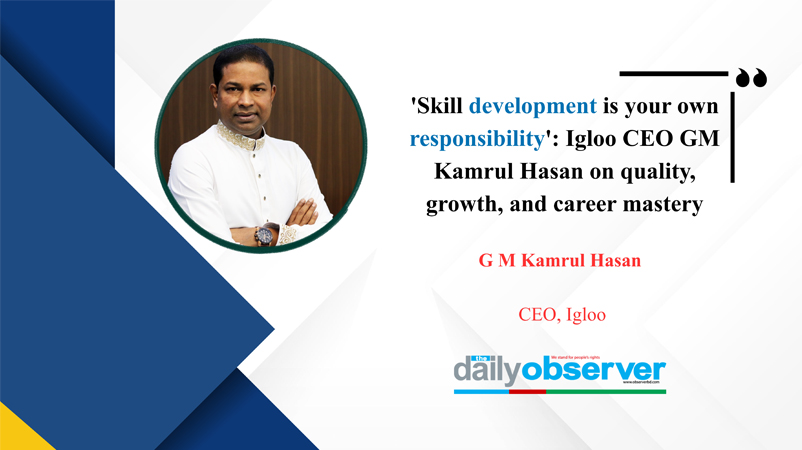
With decades of experience spanning multinationals and top domestic corporates, GM Kamrul Hasan took charge as the Chief Executive Officer of Igloo, a concern of Abdul Monem Limited, in January 2026. In an exclusive interview with The Daily Observer, he speaks about his professional journey, the evolving dynamics of Bangladesh's food sector, maintaining quality standards, and advice for young professionals.
The Daily Observer (TDO): You have navigated a long journey since your student days. How do you look back on it?
GM Kamrul Hasan: I would say my journey has been quite simple, though I am still learning every day. I completed my Bachelor’s degree in Biochemistry from the University of Dhaka and later pursued a Master’s from East West University.
My career started with Nestlé in July 1995, where I spent nearly 12 years. Following that, I worked as the Country Head for New Zealand Dairy (Fonterra) and served as the Chief Marketing Officer (CMO) at PRAN Group. Later, I worked with Akij and Igloo. Since January 2026, I have been serving as the CEO of Igloo.
TDO: How do you view the current trajectory of the food industry in Bangladesh?
Hasan: Food is an emerging and rapidly expanding sector. Food is one of our fundamental basic needs, so the business is bound to grow. Today, consumer habits are shifting - people now regularly buy frozen parathas and ready-to-cook items, something few imagined years ago. As literacy, busy lifestyles, and disposable incomes increase, urban consumers actively seek convenience.
The ice cream segment is also performing remarkably well. While we currently face infrastructure challenges like electricity disruptions, I am confident these issues will be resolved soon.
TDO: Adulteration in dairy products is a frequent concern. How does Igloo maintain its quality standards?
Hasan: Igloo operates on uncompromised fundamental pillars. Our late Chairman, Abdul Monem, used to say: "Never serve to a customer what you wouldn't eat yourself."
Over 70 per cent of Igloo’s raw materials are imported from overseas, including various specialized components beyond basic dairy. While a few basic ingredients like flour are sourced locally, our core inputs undergo strict quality control to maintain global standards.
TDO: What are the primary operational challenges for manufacturing businesses in Bangladesh currently?
Hasan: We face several systemic challenges, particularly high import duties, banking issues, and rising operational costs. Moreover, ice cream is not an essential daily utility, making it sensitive to economic pressure.
Currently, we are in a 'survival mode' due to increased cost structures. Factor in utility disruptions - such as gas and electricity shortages - and factories are sometimes forced to pause operations. This impacts factory workers directly, as day-wage earners lose income when production halts. I do not blame anyone specifically; structural crises cannot be resolved overnight. Many manufacturing entities are suffering similarly, but I strongly believe this phase will pass.
TDO: Igloo recently launched a sugar-free dessert segment. Could you elaborate on this product?
Hasan: To clarify, referring to it as "sugar-free" is technically inaccurate. Under BSTI regulations, if a product contains carbohydrates or natural milk sugars, you cannot label it sugar-free. Therefore, this new frozen dessert is officially categorized as a ‘No Added Sugar’ product.
The market for health-conscious items is expanding rapidly, especially among the youth and individuals avoiding refined white sugar or managing diabetes. Before launching, we conducted blind samplings with 300 consumers to gather feedback. It is not exclusively a medicinal food for diabetic patients, but it serves as a healthy, well-crafted alternative for indulgence.
TDO: How do Bangladeshi quality and safety standards differ from foreign regulations?
Hasan: The differences primarily stem from regional conditions - such as climate, humidity, geographical nuances, and local public health profiles. Foreign standards are designed around their local realities. When international concepts are brought to Bangladesh, recipes and standards are modified to suit local conditions rather than being blindly adopted.
TDO: What core skills should aspiring professionals focus on to excel in marketing and branding?
Hasan: First and foremost: thorough market analysis. One must understand the consumer and distinguish between a 'product' and a 'brand.' To truly learn, you must talk directly to consumers. As I often say: If you want to learn how to cook, you must go into the kitchen. Without direct field exposure, retail feedback, and consumer interactions, marketing skills cannot develop.
Career progression is a continuous effort. Look at Lionel Messi - he is the best in the world, yet he trains relentlessly every single day. The same applies to sales and marketing professionals. Entering a career at 20 or 24 is like walking a tightrope; your academic degree is merely an entry ticket to the stadium. Continuous skill development is entirely your own responsibility.
TDO: With the young generation relying heavily on AI tools like ChatGPT for marketing, how do you evaluate this trend?
Hasan: Utilizing AI for ideas is completely fine - even intelligence agencies rely on gathered intelligence. AI is undoubtedly a great tool, but everything depends on how you use it.
You read books to acquire knowledge, which you then apply using your own judgment. The same applies here. If you rely on AI without customizing its output, or if you submerge your own thinking entirely into the tool, you lose your original edge. Use AI to inform your intellect, not replace it.

Loading...
Loading...


Editor : Iqbal Sobhan Chowdhury
Published by the Editor on behalf of the Observer Ltd. from Globe Printers, 24/A, New Eskaton Road, Ramna, Dhaka.
Editorial, News and Commercial Offices : Aziz Bhaban (2nd floor), 93, Motijheel C/A, Dhaka-1000.
Phone: PABX- 41053001-06; Advertisement: 41053012; 01793317829, 01550707291, E-mail: [email protected], [email protected] Online: email: [email protected] 41053014; 01550707297 Advertisement: 01550707296
Published by the Editor on behalf of the Observer Ltd. from Globe Printers, 24/A, New Eskaton Road, Ramna, Dhaka.
Editorial, News and Commercial Offices : Aziz Bhaban (2nd floor), 93, Motijheel C/A, Dhaka-1000.
Phone: PABX- 41053001-06; Advertisement: 41053012; 01793317829, 01550707291, E-mail: [email protected], [email protected] Online: email: [email protected] 41053014; 01550707297 Advertisement: 01550707296


