



| HEADLINE |

|
Revival of 13 canals improves rural life in Naogaon
Published : Saturday, 22 August, 2026 at 12:00 AM
Our Correspondent


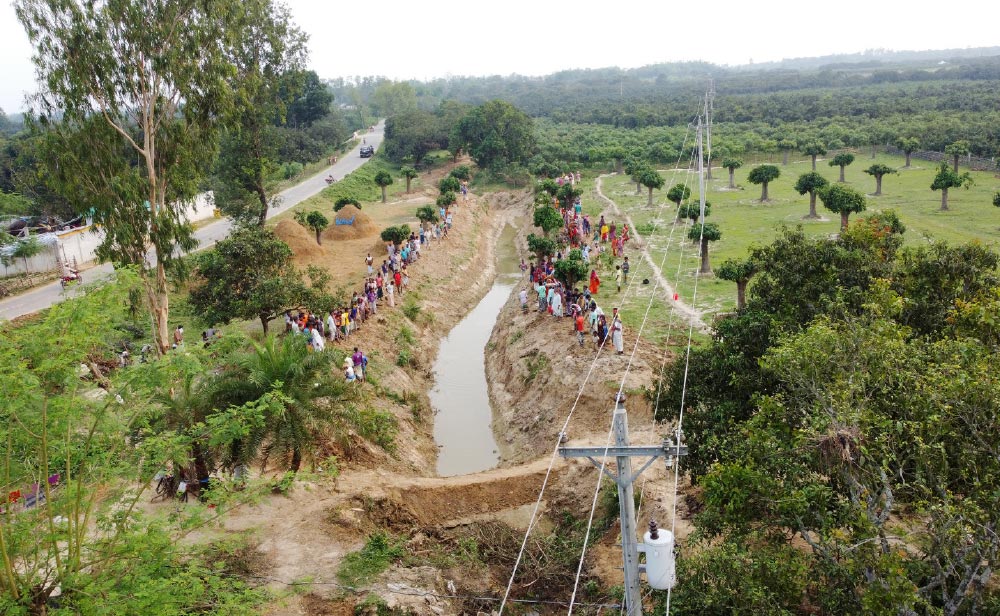 NAOGAON, Aug 21: The landscape of rural Naogaon has changed after the excavation and re-excavation of 13 canals across the district, with farmers using the stored water for cultivation while fishers and households are benefiting from the revived waterways.
The projects have also created employment opportunities for local unemployed and disadvantaged people.
In an example of saving public money, the district and upazila administrations spent Tk 73,05,54,389 out of Tk 87,03,39,397 allocated for the 13 canal projects in 10 upazilas. The remaining Tk 13,98,85,008 was returned to the government treasury.
According to the District Relief and Rehabilitation Office, around 26 kilometres of canals were excavated or re-excavated under the 13 projects.
Badalgachhi saw the highest amount of savings, with Tk 40,72,600 returned from two projects. In contrast, only Tk 30,531 was returned from two projects in Manda.
A one-kilometre canal from Shyampur Main Road through Haripur towards Kalupara Beel in Naogaon Sadar was re-excavated at a cost of Tk 52,45,728 against an allocation of Tk 71,10,879, saving Tk 18,65,151.
Another 2.04-km canal from Hamra Beel towards Krishnapur was re-excavated at a cost of Tk 67,57,965 against Tk 90,42,015, saving Tk 22,84,050.
In Raninagar, Tk 72,60,932 was spent from an allocation of Tk 77,28,842 for re-excavating a three-kilometre canal from Deola-Bargachha Bridge towards Malshan-Girigram. The remaining Tk 4,67,910 was returned.
In Badalgachhi, Tk 28,99,210 was returned from the Tk 77,28,842 allocated for repairing a 1.2-km canal from Dhekra Safir's land to Khorddabhuban Bridge.
However, allegations of irregularities have emerged over the two projects in Manda. Locals alleged that excavation work was completed superficially at some locations, raising questions about the quality of work despite the small amount of money returned.
Water revives farming
The canal near Deola-Bargachha Bridge in Raninagar had remained almost dead for years. Following re-excavation, it has now become a source of water for farmers during the dry season.
Suman Ali of Harkishor village in Manda said the canal had previously been almost unusable.
“After the re-excavation, water has accumulated in the canal. We can now use it for cultivation during the dry season.
Many people are catching fish and raising ducks, while the water is also useful for cattle and goats,” he said.
According to local residents and government officials, the revived canals are helping reduce waterlogging, create fish habitats, ease pressure on groundwater and protect local biodiversity.
Focus on employment, savings
Porsha Upazila Nirbahi Officer Md Rakibul Islam said creating employment for local people was one of the main objectives of the canal excavation projects.
He said at least 50 percent of the allocation was supposed to be spent on workers' wages, and despite the use of machinery at some locations, they employed workers to meet the government's objective.
“Even after completing 100 percent of the work according to the design and specifications, strict supervision helped save around Tk 13 lakh. The money was returned to the government treasury,” he said.
Naogaon Deputy Commissioner Mohammad Saiful Islam said the administration had undertaken the projects in line with government directives to revive dying canals.
He said the projects would help improve agricultural production, reduce waterlogging, boost fish breeding, ease pressure on groundwater and revive small rural waterways.
The DC said other canals in the district that remain in critical condition should also be excavated or re-excavated in phases.
Loading...
Loading...
Also read



Editor : Iqbal Sobhan Chowdhury
Published by the Editor on behalf of the Observer Ltd. from Globe Printers, 24/A, New Eskaton Road, Ramna, Dhaka.
Editorial, News and Commercial Offices : Aziz Bhaban (2nd floor), 93, Motijheel C/A, Dhaka-1000.
Phone: PABX- 41053001-06; Advertisement: 41053012; 01793317829, 01550707291, E-mail: [email protected], [email protected] Online: email: [email protected] 41053014; 01550707297 Advertisement: 01550707296
Published by the Editor on behalf of the Observer Ltd. from Globe Printers, 24/A, New Eskaton Road, Ramna, Dhaka.
Editorial, News and Commercial Offices : Aziz Bhaban (2nd floor), 93, Motijheel C/A, Dhaka-1000.
Phone: PABX- 41053001-06; Advertisement: 41053012; 01793317829, 01550707291, E-mail: [email protected], [email protected] Online: email: [email protected] 41053014; 01550707297 Advertisement: 01550707296


