



| HEADLINE |

|

Ganges Treaty renewal: ‘Uncertainty’ of water sharing
Published : Tuesday, 1 September, 2026 at 10:10 PM
Shahman Abir


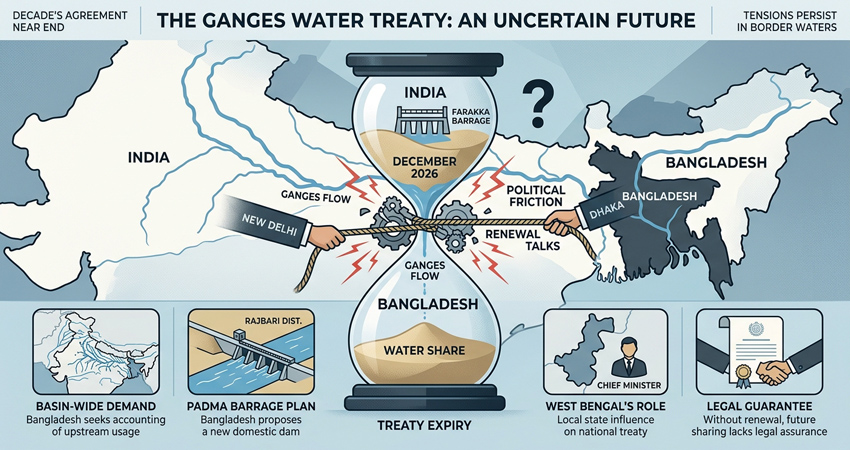
AI image
With only four months left before the 1996 Ganges Water Sharing Treaty completes its full 30-year course, the fate of one of South Asia’s most closely watched water-sharing arrangements remains under severe political friction, waiting to be resolved through bilateral talks.
The Treaty, which was signed initially at New Delhi on December 12, 1996 by then Prime Minister H D Deve Gowda of India and Sheikh Hasina of Bangladesh, guaranteed Bangladesh a share of the Ganges flow at Farakka through the dry months of January-May.
The water sharing criteria were set according to historical data and water flow rate in the dry seasons at the Farakka Barrage from 1949-1988. This Treaty brought an end to decades of bitter dispute between the two neighbouring nations.
However, unlike most of the bilateral treaties, future of this Treaty, after its expiration in next December, is unsettled and hinges entirely on ‘mutual consent’ between Dhaka and New Delhi, as spelled out in the Treaty’s Article XII.
As things stand, that consent has yet to take the shape of an actual agreement.
Talks Underway, but Disagreement Remains
Officials on both ends claim that the process is slowly moving towards resolution. India’s Ministry of External Affairs (MEA) has said discussions on renewal will proceed through the existing Joint Rivers Commission (JRC) framework rather than a freshly created negotiating track.
Analysts, however, signal that New Delhi is interested in the renewal of the existing Treaty, rather than a whole new rewrite.
In May of this year, four-day long technical talks were held in Kolkata. Engineers and officials from both countries discussed the future of Farakka Barrage itself for joint inspections and flow measurements.
The conflict initiated from here. Sources said Bangladeshi delegation wanted the sharing formula to look beyond Farakka altogether.
According to Dhaka, measuring water only at the barrage fails to identify what happens upstream. Canals and irrigation systems actively draw off Ganges’ waters in Uttar Pradesh, Bihar, Jharkhand and Uttarakhand - long before the river reaches West Bengal.
Bangladeshi delegation described the details as a demand for basin-wide accounting, not ‘barrage-level arithmetic,’ and are pushing for climate resilience to be written into whatever Treaty eventually emerges.
Indian officials, for their part, have pushed back, arguing that population growth and irrigation demands have changed so drastically since 1996 that "present-day flow realities at Farakka itself cannot be ignored," as one official confirmed.
The Padma Barrage Complication
A fresh layer of complexity has emerged as Bangladesh has announced its own move to build a barrage on the Padma River in Rajbari district, roughly 30-35 kilometers from the Indian border.
Officials in Dhaka claim, the project is meant to improve dry-season irrigation capabilities and retain water domestically during the lean months.
This is a long-standing ambition which was given a fresh urgency just before the uncertainty is condensing over the Ganges Treaty itself.
West Bengal's Shadow over the Talks
In this 30-year-long Treaty, the New Delhi central government has never been able to negotiate it without the active presence of West Bengal.
West Bengal still proves to be the most vital entity in forming this Treaty, even after a change of guard in Kolkata.
For years, it was Mamata Banerjee, as West Bengal's chief minister, who stood as the Treaty's most persistent domestic obstacle, repeatedly writing to the prime minister to object to being left out of talks and warning that "the people of West Bengal will be the worst sufferers" of any water-sharing arrangement with Bangladesh.
She blamed the Farakka Barrage itself for erosion, siltation and flooding across the state, and had, in 2011, blocked a separate draft deal on Teesta water sharing over similar concerns.
However, the reign of Mamata dramatically shifted with this year’s election. The Bharatiya Janata Party swept the West Bengal assembly election, ending Trinamool Congress's long hold on the state, and Suvendu Adhikari was sworn in as chief minister in May.
In Dhaka, some officials had allowed themselves a cautious hope that political alignment between Kolkata and New Delhi might finally unlock long-stalled river agreements, Teesta included.
Officials familiar with the discussions say New Delhi is unlikely to finalise any settlement with Dhaka without first dealing Kolkata - a dynamic that has outlasted the change of government in the state and appears set to shape the endgame of these talks regardless of which party sits in Writers' Building in Kolkata.
Bihar's Old Grievance Resurfaces
West Bengal is not the only Indian state with a stake in the outcome. Bihar Chief Minister Nitish Kumar, an important ally in the ruling coalition at the centre, has for years called for the Farakka Barrage to be decommissioned altogether, arguing it serves little purpose while worsening floods in his state.
External Affairs Minister S Jaishankar has reportedly given Bihar assurances that its concerns will be factored into the renewal process - though what that means in practice remains unclear.
A Deadline That Concentrates Minds
Water experts on both sides of the border agree on a singular point: If the Treaty is not renewed, it would leave Bangladesh with no legal guarantee of any specific water share from India.
Nevertheless, Bangladesh as a lower riparian country has a right to share water of a common river under International Law.
That prospect alone has kept the pressure on both governments to find common ground, even as the underlying disputes - over how flows are measured, over whose barrages get built where, over which Indian state gets a say - remain unresolved with the clock running down.
Whether a new Treaty text can be finalised before the current one lapses in December, or whether the two governments settle for an interim extension while talks continue, is a question officials on both sides are, for now, declining to answer definitively.

Loading...
Loading...
Also read







Editor : Iqbal Sobhan Chowdhury
Published by the Editor on behalf of the Observer Ltd. from Globe Printers, 24/A, New Eskaton Road, Ramna, Dhaka.
Editorial, News and Commercial Offices : Aziz Bhaban (2nd floor), 93, Motijheel C/A, Dhaka-1000.
Phone: PABX- 41053001-06; Advertisement: 41053012; 01793317829, 01550707291, E-mail: [email protected], [email protected] Online: email: [email protected] 41053014; 01550707297 Advertisement: 01550707296
Published by the Editor on behalf of the Observer Ltd. from Globe Printers, 24/A, New Eskaton Road, Ramna, Dhaka.
Editorial, News and Commercial Offices : Aziz Bhaban (2nd floor), 93, Motijheel C/A, Dhaka-1000.
Phone: PABX- 41053001-06; Advertisement: 41053012; 01793317829, 01550707291, E-mail: [email protected], [email protected] Online: email: [email protected] 41053014; 01550707297 Advertisement: 01550707296


