



| HEADLINE |

|

Historic milestone: RNPP supplies 350MW on nat’l grid
Published : Tuesday, 17 November, 2026 at 3:50 PM
Observer Online Report


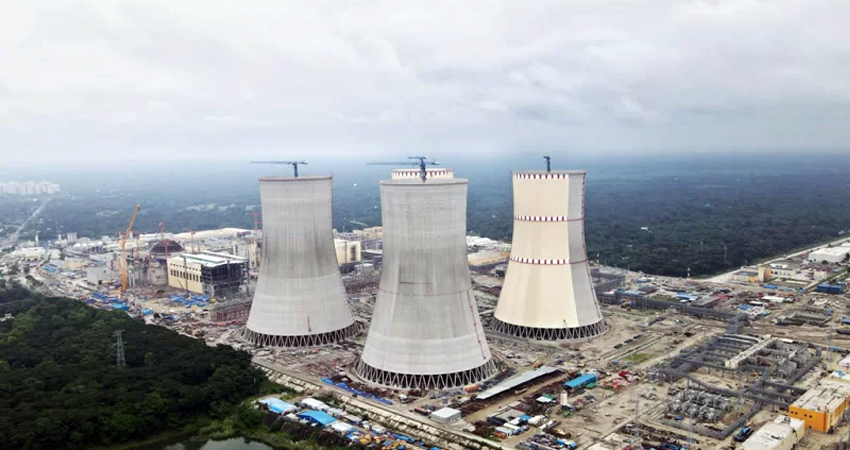
Symbolic Photo
Following years of anticipation, meticulous technical procedures, and rigorous safety checks, electricity generated from Bangladesh's maiden nuclear power facility has been fed into the national grid on a trial basis.
Science and Technology Minister Fakir Mahbub Anam oversaw the landmark event as Rooppur Nuclear Power Plant's first unit began supplying 350 megawatts of electricity to the national grid at 3:00 PM on Tuesday (November 17).
Testing Phases and Grid Integration
This initial trial connection marks a critical milestone for the power plant's generation and grid integration workflow. Under the schedule, electricity from this preliminary test will feed into the grid for approximately eight to ten hours.
During this window, engineers will monitor turbine and generator performance, evaluate system stability, and complete vital technical checks regarding coordinated grid operations.
Following these evaluations, the plant will temporarily disconnect from the grid for data review. After a break of roughly 28 hours, it will reconnect for another four to six hours to carry out additional operational assessments.
Approval Process and Commercial Timeline
Every testing phase closely examines system efficiency, turbine output, and grid synchronisation. Once the results of these technical trials satisfy safety standards, the Bangladesh Atomic Energy Regulatory Authority (BAERA) must grant approval before subsequent trial operations can run.
Under the agreement with the Russian contractor, the first unit will achieve Provisional Takeover by the Bangladesh Atomic Energy Commission following ten months of successful trial operation, leading to full-capacity commercial generation.
The government will subsequently issue a gazette notification to officially launch the Nuclear Power Plant Company Bangladesh Limited (NPCBL) as the operating organisation.
Project Capacity and Significance
Each of the two units at the Rooppur facility boasts a generation capacity of 1,200 megawatts, bringing the plant's total capacity to 2,400 megawatts. The project is expected to play a pivotal role in meeting Bangladesh's rising electricity demand, reinforcing energy security, and ensuring sustainable power generation.
The successful trial grid connection stands as a historic leap forward for Bangladesh's energy sector, marking the nation's formal entry into nuclear-powered electricity generation.
-SA

Loading...
Loading...
Also read









Editor : Iqbal Sobhan Chowdhury
Published by the Editor on behalf of the Observer Ltd. from Globe Printers, 24/A, New Eskaton Road, Ramna, Dhaka.
Editorial, News and Commercial Offices : Aziz Bhaban (2nd floor), 93, Motijheel C/A, Dhaka-1000.
Phone: PABX- 41053001-06; Advertisement: 41053012; 01793317829, 01550707291, 01550707296
E-mail: [email protected], [email protected]. [email protected], [email protected], [email protected], [email protected], Online-email: [email protected]


