



| HEADLINE |

|

Nepal and China experience unprecedented heat on August 26
Published : Thursday, 10 September, 2026 at 12:00 AM


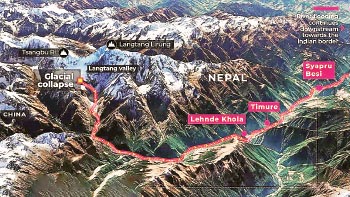 The mountain section whose collapse triggered fatal floods in Nepal and China on August 26 had experienced unprecedented heat for the time of year, meteorological data analyzed by a researcher shows.
Average temperatures on the mountain glacier at an altitude of 5,200 meters (17,060 feet) were estimated at around five degrees Celsius between August 21 and 26. This is exceptionally high. They had not exceeded 4.0C over the same period in more than 55 years of data recording, although no direct link to the collapse has so far been established.
This series of highly localized temperatures was reconstructed by Robert Rohde, chief scientist at the independent Berkeley Earth organization in California. At the site of the collapse, the average temperature recorded over that six-day period has risen by about 1.8C since the mid-20th century. The collapse came during the Langtang region's fourth-hottest summer on record, according to AFP's analysis of data from Europe's Copernicus observatory dating back to 1970.
Satellite images also showed significant snowmelt in the days before the disaster, providing "a substantial source of liquid water that can infiltrate fractures in the mountain and facilitate landslides", said Etienne Berthier, a glaciologist at France's CNRS research agency.
Experts remain cautious, however, about the precise role played by the heatwave.

Loading...
Loading...
Also read



Editor : Iqbal Sobhan Chowdhury
Published by the Editor on behalf of the Observer Ltd. from Globe Printers, 24/A, New Eskaton Road, Ramna, Dhaka.
Editorial, News and Commercial Offices : Aziz Bhaban (2nd floor), 93, Motijheel C/A, Dhaka-1000.
Phone: PABX- 41053001-06; Advertisement: 41053012; 01793317829, 01550707291, E-mail: [email protected], [email protected] Online: email: [email protected] 41053014; 01550707297 Advertisement: 01550707296
Published by the Editor on behalf of the Observer Ltd. from Globe Printers, 24/A, New Eskaton Road, Ramna, Dhaka.
Editorial, News and Commercial Offices : Aziz Bhaban (2nd floor), 93, Motijheel C/A, Dhaka-1000.
Phone: PABX- 41053001-06; Advertisement: 41053012; 01793317829, 01550707291, E-mail: [email protected], [email protected] Online: email: [email protected] 41053014; 01550707297 Advertisement: 01550707296


