



| HEADLINE |

|

A Lesson from Maupassant’s Mathilde Loisel
Published : Saturday, 19 September, 2026 at 12:00 AM
Jeba Tasnim Binta Alamgir


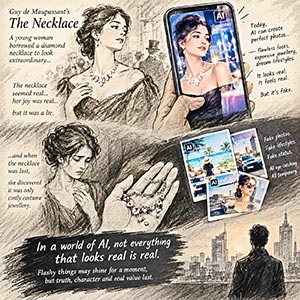 In Guy de Maupassant's phenomenal short story “The Necklace”, Madame Loisel (Mathilde) - the protagonist, borrowed a stunning ‘diamond’ necklace from her affluent friend -Madame Forestier, to wear it in an upcoming party. Mathilde donned it and received praises from strangers as she felt her look, enhanced by the sparkling jewellery that hung in her neck- dazzled the onlookers. In course of action, she lost the necklace and had to purchase an original duplicate by paying a grand sum to a jeweller to save her face in front of her rich friend.
 Afterwards, both Madame and Monsieur Loisel had to toil really hard for next ten years, spending their youth in trying to pay monthly instalments of loan that they took when they bought the original diamond necklace to return it to the owner. Anyone who has read Maupassant's this story knows what comes afterwards.
The last line of this short story is beautifully crafted, probably one of the finest examples of how a short story works- that revealed the necklace Madame Forestier let Mathilde Loisel to borrow was a fake one that looked like real diamond. She, upon meeting an aged, tired Mrs. Loisel in the Champs Élysées after ten years- was surprised to know that Mathilde Loisel had returned an original diamond necklace whereas her one's was not even a real one. The moral is clear, never to boast about something that is not owned. From a different perspective- a stitch of time, saves nine. Mathilde Loisel's a decade of hard work went to vain, in expense for a few praises thrown by onlookers who probably never remembered her after that fleeting moment.
A similar pattern can recently be traced in social media platforms, whenever a trend appears when people modify his or her picture to generate a “what if I looked like...” version with help from artificial intelligence based tools. Social media users are generating such pictures in flocks and the newsfeed is flooded by such contents.
Recently there is a trend that people claim is bringing back nostalgia from the 80’s. People generate AI pictures of themselves through inanimate AI tools that ‘imagine' what real humans would have looked like in the 80’s and modify real pictures with outfits and hairstyles that are reminiscent of the 80’s fashion and culture. It perhaps sounds fun to many people. Seeing themselves in perm hairstyles or in bright coloured retro outfits provide them dopamine boosts and like any other band wagoner, they insert prompt after prompt to generate multiple photos and then they post in social media where fellow band wagoners comment “ You look pretty” “ amazing “ and a myriad of other encouraging comments that are usually replied with a thanks. The question is for whom this praises are aimed?
Like Mathilde Loisel's borrowed necklace, AI generated photos are also fake and not real attributes ( or possessions) of a person. Henceforth, the shallow dopamine drive upon receiving such validations from others would not last long. It will eventually fade away, and what will remain is the harsh truth that people willingly gave consent to use personal photos to be used in development and training of future AI models and the sad reality that the global water crisis is deepened due to such trends taking effect worldwide. One University of California study reported prompts around 100 to 500 words or prompt to generate a picture in an AI tool approximately cost 500 ml to 1 litre water to cool down AI processors.
This might sound like a killjoy, and already others who have raised concern in social media about the utility of such trends, were attacked with the counter that it is fool to make everything complicated and modern people need some respite from complexities of life through such ‘fun', be it through AIs. They ask, “Don’t you use GPT for assignments and work? Where is your concern for global water crisis then?” Well, there are people, although may be a tiny community - still exist who like to do stuffs in the old way. About the ‘fun' part , isn’t it a matter of ardent shame that earlier people who used to pursue creative hobbies to gain dopamine and to take a break - are now relying on a few prompts to receive dopamine by gazing on fake photos! Humans are capable to do more than that and they are perfectly able to fight the urge to blindly follow a trend only if we think critically. Seen from a critical perspective, when a trend erupts worldwide, especially such that allows AI tools to accumulate people’s photos - needs to be viewed with caution, providing that deep fakes and privacy infringement through data leaks are occurring recurrently in recent times. There is also a suspicion that such trends that highlight certain accessories and style (oversized blazers, fluffy hairstyles, denim jackets and more) are intricately orchestrated to boost sales globally and to strengthen the consumer culture as well. A lot of fashion enthusiastic people are now interested to buy retro outfits, without them realizing that such interest is not organic choices rather a product of global neoliberal economy.
To conclude, certainly we are not in a position to entirely discard uses of artificial intelligences from our lives. In the upcoming years, it is going to be more intense. However, we are in a position to regulate our uses of AI models. Taking part in the global culture of AI slop is harming our environment, our intellects and wasting our individual human potentials. Uncritical AI users perhaps thus can take lessons from Maupassant’s Mathilde Loisel, who suffered for a decade for a few moments of fleeting pleasure. AI generated contents do the same, provide short-lived dopamine that in the long run damage our planet and help to fritter away our intellectual capacities.
The writer is a student, Department of English, University of Dhaka

Loading...
Loading...
Also read



Editor : Iqbal Sobhan Chowdhury
Published by the Editor on behalf of the Observer Ltd. from Globe Printers, 24/A, New Eskaton Road, Ramna, Dhaka.
Editorial, News and Commercial Offices : Aziz Bhaban (2nd floor), 93, Motijheel C/A, Dhaka-1000.
Phone: PABX- 41053001-06; Advertisement: 41053012; 01793317829, 01550707291, E-mail: [email protected], [email protected] Online: email: [email protected] 41053014; 01550707297 Advertisement: 01550707296
Published by the Editor on behalf of the Observer Ltd. from Globe Printers, 24/A, New Eskaton Road, Ramna, Dhaka.
Editorial, News and Commercial Offices : Aziz Bhaban (2nd floor), 93, Motijheel C/A, Dhaka-1000.
Phone: PABX- 41053001-06; Advertisement: 41053012; 01793317829, 01550707291, E-mail: [email protected], [email protected] Online: email: [email protected] 41053014; 01550707297 Advertisement: 01550707296


