



| HEADLINE |

|

US steps up focus on Teesta water management



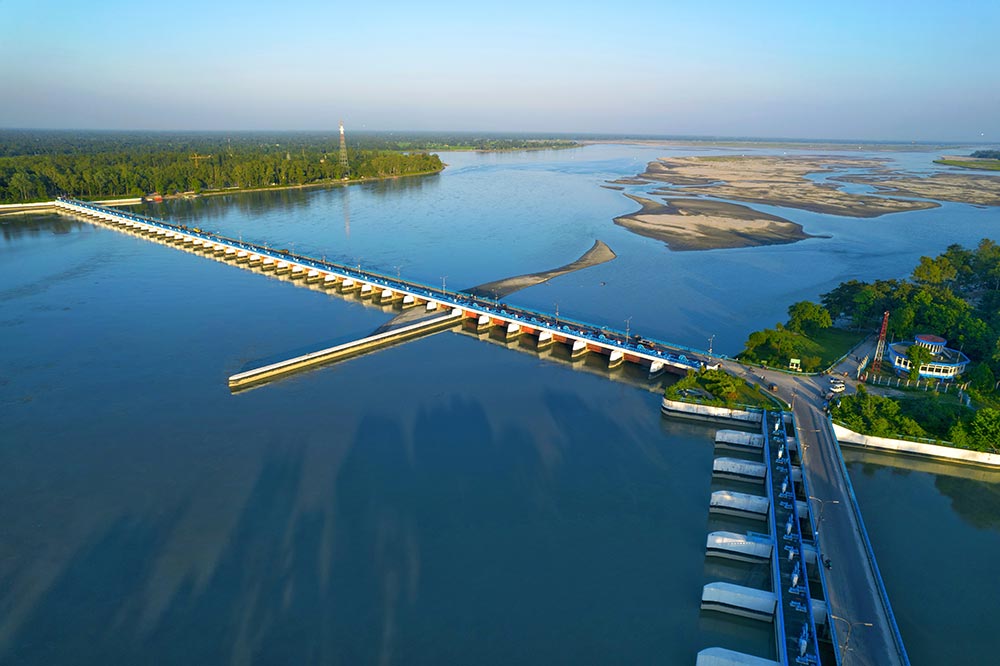 The United States has stepped up its engagement with Bangladesh’s water-resource management, with a particular focus on the Teesta Barrage and the proposed Teesta Master Plan, as Washington’s interest grows amid existing Chinese involvement and India’s stakes in the transboundary river.
According to Bangladesh Water Development Board (BWDB) and diplomatic sources, US officials have made several visits to the Teesta region over the past two months, holding discussions with officials and gathering information on water management, irrigation and flood control.
Repeated US teams' visits to Teesta region signal growing strategic interest in northern Bangladesh
The increased US engagement comes as China’s state-owned Sinohydro has already conducted a feasibility study for the Teesta Master Plan and is awaiting a final agreement with the government. China has expressed interest in assisting Bangladesh from the feasibility-study stage through implementation, while India has longstanding interests in the Teesta because of the river’s transboundary nature.
US Ambassador to Bangladesh Brent T Christensen’s visit to the Dalia Teesta Barrage in Lalmonirhat on August 30 was followed by visits of other US teams.
On September 9, US Army water-resources engineer Calvin Trebor Phesoj Creech visited the Teesta Barrage Project accompanied by four US Embassy officials, including Political and Economic Officer Charles Philippe Besnard Jr, David Evan Hurley, William Stevenson Logan IV and Michelle Angela Hilleary.
"Three separate US teams visited Rangpur and the Teesta region over the past two months," officials said on condition of anonymity.
A five-member US delegation also left Rangpur on September 10 after a three-day visit, according to sources.
No official details have been disclosed about the discussions between US army engineer Creech's delegation and BWDB engineers. However, a BWDB source said the US delegations conducted field visits, collected technical information and data, and indicated an interest in providing technical assistance to the Teesta Barrage Project.
The source said the United States views the Teesta Master Plan as an important geopolitical project.
US Ambassador Christensen, during his visit to the Teesta Barrage in Hatibandha upazila of Lalmonirhat, described the river as the "lifeline of the north". He attended a views-exchange meeting with BWDB officials, the local administration and local political leaders.
The discussions covered barrage operations, river-water management, irrigation and flood control during the monsoon. The Ambassador was also briefed on the current water situation in the Teesta, irrigation supply and water-management challenges in the northern region.
The Teesta Master Plan has increasingly acquired a geopolitical dimension. During Prime Minister Tarique Rahman's visit to Beijing last June, Bangladesh and China signed an agreement on a joint feasibility study on the Teesta River Integrated Management and Restoration Project.
Although the project was not included on the agenda of the prime minister's China visit, the BNP-led government later announced that it would implement the project using Bangladesh's own financing.
Under a government-to-government arrangement, Chinese state-owned Sinohydro has already completed a feasibility study for the broader Teesta Master Plan and is awaiting a final agreement.
A Water Resources Ministry official said the government could welcome cooperation from any country, whether Chinese technology, Indian cooperation or US expertise.
Experts, however, said proposals should be evaluated individually, taking into account costs, financing terms, control of information, ownership of infrastructure, security and environmental impacts.
The Teesta has long been viewed through the lens of India-China competition, but the growing US involvement is adding a new dimension to the equation. Diplomatic and water-management sources say the developments point to increasing strategic interest in northern Bangladesh.
The river is central not only to irrigation but also to water security, agriculture and the economy of northern Bangladesh, as well as the country's relations with India and China.

Loading...
Loading...
Also read



Editor : Iqbal Sobhan Chowdhury
Published by the Editor on behalf of the Observer Ltd. from Globe Printers, 24/A, New Eskaton Road, Ramna, Dhaka.
Editorial, News and Commercial Offices : Aziz Bhaban (2nd floor), 93, Motijheel C/A, Dhaka-1000.
Phone: PABX- 41053001-06; Advertisement: 41053012; 01793317829, 01550707291, E-mail: [email protected], [email protected] Online: email: [email protected] 41053014; 01550707297 Advertisement: 01550707296
Published by the Editor on behalf of the Observer Ltd. from Globe Printers, 24/A, New Eskaton Road, Ramna, Dhaka.
Editorial, News and Commercial Offices : Aziz Bhaban (2nd floor), 93, Motijheel C/A, Dhaka-1000.
Phone: PABX- 41053001-06; Advertisement: 41053012; 01793317829, 01550707291, E-mail: [email protected], [email protected] Online: email: [email protected] 41053014; 01550707297 Advertisement: 01550707296


