



| HEADLINE |

|
‘We have been the victims of terrorism’: Pezeshkian
Published : Thursday, 24 September, 2026 at 12:00 AM


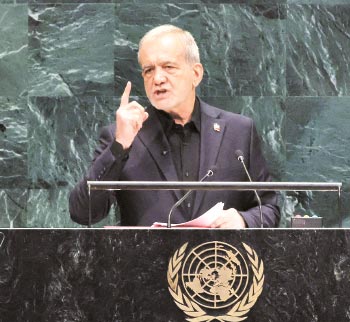 NEW YORK, Sept 23: Iranian President Masoud Pezeshkian opened his address to the UN General Assembly on Wednesday by recalling the deadly strike on an Iranian elementary school at the outset of the war, saying Iran had been the victim of terrorism.
“The United States president described us as terrorists,” Pezeshkian told world leaders. “We have been the victims of terrorism.”
Pezeshkian said he came from “an Iran where, in truth, they bombed a school”, referring to the February 28 strike on a school in the southern city of Minab. Iranian officials said at least 120 children and 26 teachers were among those killed.
“These children perished under bombs with weapons used by the United States and Israel. They were innocent, had committed no crimes,” he said.
Pezeshkian said Iran would not surrender under pressure, while stressing that Tehran remained ready for dialogue and diplomacy without threats or the use of force.
“The resistance of the Iranian people will only increase in the face of sanctions, increased pressure, increased bullying,” he said, adding that Iran “cannot be made to surrender”.
He accused the United States and Israel of violating international law by targeting civilian infrastructure in Iran.
“Yes, they did hit us,” Pezeshkian said. “But we did not bend the knee.”
At the same time, he said Iran was ready for negotiations. “We are ready for dialogue and diplomacy and negotiations �" without accepting the language of force,” he said.
Addressing those who had “carried out aggressions” against Iran, Pezeshkian said the conflict had demonstrated that Iran could not be forced to surrender.
“Iran has never, ever been an aggressor, has never started a war, and has always shown her commitment to the negotiating table,” he said.
He said Iran would defend itself “until our last breath”, describing the conflict as defensive in nature.
Pezeshkian also accused the international community of applying double standards to Iran and Israel, saying, “The nuclear weapon is in Israel, but the inspectors in Iran. Israel kills, but Iran is subject to sanctions.”
On the Strait of Hormuz, Pezeshkian said Iran could not accept a situation in which countries used the waterway for their interests while simultaneously using it to impose “aggressions” and insecurity on Iran.
He warned that any expansion of the war would not bring security.
Turning to the Palestinian issue, Pezeshkian described the situation in Palestine as “an open wound on the conscience of the international community” and a symbol of the failure of international mechanisms to prevent civilian suffering.
“We cannot speak of peace while ignoring Palestine,” he said. “Lasting peace in West Asia is impossible without justice for Palestine.”
Pezeshkian also reiterated Iran’s position that US military forces should leave the Middle East, saying regional issues should be resolved by countries in the region without outside interference.
On Iran’s nuclear programme, he said peaceful nuclear technology was part of the country’s development and insisted that Tehran did not seek nuclear weapons.
However, he said Iran would not accept restrictions on its civilian nuclear programme. Iran has long maintained that any agreement must allow uranium enrichment for medical research and electricity generation, while Washington opposes enrichment as part of the dispute over Tehran’s nuclear activities.
Pezeshkian’s address came amid renewed diplomatic efforts between Washington and Tehran aimed at ending the war and resolving the dispute over the Strait of Hormuz.�"AGENCIES
Loading...
Loading...
Also read



Editor : Iqbal Sobhan Chowdhury
Published by the Editor on behalf of the Observer Ltd. from Globe Printers, 24/A, New Eskaton Road, Ramna, Dhaka.
Editorial, News and Commercial Offices : Aziz Bhaban (2nd floor), 93, Motijheel C/A, Dhaka-1000.
Phone: PABX- 41053001-06; Advertisement: 41053012; 01793317829, 01550707291, E-mail: [email protected], [email protected] Online: email: [email protected] 41053014; 01550707297 Advertisement: 01550707296
Published by the Editor on behalf of the Observer Ltd. from Globe Printers, 24/A, New Eskaton Road, Ramna, Dhaka.
Editorial, News and Commercial Offices : Aziz Bhaban (2nd floor), 93, Motijheel C/A, Dhaka-1000.
Phone: PABX- 41053001-06; Advertisement: 41053012; 01793317829, 01550707291, E-mail: [email protected], [email protected] Online: email: [email protected] 41053014; 01550707297 Advertisement: 01550707296


