



| HEADLINE |

|

City roads turn into traps
Published : Saturday, 3 October, 2026 at 12:00 AM
Tanvir Raihan


 Dhaka’s roads are increasingly becoming a daily source of risk and inconvenience for commuters. From major thoroughfares to roads in residential neighbourhoods, asphalt has peeled away in many places, while small and large potholes have appeared and sections of roads have sunk. During rainfall, water often accumulates in the potholes, making it difficult for drivers and pedestrians to judge their depth. In dry weather, uneven surfaces cause constant jolts for vehicles and add to dust pollution.
The condition of roads across different parts of the capital suggests that inadequate regular maintenance has become a major source of public suffering. According to data from the engineering department of Dhaka South City Corporation (DSCC), nearly 30 per cent of the corporation’s more than 1,600 kilometres of roads have potholes or other forms of damage in different sections.
Several connecting roads between Mirpur and Agargaon have developed large potholes, while asphalt has peeled away at various points. Some sections are also prone to water accumulation after rainfall.
Secondary roads in many areas appear to be in worse condition than the main roads. Rickshaws, motorcycles and other small vehicles are frequently forced to slow down or make sudden manoeuvres to avoid potholes, disrupting traffic flow and increasing the risk of accidents.
Local residents say minor potholes often remain unattended for long periods, allowing them to gradually become larger. Eventually, authorities have to undertake extensive rehabilitation instead of carrying out simple repairs, increasing both public expenditure and commuter suffering.
Several roads in Dakshinkhan under Dhaka North City Corporation (DNCC), including Thana Road, Faidabad, Dewanbari, Lal Mosque, Gawair and Mollabari areas, have also been reported to suffer from potholes and waterlogging.
The problem becomes particularly serious after rainfall, when standing water conceals damaged sections of roads. Residents say repairing the road surface alone will not provide a lasting solution unless drainage problems are addressed at the same time. Otherwise, newly repaired roads can quickly deteriorate again.
A number of roads in Jatrabari, Sayedabad and surrounding areas under DSCC are also in poor condition. Various sections of Hatkhola Road between Tikatuli and Jatrabari, the road beneath the Dayaganj railway bridge, and roads in Mirhajirbagh and Dolairpar have developed potholes.
Several roads in Demra, including Barnamala School Road and the Staff Quarter�"Sarulia Bazar Road, have also deteriorated.
The roads around Mugda Hospital, Basabo, Madartek and adjoining areas have likewise developed numerous potholes. Several damaged sections have also been reported along the road from Golapbagh to Mugda Medical College.
The condition of these roads is particularly concerning because they are used by patients, hospital visitors and ambulances. During rainfall, the combination of standing water and potholes can make movement even more difficult for emergency vehicles.
Even roads in relatively developed and busy areas of the capital are not free from maintenance problems. In some places, utility service providers repeatedly excavate roads, while drainage works and rainfall damage asphalt surfaces elsewhere.
Failure to properly restore roads after excavation and inadequate coordination among utility agencies have long been concerns. The need for greater coordination to prevent repeated excavation of the same roads has also been raised at government meetings.
A key question is why many roads deteriorate again within a relatively short period despite substantial public spending on repairs.
DNCC officials say rainfall and waterlogging during the monsoon contribute to potholes and cracks, while damaged roads are being repaired whenever weather conditions permit.
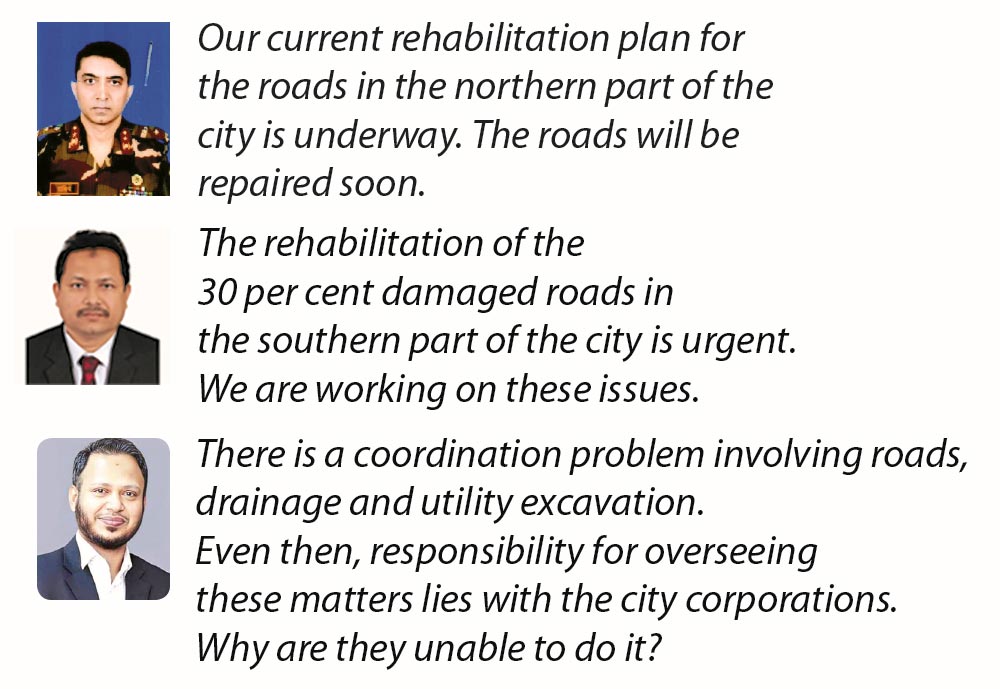
DNCC Chief Engineer Brigadier General Syed Rakibul Hasan said, “Our current rehabilitation plan for the roads in the northern part of the city is underway. The roads will be repaired soon.”
DSCC Chief Engineer Nur Azizur Rahman said, “The rehabilitation of the 30 per cent damaged roads in the southern part of the city is urgent. We are working on these issues.”
Yet questions remain over why potholes frequently reappear on the same roads soon after repairs.
Transport experts say the reasons for premature road damage cannot be determined simply by examining the asphalt surface. The condition of underlying road layers, drainage systems, heavy vehicle movement, construction quality and maintenance practices must also be considered.
A transport expert, speaking on condition of anonymity, said that when roads deteriorate shortly after rehabilitation, the quality of the work and the maintenance system should be reviewed. Regular monitoring and prompt repairs are necessary to prevent minor damage from developing into major road defects, the expert said.
Urban planner Prof Adil Muhammad Khan said, “There is a coordination problem involving roads, drainage and utility excavation. Even then, responsibility for overseeing these matters lies with the city corporations. Why are they unable to do it?”
Loading...
Loading...
Also read



Editor : Iqbal Sobhan Chowdhury
Published by the Editor on behalf of the Observer Ltd. from Globe Printers, 24/A, New Eskaton Road, Ramna, Dhaka.
Editorial, News and Commercial Offices : Aziz Bhaban (2nd floor), 93, Motijheel C/A, Dhaka-1000.
Phone: PABX- 41053001-06; Advertisement: 41053012; 01793317829, 01550707291, E-mail: [email protected], [email protected] Online: email: [email protected] 41053014; 01550707297 Advertisement: 01550707296
Published by the Editor on behalf of the Observer Ltd. from Globe Printers, 24/A, New Eskaton Road, Ramna, Dhaka.
Editorial, News and Commercial Offices : Aziz Bhaban (2nd floor), 93, Motijheel C/A, Dhaka-1000.
Phone: PABX- 41053001-06; Advertisement: 41053012; 01793317829, 01550707291, E-mail: [email protected], [email protected] Online: email: [email protected] 41053014; 01550707297 Advertisement: 01550707296


