



| HEADLINE |

|

Stranded in BD after leave
UAE visa revoke deepens crisis
Published : Saturday, 10 October, 2026 at 12:00 AM
Simanta Bardhan


 After spending decades building their lives, businesses and livelihoods in the United Arab Emirates (UAE), thousands of Bangladeshi migrants have suddenly found themselves unable to return to the middle eastern country. Cut off from their jobs, investments and, in some cases, families, many are struggling to understand why their visas were cancelled.
As the government pursues a diplomatic solution, the reasons behind many cancellations remain unclear, leaving affected migrants in distress and uncertainty.
Jahangir Alam spent 19 years building a life in the UAE. He owned two perfume shops and had investedSEE in other businesses. But after visiting Bangladesh, he discovered that he could no longer return to the country where he had built his future.
On July 24, 2026, Jahangir was informed at a UAE airport that his visa had been cancelled. Before leaving Bangladesh, he had checked his visa status at the airport and found it active. Yet, he was given no clear explanation for the change.
On July 30, he received a form from the embassy to submit an application. Although his application was received, he says he has heard nothing since. He adds that affected migrants have been protesting for nearly three months, but repeated assurances from the Ministry of Expatriates’ Welfare and Overseas Employment have yet to bring meaningful relief.
Abul Kalam, who had lived in the UAE for 27 years, faced a similar ordeal. After returning to Bangladesh on April 7, he received an email on July 24 informing him that his visa had been cancelled, without any explanation.
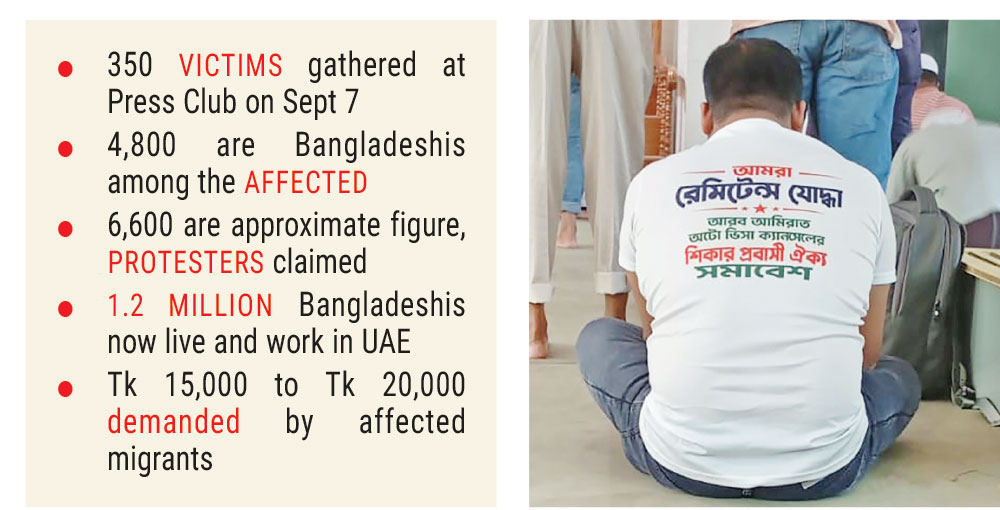
Kalam was among around 350 Bangladeshis who gathered at the National Press Club in Dhaka on September 7 to demand a solution. Some migrants received cancellation notices by email or mobile phone, while others learnt of the decisions through their sponsors.
For these migrants, the crisis extends far beyond travel restrictions. Years of hard work, savings and investment are at stake. Some have families waiting in the UAE, while others fear losing the businesses and income on which relatives in Bangladesh depend.
RISING NUMBERS, FEW ANSWERS
The reported number of affected Bangladeshis has risen sharply since July.
On July 30, State Minister for Foreign Affairs Shama Obaed Islam said 626 Bangladeshis had experienced automatic visa cancellations. The government had forwarded details of 417 people to UAE authorities for visa renewal, with the remaining cases to follow. She also said citizens of other countries, including Nepal, Pakistan, Egypt and the Philippines, had faced similar problems.
By September, ministry sources put the number of affected Bangladeshis at around 4,800. At a protest on October 7, migrants cited a figure of approximately 6,600. These figures were reported at different times and have not been reconciled in a single verified public count.
In a statement issued on July 27, the Bangladesh Embassy in Abu Dhabi acknowledged reports that Bangladeshis returning from holidays or other trips abroad had found their UAE visas cancelled without any stated reason.
The embassy said it was contacting the relevant UAE authorities through diplomatic channels to determine whether the cancellations resulted from technical errors or other causes. It added that senior government officials and the ministries concerned were monitoring developments.
The mission urged migrants to rely on official sources and beware of misinformation circulating on social media through accounts using government logos, national symbols or the embassy’s email address. It pledged to provide verified information when available.
On August 17, Expatriates’ Welfare Minister Ariful Haque Chowdhury said the specific reasons for the cancellations remained unknown. The embassy was collecting information from affected migrants and preparing a central database.
In September, State Minister for Expatriates’ Welfare and Overseas Employment Nurul Haque Nur said the UAE had cited internal security considerations. Bangladesh requested that the decisions be reconsidered and the affected cases reviewed.
POSSIBLE CAUSES REMAIN UNCONFIRMED
MS Shekil Chowdhury, chairperson of the Centre for Non-Resident Bangladeshis, suggested that the wider regional situation might be contributing to increased scrutiny.
The ongoing Middle East conflict could be prompting tighter checks, he said, with visa renewals, documentation, social media activity and potential security concerns receiving greater attention.
Chowdhury cautioned, however, that these factors had not been established as direct causes of the cancellations. He suggested that the broader regional and international political climate might be influencing the UAE’s approach and called for stronger diplomatic engagement by Bangladesh.
Other factors, including sponsorship decisions, employment disputes, company closures, documentation problems and prolonged absence from the UAE, can affect individual visa cases. But these remain possible explanations, not confirmed reasons for the reported cancellations as a whole.
FAMILIES BEAR THE BURDEN
The crisis has implications far beyond the migrants themselves. Bangladesh has been sending workers to the UAE since 1976, and around 1.2 million Bangladeshis now live and work there. They are employed in construction, transport, manufacturing, hospitality, security and other sectors, while many operate their own businesses.
DEMANDS FOR CONCRETE ACTION
The government says diplomatic efforts are continuing, but affected migrants are demanding practical support.
At the September 7 gathering, protesters called for monthly financial assistance of Tk 15,000 to Tk 20,000 for affected migrants and their families until the crisis is resolved. They also sought alternative overseas employment for those unable to return to the UAE.
On October 7, migrants staged another protest and formed a human chain outside the Ministry of Expatriates’ Welfare and Overseas Employment in Dhaka. They demanded arrangements to return to their workplaces, a lasting solution to the visa crisis and effective measures to protect their interests.
For Jahangir Alam, the two perfume shops and other investments he built over 19 years remain in the UAE, beyond his immediate reach. For Abul Kalam, 27 years of life there have brought no clear answer about his cancelled visa.
Their experiences capture the human cost of a crisis that has left thousands of Bangladeshis separated from their livelihoods and uncertain about their future. Until Dhaka and Abu Dhabi clarify the reasons for the cancellations and agree on practical remedies, migrants and their families will remain caught in a painful limbo.

Loading...
Loading...
Also read



Editor : Iqbal Sobhan Chowdhury
Published by the Editor on behalf of the Observer Ltd. from Globe Printers, 24/A, New Eskaton Road, Ramna, Dhaka.
Editorial, News and Commercial Offices : Aziz Bhaban (2nd floor), 93, Motijheel C/A, Dhaka-1000.
Phone: PABX- 41053001-06; Advertisement: 41053012; 01793317829, 01550707291, E-mail: [email protected], [email protected] Online: email: [email protected] 41053014; 01550707297 Advertisement: 01550707296
Published by the Editor on behalf of the Observer Ltd. from Globe Printers, 24/A, New Eskaton Road, Ramna, Dhaka.
Editorial, News and Commercial Offices : Aziz Bhaban (2nd floor), 93, Motijheel C/A, Dhaka-1000.
Phone: PABX- 41053001-06; Advertisement: 41053012; 01793317829, 01550707291, E-mail: [email protected], [email protected] Online: email: [email protected] 41053014; 01550707297 Advertisement: 01550707296


