



| HEADLINE |

|

'World has heard you': UNGA chief visits Rohingya camps
Published : Friday, 20 November, 2026 at 11:42 AM
Observer Online Report


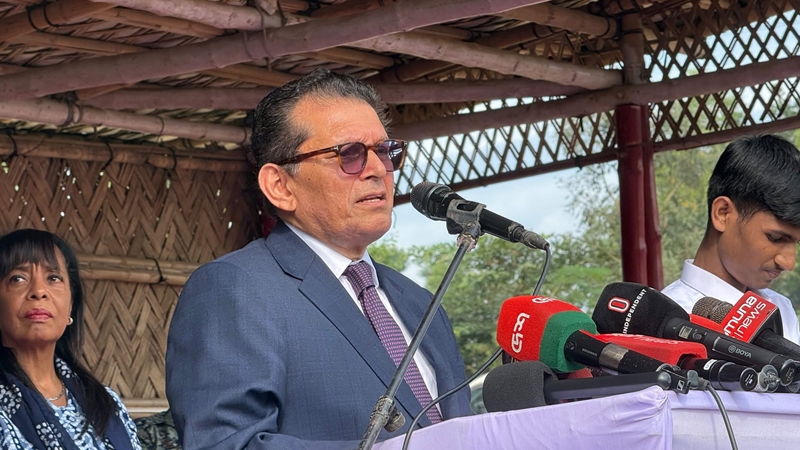
United Nations General Assembly (UNGA) 81st session President Dr Khalilur Rahman visited Rohingya refugee camps in Cox's Bazar on Friday morning (November 20), a day after the International Court of Justice (ICJ) delivered a historic ruling holding Myanmar responsible for Rohingya genocide in the case brought by The Gambia.
Speaking at 8:30 AM at a playground inside a Rohingya camp before gathered refugees, representatives of the Bangladesh government and the United Nations, and journalists, Dr Khalilur Rahman addressed the landmark legal development.
Opening his remarks emotionally, Dr Khalilur Rahman said, "Yesterday in The Hague, the highest court of the United Nations spoke. The court uttered your name—'Rohingya'. The court's verdict is clear: what was carried out against you in 2017 was genocide." He paid deep tribute to deceased Rohingyas who did not live to see the ruling.
Recalling his past work in the camps as Bangladesh’s High Representative for Rohingya Affairs, he said, "I did not want to speak about you from New York. I wanted to come and stand beside you. For years you called on the world to listen to your voice—today the world has heard it."
He noted that for the first time in history, the ICJ held a state responsible for genocide, finding evidence that Myanmar security forces systematically killed at least 10,000 Rohingyas, committed widespread sexual violence, targeted women and children, and destroyed villages, while also recognising the Rohingya as a distinct ethnic group.
Dr Khalilur Rahman expressed gratitude to The Gambia for leading the legal case, the Organisation of Islamic Cooperation (OIC), 11 intervening states, the court's judges, UN investigators, and the hosting Bangladesh government, its people, and residents of Ukhiya and Teknaf. He also paid special tribute to Rohingya women and survivors who testified courageously.
To translate the judgment into real change and deliver genuine justice in the lives of the Rohingya, Dr Khalilur Rahman set out four clear calls to action:
Ensure Accountability and Justice: Immediately investigate, try, and punish suspects involved in crimes under the Genocide Convention, while reforming flaws in Myanmar's domestic laws to guarantee such atrocities do not recur.
Safe and Dignified Repatriation: Enable displaced Rohingyas to return voluntarily, safely, and with dignity to their homeland, restoring or compensating for lost homes, land, and property, reuniting families, guaranteeing citizenship rights and security, and allowing UN access inside Myanmar.
Realistic Reparations and Greater Humanitarian Aid: Provide appropriate compensation to Rohingyas as individuals and as a community for irreparable harm, with Myanmar required to submit a report on the matter within two years. Until safe repatriation begins, international partners and donors must increase funding for food, education, healthcare, and protection in the camps, as Bangladesh cannot bear the burden alone.
Implement the Ruling and Prevent Recurrence: Build an environment where Rohingyas can live without fear through legal and institutional reforms, security force training, and effective civilian oversight, noting that compliance is binding under Article 94 of the UN Charter with recourse to the Security Council if necessary.
Concluding his speech with reference to the 1948 Genocide Convention, the UNGA president said, "Yesterday that convention worked in favour of a people who have no army or power. The theme of the current General Assembly session is 'restoring trust'. Through yesterday's verdict, the world took a major step toward keeping its promise to you. Now we must walk together until full justice is established and you safely return home."

Loading...
Loading...
Also read






Editor : Iqbal Sobhan Chowdhury
Published by the Editor on behalf of the Observer Ltd. from Globe Printers, 24/A, New Eskaton Road, Ramna, Dhaka.
Editorial, News and Commercial Offices : Aziz Bhaban (2nd floor), 93, Motijheel C/A, Dhaka-1000.
Phone: PABX- 41053001-06; Advertisement: 41053012; 01793317829, 01550707291, 01550707296
E-mail: [email protected], [email protected]. [email protected], [email protected], [email protected], [email protected], Online-email: [email protected]


