



| HEADLINE |

|

World's First
Japan launches mission to collect samples from Mars Moon
Published : Wednesday, 21 October, 2026 at 12:00 AM
Observer Desk


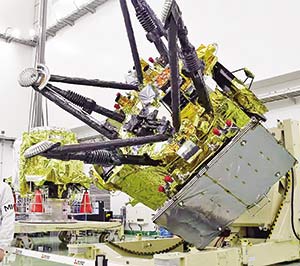 Japan successfully launched a spacecraft Tuesday on the world's first mission to collect rock and sand samples from a Martian moon, according to the country's space agency.
The Martian Moons eXploration (MMX) probe separated successfully from an H3 rocket and entered its planned orbit, the Japan Aerospace Exploration Agency (JAXA) announced, according to Kyodo News Agency.
The rocket lifted off from the Tanegashima Space Center in southwestern Japan at 4.41 am local time (1941GMT Monday).
JAXA project manager Makoto Arita said the spacecraft had reached its planned orbit with "exceptional precision."
The 4,480-kilogram spacecraft will travel to Phobos, the larger of Mars' two moons, and is scheduled to enter Martian orbit in August 2027.
A French-German rover will first land on Phobos, followed by two planned landings by the Japanese spacecraft to collect samples.
The probe will subsequently observe Mars' second moon, Deimos, before departing Martian orbit in November 2030. It is expected to return samples to Earth in July 2031.
Prime Minister Sanae Takaichi welcomed the launch, expressing hope that the historic mission would succeed.
The launch was originally scheduled for 2024 but was delayed following the failure of the H3 rocket's maiden flight in 2023.
The international MMX mission seeks to determine how Mars' moons formed and advance technologies for future planetary exploration.
Five space agencies are collaborating on the five-year mission, which will attempt to land a robotic prospector and a rover on Phobos, the larger and closer of the two moons.
The $578m mission features a five-tonne spacecraft that will sync with Phobos’ tight orbit around Mars when it arrives next summer. It will then eject a small French-German rover, named Idefix after the white terrier in the Asterix comics.
If all goes according to plan, the four-wheeled rover will bounce (due to gravity on Phobos being 1/1,000th as strong as Earth) for several minutes on Mars’s surface before coming to a halt. It will spend 100 days surveying the planet’s surface to find safe landing and sampling sites ahead of the arrival of the main craft, a four-legged stationary lander that will gather the samples.
The lander will spend only two hours on Phobos drilling and vacuuming up material, before launching back into space. Officials said it would observe Deimos during several flybys before leaving Mars’s orbit in November 2030.
“It is a once-in-a-lifetime chance. We are part of the first sample return mission from the Martian system,” said the Germany Space Agency’s rover chief Markus Grebenstein.
Scientists hope the samples will help them establish how Phobos and Deimos were formed and even offer clues about the origins of life. MMX’s findings will also help shape future Mars missions, including crewed expeditions, Nasa said.
According to one theory - the “giant impact” hypothesis - the two moons formed after a celestial body collided with Mars. A second proposition, known as the “capture” hypothesis, suggests that the moons are asteroids pulled in by Mars’s gravity.

Loading...
Loading...
Also read



Editor : Iqbal Sobhan Chowdhury
Published by the Editor on behalf of the Observer Ltd. from Globe Printers, 24/A, New Eskaton Road, Ramna, Dhaka.
Editorial, News and Commercial Offices : Aziz Bhaban (2nd floor), 93, Motijheel C/A, Dhaka-1000.
Phone: PABX- 41053001-06; Advertisement: 41053012; 01793317829, 01550707291, E-mail: [email protected], [email protected] Online: email: [email protected] 41053014; 01550707297 Advertisement: 01550707296


