



| HEADLINE |

|

United Nations Day 2026
The Architecture of Trust: Rebuilding the Global Commons
Published : Saturday, 24 October, 2026 at 12:00 AM
Dr Matiur Rahman


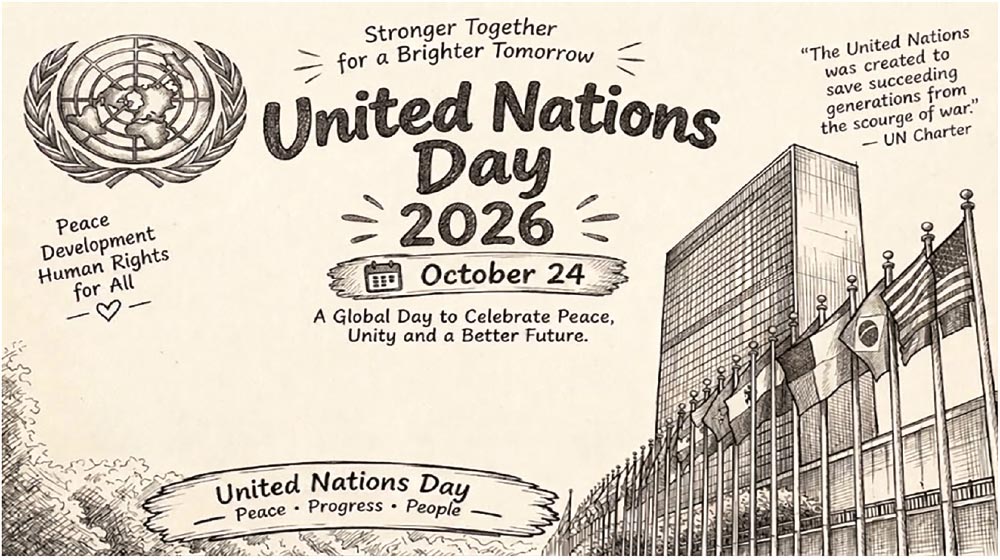
 On 24 October 2026, the United Nations marks its eighty-first anniversary amid wars, climate disruption, inequality and technological change. The theme guiding the General Assembly’s eighty-first session, “Restoring Trust, Managing Transformation: A United Nations That Delivers for All,” captures the organisation’s central challenge. Trust cannot be restored by commemorative speeches. It must be earned through fair decisions, credible action and tangible improvements in people’s lives.
The United Nations Charter entered into force on 24 October 1945, after a world war that killed tens of millions and exposed the destructive potential of militarised nationalism. Its founders knew disagreement would persist. They sought a framework for addressing disputes through diplomacy, law and collective action rather than another global catastrophe. Eighty-one years later, that ambition remains essential, even as the institution struggles to match the scale and speed of contemporary crises.
The UN’s record is neither triumph nor failure alone. It has not prevented every war, stopped every atrocity or eliminated poverty. The Security Council’s divisions have repeatedly obstructed decisive action, particularly when permanent members defend their own interests or allies. Yet the wider UN system supports vaccination, food assistance, refugee protection, disaster response, education, public health and international cooperation. This quiet work protects millions from suffering.
The crisis is that the institution’s universal promise is increasingly at odds with unequal power. Five permanent members of the Security Council retain veto authority, reflecting the geopolitical settlement of 1945 rather than the distribution of population, influence and responsibility in today’s world. Africa has no permanent seat, while major countries and regions remain underrepresented in the Council’s permanent structure. When vetoes block action over grave violations, people witnessing devastation conclude that international law is applied selectively. Such perceptions corrode legitimacy and encourage governments to bypass multilateral institutions.
Reform must therefore be more than administrative streamlining. The Security Council needs a more representative membership, meaningful restraint on veto use in cases of mass atrocities, and transparent decision-making. Changes require difficult negotiations, but resistance cannot justify delay. A rules-based order will command respect only when rules apply consistently, and when countries most affected by global decisions have a meaningful voice in shaping them.
Restoring trust also requires the UN to deliver in a world of interconnected risks. Climate change is already intensifying heat, floods, droughts and sea-level rise, with disproportionate consequences for vulnerable communities. The Paris Agreement established a common framework, but national pledges and climate finance remain insufficient for the scale of the challenge. Developing countries need predictable support for adaptation, loss and damage, and a just transition to cleaner energy. Climate solidarity cannot mean asking those least responsible for emissions to bear the greatest costs.
Technology creates a second test. Artificial intelligence can improve health care, education and productivity, but it can also accelerate disinformation, discrimination, surveillance and cyberattacks. Autonomous weapons and emerging biotechnologies raise difficult questions about accountability and human control. No country can manage these risks alone. The UN can convene governments, scientists, businesses and civil society to develop shared safeguards grounded in human rights, transparency and public benefit. Global rules should ensure innovation’s gains are shared and its dangers managed.
Financial credibility matters as much as institutional design. Humanitarian agencies cannot plan effectively when contributions arrive late, fall short or are restricted in ways that prevent urgent needs from being met. Member states should pay assessed contributions in full and on time, while improving oversight and reducing duplication. Efficiency is necessary, but indiscriminate cuts can undermine the very services that make the UN valuable. Performance should be judged by civilian protection, essential services for children and crisis prevention, not meetings or resolutions.
Bangladesh has a particular stake in this debate. Its experience in disaster preparedness, community adaptation and development offers practical lessons for international cooperation. Its peacekeepers have served in difficult environments around the world, demonstrating that countries outside the traditional centres of power contribute directly to global security. Bangladesh’s current role is also symbolically significant: Khalilur Rahman, a Bangladeshi diplomat, is President of the General Assembly’s eighty-first session, whose theme calls for trust and transformation. That leadership should advance inclusive multilateralism.
The Rohingya crisis illustrates the gap between shared principles and shared responsibility. Bangladesh continues to host refugees who fled persecution in Myanmar, while humanitarian funding pressures place essential services at risk. Relief must be sustained, host communities supported, and international efforts directed towards conditions for safe, voluntary and dignified return. No refugee should be pushed back into danger because donors lose interest. Durable solutions require accountability, diplomacy and coordinated pressure, alongside practical assistance for displaced people and the communities sheltering them.
Ultimately, the UN cannot succeed without political will from its member states, and governments cannot solve transnational problems through unilateral action alone. Its institutions must listen more closely to young people, civil society and communities experiencing conflict, poverty and climate shocks. Its leaders must acknowledge failures, explain decisions and show evidence of results. Citizens should judge it realistically: not as a world government, but as an indispensable arena for cooperation.
The Secretary-General’s 2026 message reinforces this imperative: dialogue over division, cooperation over confrontation and solidarity over fear. These are requirements for managing shared dangers. The credibility of UN commitments will be measured by whether people facing war, hunger and displacement experience protection, and whether younger generations inherit a more secure planet.
United Nations Day 2026 should be a call to rebuild trust by matching principles with practice. The alternative to imperfect multilateralism is not a safer world of isolated states; it is a more fragmented order in which power increasingly determines whose rights matter. The UN was never designed to create heaven on earth. Its purpose is to help humanity avoid catastrophe and build conditions for peace, dignity and shared progress. Eighty-one years on, the task is to renew that purpose through fair representation, responsible innovation, reliable financing and action that reaches people. Trust will return when the United Nations delivers for all.
The writer is a researcher and development professional

Loading...
Loading...
Also read


Editor : Iqbal Sobhan Chowdhury
Published by the Editor on behalf of the Observer Ltd. from Globe Printers, 24/A, New Eskaton Road, Ramna, Dhaka.
Editorial, News and Commercial Offices : Aziz Bhaban (2nd floor), 93, Motijheel C/A, Dhaka-1000.
Phone: PABX- 41053001-06; Advertisement: 41053012; 01793317829, 01550707291, E-mail: [email protected], [email protected] Online: email: [email protected] 41053014; 01550707297 Advertisement: 01550707296


