



| HEADLINE |

|

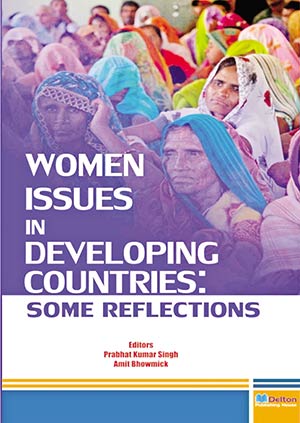
Women Issues in Developing Countries: Some Reflections
Published : Saturday, 24 October, 2026 at 12:00 AM
Prabhat Kumar Singh and Amit Bhowmick


 Reviewed by Dr Matiur Rahman
Few subjects deserve more urgent scholarly attention than the condition of women in the developing world, and few attract as much well-meaning but loosely argued writing. This edited volume of roughly three dozen essays, mostly by South Asian academics, illustrates both the promise and the hazards. It is wide-reaching, humane in intent, and valuable as a regional snapshot, yet held back by uneven rigour and a thin editorial hand.
Edited by Prabhat Kumar Singh and Amit Bhowmick, the book was published in 2018 by Delton Publishing House, Delhi, in collaboration with A H Development Publishing House, Dhaka.
The editors, sociologists from Ranchi University and a West Bengal college, say they wanted to voice stories untold under the veil of the so-called third world. They invoke the feminist critique of modernisation theory, which assumed that economic growth would liberate women automatically. That is a sound starting point. The preface concedes, however, that contributions reflect the authors' own specialisations. The book is therefore a mosaic rather than an argument; expect no single thesis.
The opening chapters are the most conceptual. Laksman Chandra Ojha traces the status of Indian women from the relative freedom of the Rig Vedic period to the later constraints of child marriage, purdah and widow burning. Tahiti Sarkar examines colonial India, and Jhuma Paul surveys feminism across the ages.
A recurring insight is that colonial and nationalist reformers alike confined women to the symbolic space of the home, the "ghar", so that elevation became a new form of enclosure. This is the book's sharpest theme, and it deserves more development than it receives. Ojha's golden-age narrative, by contrast, rests on selective scriptural readings.
The strongest essays are those grounded in fieldwork or law. Studies of displaced rural women in Odisha, migrant garment workers in Tirupur, self-help groups in Assam and the Kanyashree conditional cash-transfer scheme in West Bengal ask concrete questions about how policy touches lives. The legal essays are equally forceful. Girish Kumar Sarova argues for criminalising marital rape in India, pointing to the statutory exemption that still shields husbands, while Masood Ahmad and S M Aamir Ali document wartime sexual violence as a deliberate tactic and note why survivors so seldom obtain justice. Such pieces carry the volume's moral weight.
For Bangladeshi readers, the Bangladesh contributions are of particular interest. Two chapters address child marriage, a problem on which the country's record remains troubling despite gains in female schooling. One attributes it to poverty, insecurity and social prejudice, and that diagnosis is persuasive. The second, by Tahsina Ferdous and Mohammad Ismail Bhuiyan, contrasts early marriage past and present. Here the argument falters. It suggests that girls of earlier decades were healthier and more mature because their food was unadulterated and rich in fish, a claim offered without evidence and likely to mislead. A chapter on rural women's decision-making in Jhenaidah, based on a household survey of 85 respondents in two villages, yields a telling finding: husbands claim sole authority over decisions on health, marriage and money, while wives describe those same decisions as joint. The result is a reminder that empowerment is perceived differently by men and women, though the small sample limits what can be generalised. The study also finds that most women own no land and cannot spend money independently, limiting autonomy.
Other chapters cover Sri Lankan mothers, gender equality and education in Nepal, women administrators in higher education, and media. The two final essays, on the Manipuri campaigner Irom Sharmila's long fast against the Armed Forces Special Powers Act and on the "memsahibs" of the Darjeeling tea gardens, are fascinating but sit oddly in a book otherwise devoted to development. The Sharmila piece reads as admiring biography, and the memsahib study concerns European rather than local women, so neither engages the volume's central question.
The weaknesses are mostly editorial. Despite the title's reference to developing countries, India dominates; Bangladesh, Sri Lanka and Nepal appear in only a handful of chapters, and the advisory boards listing Ethiopian and Nigerian scholars are not matched by a single African case study. Quality varies sharply across chapters. Some, such as the one on entrepreneurship, devote pages to Cantillon and Schumpeter before reaching rural Odisha. Others recycle familiar statistics. Several read as a celebration of government schemes rather than evaluation, and almost none confront the possibility that microfinance and self-help groups may overburden women instead of liberating them. Proofreading lapses and an incomplete table of contents suggest hurried production. A framing introduction and a synthesising conclusion would have turned scattered observations into a coherent case.
Even so, the collection does something useful. It records, through scholars who live among the problems they describe, that women's disadvantage is cumulative: low education feeds early marriage, early marriage limits income and health, and weak legal protection leaves violence unpunished. The recurring policy conclusions, namely girls' schooling, secure livelihoods, legal reform and changed attitudes, are familiar yet remain unfinished business.
The book will serve students, social workers and development practitioners as a reference to current South Asian debates. It will serve policymakers less well, since few chapters supply comparative data. Bangladeshi specialists should read it for the country chapters and Indian parallels, remembering that evidence varies. Overall, it is a sincere and informative if unpolished contribution, and its best chapters point to the larger, more rigorous work still to be done.
The reviewer is a researcher and development professional

Loading...
Loading...



Editor : Iqbal Sobhan Chowdhury
Published by the Editor on behalf of the Observer Ltd. from Globe Printers, 24/A, New Eskaton Road, Ramna, Dhaka.
Editorial, News and Commercial Offices : Aziz Bhaban (2nd floor), 93, Motijheel C/A, Dhaka-1000.
Phone: PABX- 41053001-06; Advertisement: 41053012; 01793317829, 01550707291, E-mail: [email protected], [email protected] Online: email: [email protected] 41053014; 01550707297 Advertisement: 01550707296


