



| HEADLINE |

|

Hope of Padma–Yangtze: Reflections on China–Bangladesh Relations
Published : Saturday, 28 November, 2026 at 12:00 AM
Lt Col Md Shahadat Hossain, psc, Retd


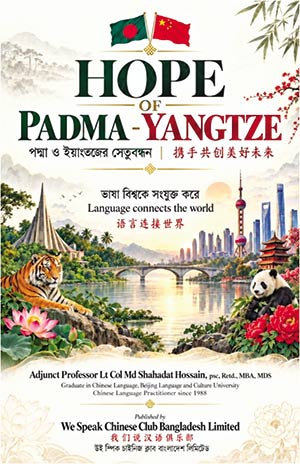 Friendship between nations is often measured through diplomatic visits, trade agreements, development projects and formal partnerships. Yet, behind these visible expressions of international relations lies something equally important: the understanding that develops between their people. It is this human dimension of friendship that gives Hope of Padma-Yangtze: Reflections on China-Bangladesh Relations, written by Adjunct Professor Lieutenant Colonel Md Shahadat Hossain, psc, Retd, its particular appeal.
Published in October 2026, the book brings together fourteen articles and reflections on different aspects of Bangladesh-China relations. It covers a wide range of subjects, including the history of bilateral friendship, economic cooperation, defence relations, language education, cultural exchanges, China’s development experience and opportunities for future collaboration. However, what makes the publication particularly interesting is the author’s personal connection with the subject. His reflections are not based solely on reading or academic observation. They come from a journey that began nearly four decades ago and has continued through military service, professional engagements, teaching and research.
The story behind the book is worth mentioning. In September 1988, as a young officer of the Bangladesh Army, Shahadat Hossain travelled to Beijing on a government scholarship to study the Chinese language at the then Beijing Language Institute, now known as Beijing Language and Culture University. At that time, he could hardly have imagined how significantly that experience would influence the course of his life.
Learning a foreign language opened the door to a new culture, introduced him to people from a different society and eventually became the foundation of his lifelong involvement in Bangladesh-China relations.
During his military career, he had the opportunity to work as an interpreter during engagements involving senior Bangladeshi and Chinese leaders and high-level delegations. Such responsibilities gave him an unusual opportunity to observe diplomacy at close quarters. He witnessed how communication, personal understanding and mutual confidence contribute to building relationships between countries. These experiences are reflected throughout the book and give many of its articles a personal quality that readers are likely to appreciate.
His association with China did not end with his retirement from the Army in 2008. Instead, he took his interest in the Chinese language and culture into the field of education. Starting with a single student, he gradually developed his teaching activities and went on to teach Chinese to more than 3,500 learners. He also contributed to the promotion of Chinese-language education through different institutions and initiatives, including We Speak Chinese Club Bangladesh Limited. This part of his journey is particularly inspiring because it demonstrates how an individual can continue serving a wider cause even after completing a formal professional career.
The historical account of Bangladesh-China relations forms an important part of the book. Since the establishment of diplomatic relations in 1975, the two countries have gradually expanded their engagement in several fields. The author takes readers through significant developments and high-level exchanges that have helped shape this relationship. His discussion of the visits of Chinese leaders to Bangladesh, particularly President’s state visit in October 2016, highlights an important chapter in bilateral relations. That visit resulted in the elevation of the relationship to a Strategic Partnership of Cooperation and opened new avenues for engagement in infrastructure, trade, investment, energy, transportation and other areas.
The fiftieth anniversary of diplomatic relations in 2025 also receives attention. Fifty years of formal relations represent more than a historical milestone. They provide an opportunity to look back at the progress made by both countries and consider what the next stage of cooperation should look like. The author’s reflections on the evolving relationship, including the more recent discussions on building a China-Bangladesh community with a shared future, give the book a contemporary relevance.
One of the most engaging aspects of the publication is the author’s account of China’s transformation. Having first visited the country in 1988, he has been able to observe its development over a considerable period. The China he encountered as a young officer was very different from the modern and technologically advanced country that it is today. His observations on infrastructure, industrial growth, technological progress and the changing lives of ordinary people provide an interesting perspective on one of the most significant development stories of modern times.
For Bangladeshi readers, this discussion carries particular significance. Bangladesh is also pursuing ambitious development goals, and the experiences of countries that have undergone remarkable economic transformation deserve careful attention. The author draws attention to factors such as long-term planning, discipline, education, skills development, institutional capacity and the effective use of technology. His reflections encourage readers to consider what lessons Bangladesh may draw from China’s experience while following its own development priorities and national circumstances.
Economic cooperation is another major theme. China has become one of Bangladesh’s important economic and development partners, with cooperation extending across trade, investment, infrastructure, energy and industrial development. The author discusses the opportunities that this partnership can create, particularly in expanding Bangladesh’s industrial capacity and strengthening its economic foundations.
His discussion of the Chinese Economic and Industrial Zone in Chattogram is especially relevant. The development of such an industrial zone has the potential to attract investment, create employment, encourage technology transfer and support the growth of local industries. The book also looks towards emerging areas of cooperation, including the digital economy, artificial intelligence, renewable energy and human-resource development. These are sectors that will increasingly influence the future of the global economy, and Bangladesh has much to gain by preparing its young population to participate in them.
The author also recognizes that economic relations are not built through infrastructure and investment alone. People, skills and professional understanding are equally important. Greater opportunities for Bangladeshi products, businesses and skilled professionals in the Chinese market could add a new dimension to the partnership. His emphasis on education and vocational training is therefore particularly meaningful.
Given the author’s military background, it is hardly surprising that defence cooperation receives thoughtful attention. His discussion of the People’s Liberation Army and its development offers readers an additional perspective on China’s military modernization. He also reflects on the longstanding professional relationship between the armed forces of Bangladesh and China.
Military cooperation is an important part of the broader bilateral relationship. Training, professional exchanges and institutional interaction have helped develop familiarity and mutual confidence between the two armed forces. The author’s personal experiences in this field add considerable value to the discussion. For serving and retired military personnel, as well as students of defence studies, these sections provide an interesting account of a subject that is not always discussed in detail in general publications on international relations.
Perhaps the most appealing theme of the book is its emphasis on language and cultural understanding. The author clearly believes that lasting friendship between countries must be supported by friendship between their people. This is a simple but important idea. Diplomatic agreements may establish the framework for cooperation, but it is people who give that relationship its meaning.
The growing importance of the Chinese language in Bangladesh is discussed from both practical and cultural perspectives. As cooperation expands, knowledge of Chinese can create opportunities for young Bangladeshis in education, employment, business, research and professional services. It can also help Bangladeshi institutions and businesses communicate more effectively with their Chinese counterparts. The author’s own work in this field gives substance to his argument. His efforts to teach the language, train professionals and promote cultural activities reflect a long-term commitment to bringing the two societies closer.
Among the human stories included in the book, the account of Alifa Chin is particularly touching. Her mother received emergency medical assistance from Chinese military doctors aboard the hospital ship Peace Ark during its visit to Bangladesh in 2010. Her father named her Chin, meaning China in Bengali. Years later, she wrote to Chinese President and received a reply encouraging her to pursue her dreams. It is a small but memorable story. It reminds readers that the relationship between two countries is not limited to government offices, conference rooms or official agreements. Sometimes, its most meaningful expressions can be found in the lives of ordinary people.
The book also looks towards areas where Bangladesh and China may strengthen their cooperation in the years ahead. Water-resource management, particularly the Teesta River, maritime cooperation, the blue economy, regional connectivity, healthcare, education and the Rohingya issue all feature in the author’s reflections. These subjects are important to Bangladesh’s development and regional interests. The country’s geographical position gives it considerable potential to benefit from stronger connectivity with neighboring regions and wider Asian markets. Cooperation in these areas could create opportunities not only for the two countries but also for regional development.
An important point running through the author’s discussion is that Bangladesh must continue to pursue its national interests while maintaining constructive relations with all its development partners. His reflections are consistent with Bangladesh’s longstanding foreign-policy principle of friendship with all. Stronger relations with China can create valuable opportunities, while an independent and balanced approach to international engagement remains essential. This perspective gives the book a broader relevance beyond the immediate subject of bilateral friendship.
As a collection of articles written over time, the book brings together different experiences and perspectives rather than following the structure of a conventional academic study. This gives it a conversational quality and allows readers to approach the subject from several directions. The author’s personal narratives, historical references and observations make the discussion accessible to readers who may not have a specialized background in international relations. At the same time, the range of subjects makes it useful for diplomats, military professionals, academics, researchers, students and members of the business community.
The title itself deserves appreciation. The Padma and the Yangtze are two great rivers associated with Bangladesh and China respectively. Bringing their names together creates a simple yet powerful image of two countries connected by friendship and shared aspirations. It also captures the central message of the publication: that geographical distance need not be a barrier to understanding, cooperation and lasting friendship.
What ultimately makes Hope of Padma-Yangtze an interesting read is the personal sincerity with which the author approaches his subject. His journey from a young Army officer arriving in Beijing in 1988 to an educator, interpreter and advocate of Bangladesh-China friendship gives the publication a human foundation. The book reflects not only his professional experiences but also his enduring belief in the value of language, culture and mutual respect.
Bangladesh-China relations have come a long way over the past five decades. The opportunities ahead are considerable, and the nature of the partnership will continue to evolve with changing economic and international circumstances. Publications such as this are valuable because they encourage people to look beyond the immediate headlines and understand the deeper connections that shape relations between nations.
Hope of Padma-Yangtze: Reflections on China-Bangladesh Relations is, in essence, a book about friendship, experience and hope. It records important moments from the past, reflects on the progress made in the present and looks towards the possibilities of the future. Through his personal observations and sustained engagement with the subject, Lt Col Md Shahadat Hossain has made a positive contribution to the discussion on Bangladesh-China relations. The book deserves attention from readers interested in international friendship and, more importantly, in the opportunities that mutual understanding and cooperation can bring to the people of Bangladesh and China.

Loading...
Loading...



Editor : Iqbal Sobhan Chowdhury
Published by the Editor on behalf of the Observer Ltd. from Globe Printers, 24/A, New Eskaton Road, Ramna, Dhaka.
Editorial, News and Commercial Offices : Aziz Bhaban (2nd floor), 93, Motijheel C/A, Dhaka-1000.
Phone: PABX- 41053001-06; Advertisement: 41053012; 01793317829, 01550707291, 01550707296
E-mail: [email protected], [email protected]. [email protected], [email protected], [email protected], [email protected], Online-email: [email protected]


