



| HEADLINE |

|

Rising feed prices squeeze Rajshahi cattle farmers



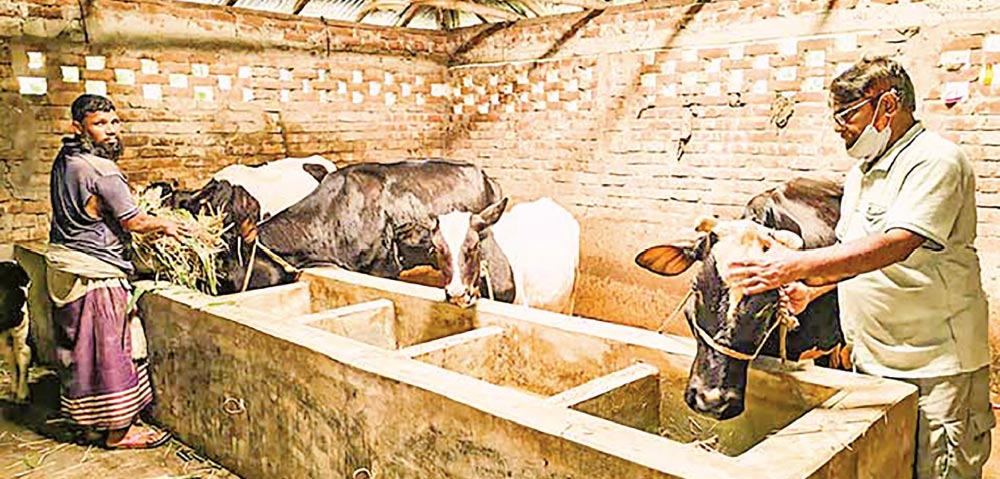 RAJSHAHI, Oct 30: Livestock farmers in Rajshahi are struggling to keep their businesses afloat as prices of cattle feed continue to rise, pushing up production costs without a corresponding increase in the prices of milk and cattle.
Prices of almost all types of feed, including wheat bran, oilcake, rice bran, straw and commercially produced animal feed, have increased. Over the past year, farmers have also faced higher labour wages and other livestock rearing costs, leaving many struggling to cover expenses. Some are relying on loans and savings to keep their farms running amid fears of mounting losses.
Farmers allege that there is no clear justification for repeated feed price hikes. They suspect that some feed mill-owners and companies, along with the influence of a syndicate, are contributing to the increases. Meanwhile, higher feed costs could affect livestock rearing and marketing, potentially pushing up milk and cattle prices in the future, traders say.
Altaf Hossain, a farmer in Charghat Upazila, said feed prices had increased repeatedly while milk prices had not risen at the same pace.
“Labour wages have also gone up significantly. It has become difficult to run a farm after covering all the expenses. I am still managing despite the difficulties, but the big question is how long I can continue,” he said.
Babu Hossain, a cattle farmer in the Shimulia area of Charghat, said he previously had more than 100 goats, but the number had fallen to 58 as feed became more expensive.
“It is no longer possible to run the farm by buying feed at such high prices. So I am gradually winding it down,” he said.
Ashikur Rahman of Komela Agro Farm in the Kharkhari area of Paba Upazila said rising feed costs and labour wages had left farmers with little or no profit.
“Almost everything is expensive in the current market. Production costs are rising, but income is not increasing accordingly. It has become difficult to keep farms running this way,” he said.
According to farmers, prices of several feed ingredients have risen significantly over the past year.
A 37kg sack of wheat bran now sells for Tk 2,200, up from Tk 1,800 a year ago. A 74kg sack of oilcake costs Tk 3,400�"3,600, compared with Tk 2,800 last year. A 50kg sack of rice bran now costs Tk 800, up from Tk 650 recently.
The price of 1,000 pieces of straw has risen to Tk 8,000 from Tk 3,000�"4,000. The price of chickpeas has increased to Tk 110 per kg from Tk 90, while khesari has risen to Tk 60 from Tk 48 per kg. Maize now costs Tk 36 per kg, up from Tk 27, while broken rice has increased to Tk 34 from Tk 28 per kg.
A 50kg sack of commercial animal feed now costs Tk 3,500, up from Tk 3,200.
Farmers say these ingredients are essential to their animals' daily diets, forcing them to spend more every day. The additional costs have become particularly difficult for small-scale farmers to manage.
Higher labour costs have further increased the expense of running farms. According to farmers, a worker's monthly salary was Tk 8,000�"10,000 two years ago. Now, it is difficult to hire a worker for less than Tk 15,000 a month.
Electricity bills, veterinary treatment, animal care and other expenses have added to the burden. Many farmers have taken loans from banks and non-governmental organisations (NGOs) to run their businesses. With production costs rising, they are also struggling to repay loan instalments and interest.
Sabina Khatun, a cattle farmer in the Naohta Pillapara area of Paba Upazila, said she reared three to four cows at home every year but no longer made as much profit as before.
“The cost of feed and the labour involved in raising cattle leave almost no profit. Still, I continue raising cows alongside my household work. It has now become a hobby and a habit,” she said.
She added that she used to recover her investment when she sold the cattle at the end of the year after spending money on bran and oilcake throughout the year.
“But this year, I am not even sure whether I will be able to recover my principal after paying interest on my NGO loan, let alone make a profit,” she said.
Livestock officials have advised farmers to cultivate improved varieties of grass to reduce production costs amid rising feed prices. They say planned grass cultivation could significantly reduce expenses by lowering dependence on purchased feed such as bran, oilcake and straw.
Dr Md A Latif, Livestock Officer of Paba Upazila, said farmers should cultivate improved varieties of grass to meet their animals' feed requirements.
“This will significantly reduce feed costs. Grass is also highly beneficial for cattle's health,” he said.
Farmers who depend entirely on purchased feed would find it particularly difficult to make a profit this year, he added. The livestock office is therefore advising them to grow improved varieties of grass.
According to the Rajshahi district livestock office, there are around 26,234 small and large livestock farms in the district, including more than 150 large farms. Many farmers, workers and traders are directly or indirectly involved in the sector.
Atowar Rahman, Rajshahi District Livestock Officer, said his office was encouraging farmers to cultivate grass as feed prices continued to rise.
“Grass contains all the essential nutrients livestock need. We also provide grass seedlings to farmers free of charge,” he said.

Loading...
Loading...
Also read



Editor : Iqbal Sobhan Chowdhury
Published by the Editor on behalf of the Observer Ltd. from Globe Printers, 24/A, New Eskaton Road, Ramna, Dhaka.
Editorial, News and Commercial Offices : Aziz Bhaban (2nd floor), 93, Motijheel C/A, Dhaka-1000.
Phone: PABX- 41053001-06; Advertisement: 41053012; 01793317829, 01550707291, 01550707296
E-mail: [email protected], [email protected]. [email protected], [email protected], [email protected], [email protected], Online-email: [email protected]


