



| HEADLINE |

|

Teaching, learning gaps fuel HSC result slump
Poor English, ICT results account for 382,021 failures as pass rate falls again
Published : Sunday, 1 November, 2026 at 12:00 AM
Tanvir Raihan


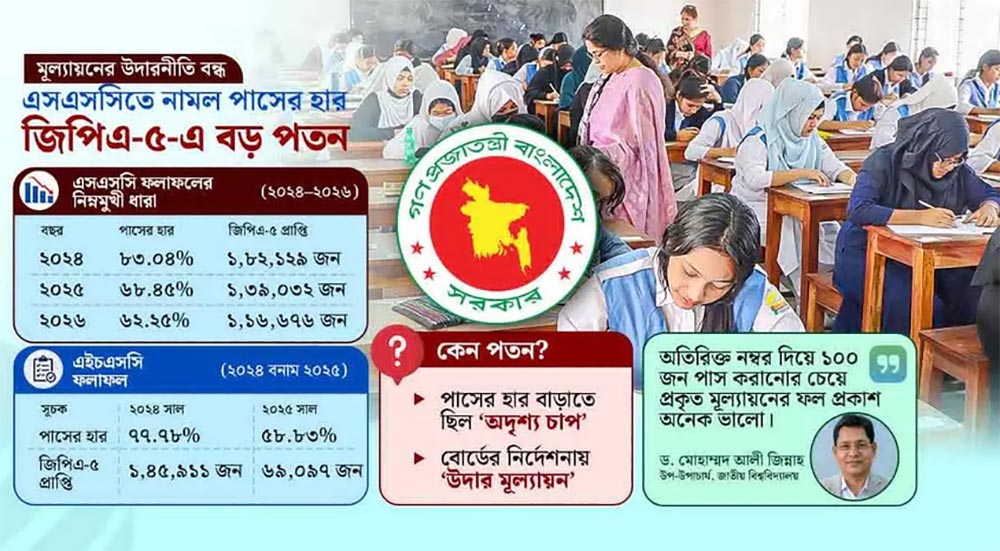 Teacher shortages, weak subject knowledge and widening learning gaps have emerged as major factors behind the continued decline in HSC results, with poor performance in English and Information and Communication Technology (ICT) accounting for more than 382,000 failures this year.
The pass rate fell to 52.12 per cent, down 6.71 percentage points from last year, while nearly 600,000 candidates failed. Educationists say the results expose deep-rooted weaknesses in classroom teaching, teacher training and students' basic learning.
An analysis of the results shows that 243,528 candidates failed in English and 138,493 in ICT. The Bangladesh Bureau of Educational Information and Statistics (BANBEIS) reports that 2,625 educational institutions have no English teacher, while 3,861 lack dedicated ICT teachers.
The shortage is compounded by a mismatch between teachers' qualifications and the subjects they teach. Of 64,253 English teachers, 51,360 do not hold a bachelor's, master's or higher degree in the subject. Around 40 per cent of teachers have also received no professional training.
The situation is reflected in individual institutions. An ICT teacher at a government science college, speaking on condition of anonymity, said the institution had no formally appointed ICT teacher. Though he teaches the subject, his academic qualifications are in another discipline and he has received no specialised training.
Abu Zafar, a teacher at Motijheel Model School and College, said the institution needed at least four English teachers but had only two, forcing them to take additional classes.
Professor Syed Akhtaruzzaman, president of the Bangladesh Inter-Education Board Coordination Committee and chairman of the Dhaka Education Board, cited learning gaps, shortages of subject-specific teachers and inadequate training. He also pointed to differences between classroom instruction and examination requirements.
Educationist Professor Dr Siddiqur Rahman Khan said students had failed to answer questions because they had not learned the subjects properly. He said both students' lack of attention and teachers' limitations needed to be addressed through better training and a more understandable curriculum.
Some teachers also blamed the late decision to introduce a common question paper nationwide, errors in some papers and the challenge of sitting examinations under the full syllabus. However, the extent of their impact requires further examination.
The results announced by Education Minister Dr ANM Ehsanul Haque Milon on Saturday show that 646,685 of 1,240,798 candidates passed, while 594,113 failed. The number of unsuccessful candidates rose by 85,412 from last year.
The pass rate has fallen from 77.78 per cent in 2024 to 58.83 per cent in 2025 and 52.12 per cent this year. GPA-5 achievers also declined from 145,911 in 2024 to 69,097 last year and 40,084 this year.
Among the nine general education boards, the humanities group recorded the lowest pass rate at 42.17 per cent. Dhaka posted the highest overall pass rate at 61.80 per cent, while Barishal recorded the lowest at 44.84 per cent.
Minister Milon acknowledged shortcomings in learning outcomes, teaching methods, parental involvement and the overall educational environment, describing teacher shortages and recruitment delays as longstanding challenges.

Loading...
Loading...
Also read


Editor : Iqbal Sobhan Chowdhury
Published by the Editor on behalf of the Observer Ltd. from Globe Printers, 24/A, New Eskaton Road, Ramna, Dhaka.
Editorial, News and Commercial Offices : Aziz Bhaban (2nd floor), 93, Motijheel C/A, Dhaka-1000.
Phone: PABX- 41053001-06; Advertisement: 41053012; 01793317829, 01550707291, 01550707296
E-mail: [email protected], [email protected]. [email protected], [email protected], [email protected], [email protected], Online-email: [email protected]


