



| HEADLINE |

|

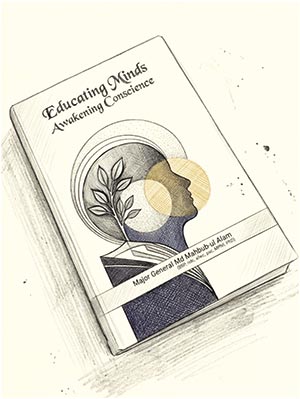
Educating Minds, Awakening Conscience
Published : Saturday, 7 November, 2026 at 12:00 AM
Major General Md Mahbub-ul Alam


 Reviewed by Shaon Arafat
If you step back and look at the way we talk about education today, it is hard not to notice a recurring obsession. An obsession with technological progress, skill specialisation and maximising economic output has quietly turned our universities into assembly lines designed to churn out efficient cogs for the job market. Yet, somewhere along the way, the human side of education seems to have received less attention.
Reading Major General Md Mahbub-ul Alam’s Educating Minds, Awakening Conscience brought this concern back to me. When I turned the final page of the book, it felt less like I had just finished an academic manuscript and more like someone had gently pulled my arm to stop and ask where we are actually heading.
Drawing on his experience as a military officer, scholar and Vice Chancellor of the Bangladesh University of Professionals (BUP), Mahbub-ul Alam examines a problem that goes beyond classrooms and academic institutions. In the book, he explores a quiet crisis in which an educational system that devotes all its energy to technical literacy while neglecting the human conscience ultimately builds on sinking sand.
What struck me immediately as I began reading this bilingual collection of essays, written in both English and Bengali, was how the first act takes us right into the hearts and minds of the youth where meritocracy is framed not as some abstract economic policy, but as the lifeblood of a fair society. These pages resonated deeply because of how grounded they are in our immediate reality, as the author points directly to recent events like the student uprisings of July 2024 to show how desperately people long for a world where success is earned through ability rather than political favouritism or backdoor connections, even while he refuses to look through rose-coloured glasses by readily confronting the “myth of meritocracy” and acknowledging that true fairness remains an uphill battle when systemic inequalities lock brilliant minds out of basic resources. From there, walking through quiet reflections on what incoming university freshers should look for, the delicate bond between teachers and students, and why character building cannot be treated as an afterthought felt intensely personal.
Moving into the second act, I appreciated how the book pulls back the curtain on the actual machinery of our education system without shying away from messy administrative truths as it dives straight into faculty selection criteria, university admission policies and the logistical knots of cluster admission methods. One of the most unexpected twists that really made me pause and think was his argument for looking at retired military personnel as a strategic asset for civilian education, because by examining how structured leadership and discipline have historically helped shape national educational infrastructure, he outlines very practical ways to inject order and accountability back into public institutions.
The third act widened the lens entirely to move beyond campus walls and look at the moral health of society itself, and that was where the book hit closest to home for me as Mahbub-ul Alam walked us through uncomfortable modern truths like the heartbreaking rise of old-age homes as family structures fray, the digital wildfire of character assassination, the subtle psychology behind why people lie, and the delicate dance between exercising our right to protest and carrying our civic responsibilities. He argues persuasively that modern phenomena like social polarisation aren’t happening in a vacuum, but are instead the direct symptoms of a world that teaches people how to make a living while forgetting to teach them how to live alongside one another.
What made this reading experience truly worthwhile for me is the tone, written with a rare mix of scholarly insight and deep human empathy that avoids feeling like a lecture and speaks across languages in both English and Bengali to invite everyone into the room including students, parents, teachers and policymakers. Even reading the foreword by Professor Dr SMA Faiz, the former Chairman of the UGC and former VC of Dhaka University, felt like an invitation from a wise elder telling you that these pages matter. So that when I finally closed the book, I was left with the quiet realisation that national progress cannot be measured purely by graduation rates, high-rise campuses, or test scores, leaving me with Major General Mahbub-ul Alam’s timeless reminder that the true test of any educational system isn’t the title it prints on a degree, but the depth of the human conscience it leaves behind.
The reviewer is a journalist

Loading...
Loading...



Editor : Iqbal Sobhan Chowdhury
Published by the Editor on behalf of the Observer Ltd. from Globe Printers, 24/A, New Eskaton Road, Ramna, Dhaka.
Editorial, News and Commercial Offices : Aziz Bhaban (2nd floor), 93, Motijheel C/A, Dhaka-1000.
Phone: PABX- 41053001-06; Advertisement: 41053012; 01793317829, 01550707291, 01550707296
E-mail: [email protected], [email protected]. [email protected], [email protected], [email protected], [email protected], Online-email: [email protected]


