



| HEADLINE |

|

Garment Turmoil Clouds Bangladesh’s Per Capita GDP Lead Over India
Published : Sunday, 8 November, 2026 at 12:00 AM
Faruk Ahmed


 Bangladesh's economic foundations are facing a dangerous stress test as turmoil in its export lifeline, a deepening banking crisis, a historic slump in private investment and mounting external threats expose the fragility beneath its growth story.
Even as the country is poised to overtake India in per capita GDP, according to IMF estimates, most economists say the convergence of garment-sector unrest, record-low private credit, a mountain of bad loans and the threat of a Middle East-driven remittance shock is raising fears that a statistical triumph could turn into an economic setback.
The IMF October 2026 World Economic Outlook projects Bangladesh's per capita GDP at $2,886 in 2026, against India's $2,749 while Bangladesh's economic growth forecasts at just 3.6 per cent this year, compared with India's 7 per cent. Yet inflation hovering around 9 per cent is further eroding household purchasing power and driving up business costs.
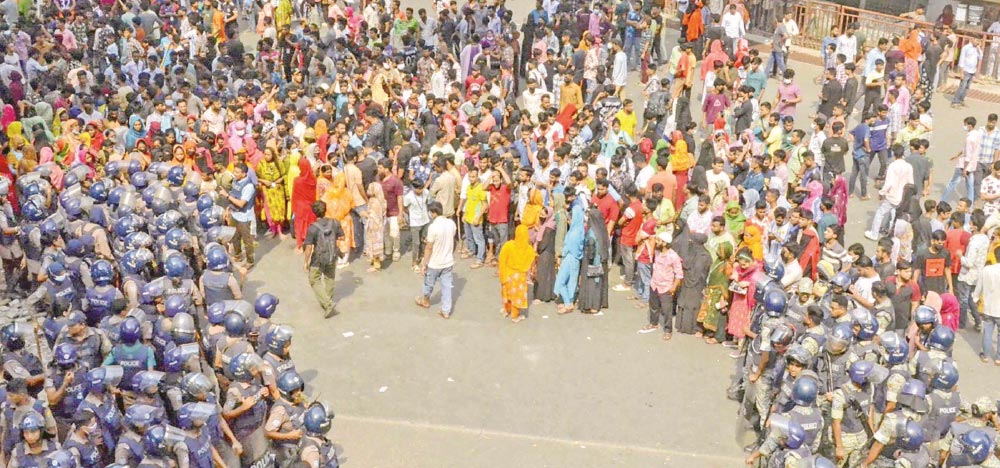
At the heart of the mounting uncertainty is Bangladesh's $38-billion-plus ready-made garment (RMG) industry, which generates more than 80 per cent of export earnings and employs around four million workers. Escalating labour unrest has exposed the vulnerability of an industry on which the country's exports, employment and foreign-exchange earnings heavily depend.
According to the Bangladesh Garment Manufacturers and Exporters Association (BGMEA), 529 factories were affected and nearly 987,190 workers left their workplaces on November 1. Industry sources reported that production at around 690 factories was suspended the following day, affecting more than 1.7 million workers.
Workers have taken to the streets demanding a minimum monthly wage of Tk30,000, against the existing Tk12,500. A six-member government wage board agreed on November 4 to introduce a revised pay structure from December, with the first salaries under the new scale expected in January. The proposed increase, however, remains undetermined.
The immediate concern is not simply factory closures but the potential damage to Bangladesh's export competitiveness. Production disruptions, delayed shipments and cancelled orders could erode international buyers' confidence and divert business towards competing countries, including India and Pakistan.
Export figures nevertheless present a mixed picture. Bangladesh earned $17.04 billion from merchandise exports during July-October of FY2026-27, up 6 per cent year-on-year. Garment exports accounted for $13.71 billion, or around 80.4 per cent of the total. Prolonged industrial instability could put this momentum at risk.
The crisis is compounded by an alarming contraction in private-sector credit. Bangladesh Bank data show that credit growth plunged to a historic low of 4.17 per cent in September, the weakest since the central bank began compiling the series in 2003. Remaining below 5 per cent for seven consecutive months, the rate reflects businesses' growing reluctance to borrow amid high lending costs, energy shortages, weak demand and economic uncertainty.
The slowdown has serious implications for factory expansion, working capital, employment and new investment. At 4.17 per cent, credit growth is also far below the prevailing inflation rate of 8.34 per cent, highlighting the squeeze on real credit availability.
More alarming is the banking sector's mounting bad-loan burden. Classified loans reached Tk6,06,555 crore at the end of June 2026, equivalent to 32.78 per cent of total outstanding loans, according to Bangladesh Bank. In other words, nearly Tk33 out of every Tk100 lent by banks was classified as non-performing. The amount increased by Tk17,851 crore in just three months.
The damage extends beyond loan defaults. A central bank assessment found that 15 banks faced a combined provision shortfall of Tk2,29,146 crore by June. More than two dozen banks are struggling with varying degrees of capital and asset-quality weaknesses, undermining public confidence and their ability to finance economic recovery.
Depressed banking-sector share valuations on the Dhaka Stock Exchange further reflect investors' concerns over mounting defaults, weak profitability and uncertain earnings. Low price-to-earnings ratios offer little comfort when loan recovery, capital adequacy and provisioning remain major challenges.
Another potential shock is looming from the Middle East, a major employment destination for Bangladeshi migrant workers and a critical source of foreign exchange. The escalating conflict has raised concerns over expatriate employment and earnings, while the risk of higher energy import bills could intensify pressure on the external sector.
Bangladesh received $2.874 billion in remittances in October, up 12.1 per cent year-on-year. During July-October, inflows reached $11.465 billion, a 13 per cent increase over the corresponding period last year. Although the figures do not yet indicate a remittance decline, prolonged regional instability could threaten expatriate employment and future inflows while raising the country's import costs.
The dangers are increasingly interconnected. Garment unrest threatens export earnings, weak credit constrains private investment, banking-sector distress restricts productive lending, and a prolonged Middle East conflict could undermine remittances while intensifying pressure on foreign-exchange reserves.
Bangladesh's economic transformation over the past two decades has been driven by garment exports, remittances, women's participation in the workforce and a growing domestic market. But a higher per capita GDP than India cannot, by itself, guarantee economic prosperity.
The real test for Bangladesh is whether the government can restore industrial stability, revive private investment, clean up its banking system and protect its external earnings-or risk allowing mounting vulnerabilities to erode its hard-earned economic gains.

Loading...
Loading...
Also read



Editor : Iqbal Sobhan Chowdhury
Published by the Editor on behalf of the Observer Ltd. from Globe Printers, 24/A, New Eskaton Road, Ramna, Dhaka.
Editorial, News and Commercial Offices : Aziz Bhaban (2nd floor), 93, Motijheel C/A, Dhaka-1000.
Phone: PABX- 41053001-06; Advertisement: 41053012; 01793317829, 01550707291, 01550707296
E-mail: [email protected], [email protected]. [email protected], [email protected], [email protected], [email protected], Online-email: [email protected]
Published by the Editor on behalf of the Observer Ltd. from Globe Printers, 24/A, New Eskaton Road, Ramna, Dhaka.
Editorial, News and Commercial Offices : Aziz Bhaban (2nd floor), 93, Motijheel C/A, Dhaka-1000.
Phone: PABX- 41053001-06; Advertisement: 41053012; 01793317829, 01550707291, 01550707296
E-mail: [email protected], [email protected]. [email protected], [email protected], [email protected], [email protected], Online-email: [email protected]


