



| HEADLINE |

|

Eight Listed Banks Sink into Tk 13,408cr Losses, Banking Sector on Red Alert
Published : Wednesday, 11 November, 2026 at 12:00 AM
Jibon Islam


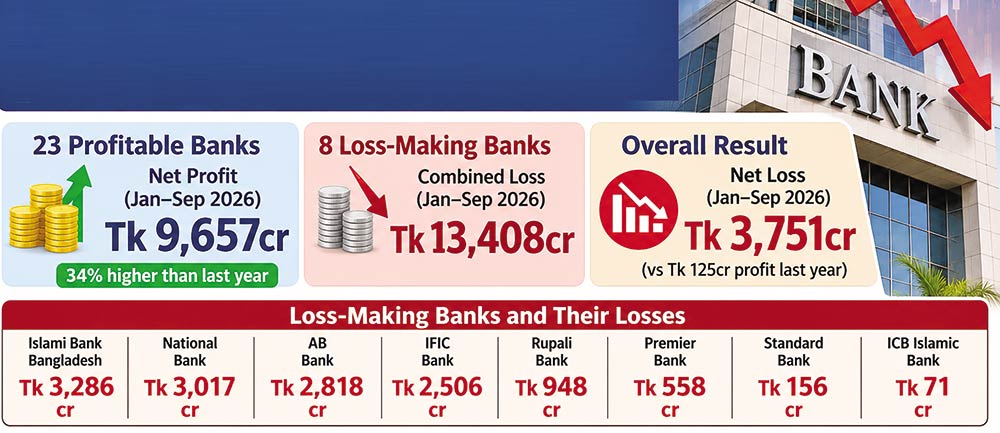 Bangladesh’s listed banking sector has suffered a staggering financial reversal, with eight troubled banks reporting combined net losses of Tk13,408 crore in the first nine months of 2026, wiping out the profits of 23 other listed lenders and plunging the entire sector into the red.
The losses have exposed the deepening financial distress of several banks, battered investor confidence in banking stocks and raised fresh questions about corporate governance, loan recovery and the stability of the country's financial system.
While 23 privately owned listed banks together posted net profits of Tk 9,657 crore during January-September, their earnings could not offset the massive losses incurred by eight struggling institutions.
Consequently, all 31 listed banks recorded a combined net loss of Tk3,751 crore during the period, against a net profit of Tk125 crore in the corresponding nine months of the previous year.
The sharp deterioration comes despite a reported 34 per cent increase in the combined profits of the 23 profitable banks, highlighting the widening divide between financially stronger lenders and institutions crippled by bad loans, provisioning pressures and liquidity shortages.
Islami Bank Bangladesh alone posted the largest loss of Tk 3,286 crore, reversing from a net profit of Tk100 crore in the same period last year. National Bank followed with a net loss of Tk 3,017 crore, while AB Bank and IFIC Bank reported losses of Tk 2,818 crore and Tk 2,506 crore respectively.
The remaining four loss-making banks were Rupali Bank, which incurred a loss of Tk 948 crore, Premier Bank Tk 558 crore, Standard Bank Tk156 crore and ICB Islamic Bank Tk 71 crore.
The mounting losses largely reflect years of reckless lending, alleged fund diversion, deteriorating asset quality and the growing burden of provisioning against defaulted loans. Several of the troubled banks experienced a sharp deterioration in their financial health after coming under the influence of powerful business groups, with alleged violations of banking regulations and lending norms contributing to the accumulation of non-performing loans (NPLs).
In numerous cases, influential borrowers allegedly obtained large loans through undisclosed identities and diverted funds, leaving banks burdened with unpaid liabilities.
Among the loss making banks, Islami Bank faces massive financial erosion. The bank’s defaulted investments had increased abnormally due to fund embezzlement and fraudulent activities involving related parties in connection with large loans carried over from previous years.
“ We could not recognise certain earned income in its financial statements because of legal obligations”, a senior bank official said that the bank’s deposit base has declined, while the cost of paying profits to depositors increased, further squeezing its earnings. National Bank attributed its losses to a sharp rise in overdue and classified loans, which prevented it from recognising interest income on a substantial volume of loans and advances.
At the same time, interest expenses on customer deposits and borrowings increased significantly, adding further pressure on its financial position. IFIC Bank also cited a surge in non-performing loans alongside a severe deterioration in asset quality.
Standard Bank, meanwhile, attributed its losses partly to a decline of around Tk256 crore in investment income following special policy concessions extended to help rehabilitate distressed and affected businesses.
Its income from commissions, foreign exchange transactions and brokerage activities also fell by nearly Tk67 crore. Higher interest expenses on deposits and increased operating costs further weakened its financial performance.
In stark contrast, 23 listed private commercial banks generated combined net profits of Tk9,657 crore during the first nine months of 2026, up 34 per cent from the corresponding period of the previous year.
BRAC Bank emerged as the largest profit earner, posting a record net profit of Tk1,763 crore, up more than 45 per cent from Tk1,211 crore a year earlier followed by Pubali Bank that recorded Tk1,585 crore in net profit, representing a 74 per cent increase from Tk910 crore in the same period last year.
City Bank ranked third with a net profit of Tk868 crore, up 20 per cent, followed by Prime Bank with Tk685 crore, registering 9 per cent growth, and Eastern Bank with Tk674 crore, up 15 per cent.
Dutch-Bangla Bank earned Tk624 crore, while Jamuna Bank posted Tk502 crore.
Bank Asia recorded a net profit of Tk451 crore, Shahjalal Islami Bank Tk445 crore and Uttara Bank Tk431 crore, reflecting comparatively stronger earnings performances. However, the contrasting financial results have exposed a growing divide in the listed banking industry, where a handful of institutions continue to generate substantial profits while others remain trapped in a cycle of bad loans, capital erosion and mounting financial obligations.
The widening gap in financial performance has also heightened concerns over the investment prospects of listed banking stocks. Market sentiment on the Dhaka Stock Exchange (DSE) remained cautious, with the benchmark DSEX hovering around 5,413 in early November 2026.

Loading...
Loading...
Also read



Editor : Iqbal Sobhan Chowdhury
Published by the Editor on behalf of the Observer Ltd. from Globe Printers, 24/A, New Eskaton Road, Ramna, Dhaka.
Editorial, News and Commercial Offices : Aziz Bhaban (2nd floor), 93, Motijheel C/A, Dhaka-1000.
Phone: PABX- 41053001-06; Advertisement: 41053012; 01793317829, 01550707291, 01550707296
E-mail: [email protected], [email protected]. [email protected], [email protected], [email protected], [email protected], Online-email: [email protected]


