



| HEADLINE |

|

Eroding Press Freedom
Published : Friday, 13 November, 2026 at 12:00 AM
ARNAB ASHRAF


 When journalists are silenced, citizens are deprived of their voices, and democracy loses one of its most essential watchdogs. A free press is not merely a defining feature of democracy; it is one of its strongest safeguards.
Often described as the Fourth Estate, the media serves as society's eyes and ears, holding those in power accountable, exposing corruption and amplifying marginalised voices. Yet, in Bangladesh, the steady erosion of press freedom has become a matter of growing national concern. The country's declining position in international press freedom rankings is more than a statistical setback. It reflects deeper structural weaknesses in democratic governance, institutional accountability and the protection of fundamental rights.
The crisis of press freedom is neither new nor attributable to any single political administration. Successive governments have struggled to recognise independent journalism as an indispensable component of democratic governance. Political interference, administrative pressure, economic vulnerabilities and legal intimidation have collectively created an environment in which journalists must navigate competing demands between professional responsibility and personal security. A change in political leadership alone cannot guarantee a change in the culture of media control. What is required is a fundamental transformation in the relationship between the state, political institutions and the independent press.
One of the most troubling dimensions of this crisis is the growing vulnerability of journalists. Reporters investigating corruption, political violence, human rights violations, financial irregularities and institutional misconduct may face threats, harassment, physical attacks and arbitrary legal action. Journalists working outside major urban centres are mostly vulnerable. When media professionals are intimidated for investigating matters of public interest, the consequences extend far beyond individual journalists. Entire communities lose their ability to expose injustice, challenge abuses of power and demand accountability.
Legal intimidation presents another serious challenge. Laws intended to protect national security, public order or individual reputation must never become instruments for suppressing legitimate criticism. Vaguely defined legal provisions, disproportionate criminal penalties and the misuse of defamation or cyber-related legislation can create a climate of fear. Equally troubling is the practice of filing politically motivated or retaliatory cases against journalists. Allegations of genuine professional misconduct must be investigated through due process. However, journalism must never be criminalised simply because its findings are uncomfortable for powerful individuals or institutions.
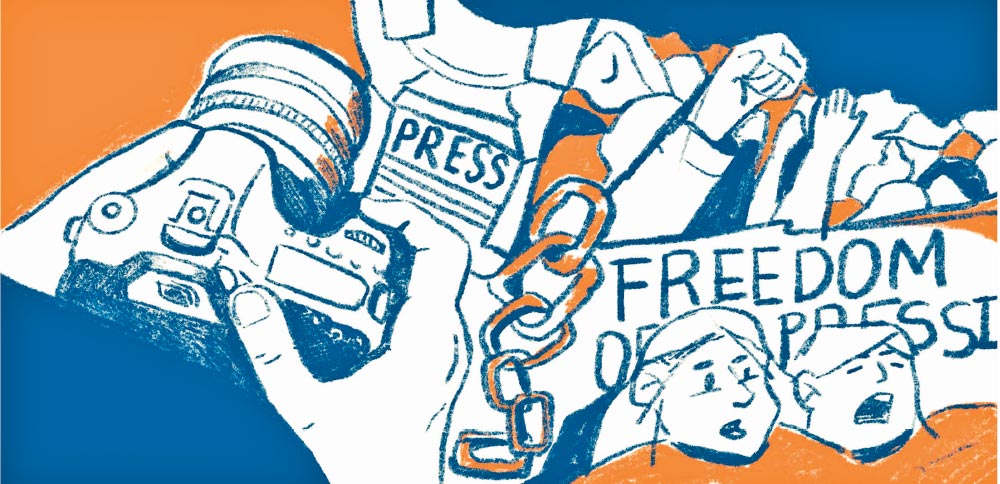 The most damaging consequence of this environment is self-censorship. When journalists fear losing their jobs, facing prosecution or becoming targets of violence, they may choose not to publish stories even when the information is accurate and serves the public interest. Editors may avoid sensitive investigations, while media organisations may prioritise commercial or political considerations over editorial independence. Such invisible restrictions are barely dangerous because they weaken journalism without necessarily requiring formal censorship.
The erosion of press freedom also carries serious consequences for social cohesion. When credible journalism is weakened, misinformation, propaganda, rumours and politically motivated narratives can spread rapidly. Citizens become increasingly vulnerable to manipulation, while public trust in institutions and the media deteriorates. A society deprived of reliable journalism is consequently more vulnerable to polarisation, intolerance and public mistrust.
Defending press freedom, however, also requires recognising the responsibilities of the media itself. Independence must not become a justification for sensationalism, misinformation, partisan reporting or violations of individual privacy. Journalists and media organisations must uphold accuracy, fairness, transparency and professional ethics. Editorial independence must go hand in hand with institutional accountability. Media ownership should be transparent.
Reversing this decline requires a comprehensive and inclusive national commitment. First, journalists must be protected from physical attacks, arbitrary detention and retaliatory legal proceedings. Allegations against media professionals should be investigated transparently and impartially, while cases lacking credible legal grounds should be addressed through appropriate judicial processes. Second, laws affecting freedom of expression and the press must be reviewed to ensure consistency with constitutional guarantees and international human rights standards. Article 39 of the Constitution of Bangladesh explicitly recognises freedom of thought, conscience, speech and the press.
Third, media institutions must be protected from undue political and corporate interference. Fair wages, job security, professional training and independent editorial policies are essential to building a resilient media sector. Fourth, journalists’ associations, civil society organisations, universities, human rights institutions and international partners should work collectively to promote media literacy, professional ethics and the safety of journalists. Above all, the government, regardless of its political orientation, must recognise that criticism is not hostility, dissent is not disloyalty and scrutiny is not an act of subversion.
Bangladesh's democratic future cannot be secured through political transitions alone. It requires strong institutions, independent journalism, an impartial judiciary and a political culture that respects dissent.
Restoring press freedom is not simply about improving Bangladesh's international standing; it is about protecting the public's right to know, restoring institutional accountability.
The writer is a journalist at The Daily Observer

Loading...
Loading...
Also read



Editor : Iqbal Sobhan Chowdhury
Published by the Editor on behalf of the Observer Ltd. from Globe Printers, 24/A, New Eskaton Road, Ramna, Dhaka.
Editorial, News and Commercial Offices : Aziz Bhaban (2nd floor), 93, Motijheel C/A, Dhaka-1000.
Phone: PABX- 41053001-06; Advertisement: 41053012; 01793317829, 01550707291, 01550707296
E-mail: [email protected], [email protected]. [email protected], [email protected], [email protected], [email protected], Online-email: [email protected]


