



| HEADLINE |

|

DCCI, TFO Canada Launch Export Development Project for Jute SMEs
Published : Friday, 13 November, 2026 at 12:00 AM
Business Correspondent


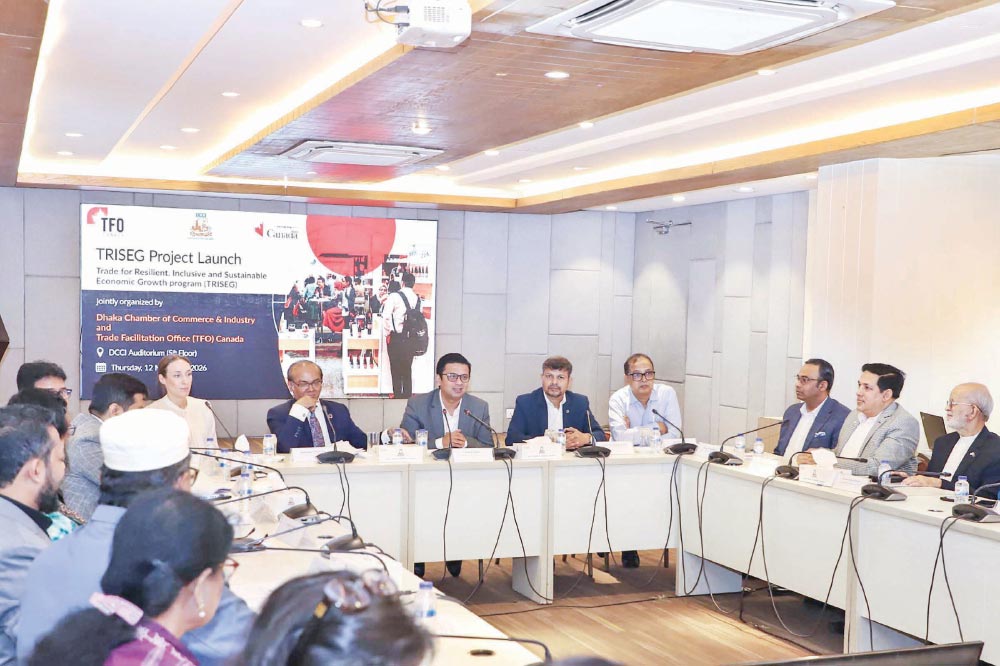 Bangladesh's jute-sector small and medium enterprises (SMEs) need to strengthen their export capabilities to tap into the Canadian market, speakers said at the launch of a new initiative aimed at improving their competitiveness and market access.
The Trade for Resilient, Inclusive and Sustainable Economic Growth (TRISEG) project, jointly undertaken by the Dhaka Chamber of Commerce and Industry (DCCI) and Trade Facilitation Office (TFO) Canada, will provide targeted training, business advisory services and market-linkage support to help local entrepreneurs diversify products and expand exports.
The launching ceremony was held at the DCCI auditorium on Thursday (November 12).
Mohammad Hasan Arif, Vice-Chairman and Chief Executive of the Export Promotion Bureau (EPB), attended as chief guest, while Khandaker Nazmul Huda Shamim, Additional Secretary of the Ministry of Textiles and Jute, was the special guest. DCCI President Taskeen Ahmed and other chamber leaders were also present.
Speaking at the event, Hasan Arif said Bangladesh earned US$48 billion from exports in 2025 despite geopolitical uncertainties, while exports to Canada reached US$1.5 billion, making it one of the country's top 10 export destinations.
He said jute and jute goods exports grew 25 per cent in the first quarter of the current fiscal year, but warned that Bangladesh's graduation from the least developed country (LDC) category would bring new challenges. Product diversification, he said, is essential to sustaining export growth and competitiveness.
Nazmul Huda Shamim said the jute sector had made some progress but continued to face challenges, particularly a lack of product diversification. He stressed improving product quality, meeting international standards and aligning production with global market demand.
DCCI President Taskeen Ahmed said export diversification had become essential as Bangladesh prepares for LDC graduation. He also stressed integrating small businesses, particularly women-led and underrepresented enterprises, into global markets.
TFO Canada Project Manager Ashraf Ahmed said the five-year project, funded by the Canadian government, is being implemented in 16 least developed and developing countries across Asia, Africa, Latin America and the Caribbean.
The initiative will support around 3,200 SMEs across participating countries, with 67 per cent of beneficiaries expected to be women entrepreneurs.
In Bangladesh, around 200 SMEs, particularly in the jute sector, will receive training and technical assistance in export readiness, digitalisation, access to finance and climate resilience.
Omar Farhan Khan, Principal Business Consultant and Portfolio Manager at LightCastle Partners, said Bangladesh had yet to fully tap the potential of the US$3 billion global jute goods market due to limited value addition.
He stressed product diversification, innovation and improved market access to unlock the sector's potential.
Mahbubur Rahman, Additional Director of Bangladesh Bank, said many SME entrepreneurs remained unaware of the central bank's available credit facilities. He said Tk4,500 crore had been allocated under the Women Entrepreneur Development Fund, offering loans to women entrepreneurs at 5 per cent interest.

Loading...
Loading...
Also read



Editor : Iqbal Sobhan Chowdhury
Published by the Editor on behalf of the Observer Ltd. from Globe Printers, 24/A, New Eskaton Road, Ramna, Dhaka.
Editorial, News and Commercial Offices : Aziz Bhaban (2nd floor), 93, Motijheel C/A, Dhaka-1000.
Phone: PABX- 41053001-06; Advertisement: 41053012; 01793317829, 01550707291, 01550707296
E-mail: [email protected], [email protected]. [email protected], [email protected], [email protected], [email protected], Online-email: [email protected]


