



| HEADLINE |

|

Dulu calls for equal participation of women in all sectors
Published : Saturday, 14 November, 2026 at 6:40 PM
Observer Online Report


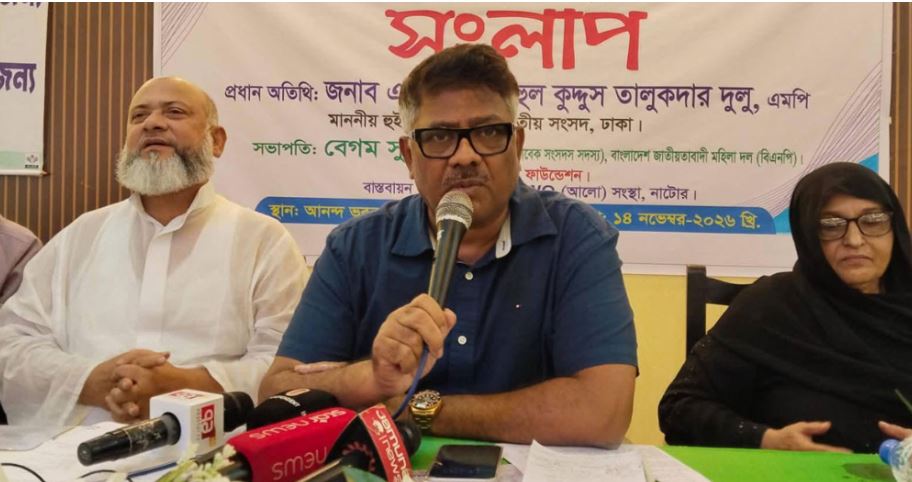
Ensuring women’s rights and empowerment is not merely a social responsibility but one of the state’s fundamental duties. The government is committed to ensuring women’s equal participation in all sectors, including education, the economy, healthcare and politics, said Advocate M. Ruhul Quddus Talukdar Dulu, Chief Whip of the National Parliament and Member of Parliament for Natore-2.
He said that the institutional initiatives for women's development undertaken by Shaheed President Ziaur Rahman, the educational revolution introduced by former Prime Minister Begum Khaleda Zia, and the Family Card and education assistance programmes of Tarique Rahman reflect the BNP’s longstanding vision for women's development.
Dulu made these remarks on Saturday (November 14) as the chief guest at a dialogue on women’s effective participation and leadership in policymaking. The event was organised under the Khan Foundation’s ‘Voice for Change’ project at Ananda Bhaban, located within the Bangojol Rajbari premises in Natore.
Former Member of Parliament for a reserved women's seat, Sufia Haque, chaired the programme.
Dulu said the BNP had never viewed women as objects of pity; rather, it had regarded them as one of the driving forces behind state and society-building.
He said that recognising the impossibility of achieving genuine national development while confining women within the four walls of their homes, Shaheed Ziaur Rahman had taken institutional initiatives to promote women's development.
He noted that the establishment of a Women’s Affairs Department under the President’s Secretariat in 1976 and the formation of the Ministry of Women’s Affairs in 1978 were significant steps towards bringing women into the mainstream of national development.
Subsequently, during Khaleda Zia’s tenure, the ministry was renamed the Ministry of Women and Children’s Affairs in 1994.
Highlighting Khaleda Zia’s contribution to women's education, Dulu said the initiative to provide free education to girls up to the twelfth grade played an important role in expanding educational opportunities for women.
He added that the current government was implementing the Family Card programme to strengthen women's economic empowerment. Various other initiatives, including free education for girls up to the undergraduate level, were also being undertaken to advance women's development.
Speaking about women's political representation, Dulu said the provisions of the Representation of the People Order (RPO) would be reflected in the BNP’s upcoming national council.
He said, Prime Minister Tarique Rahman and the party's policymakers were actively working towards this goal. Through these efforts, the party aims to ensure 33 per cent women's participation in its organisational structure and electoral processes.
He further said Bangladesh must be built on the principles of justice in Islam, the reasoning of modernity and the democratic ideal of equality. In such a country, women's empowerment would not be treated as an act of charity but would instead be established as an integral part of state policy and national development.
Among the special guests at the programme were Rahim Newaz, convener of the Natore District BNP and administrator of the District Council.
Others who addressed the gathering included Shamima Laizu Nila, executive director of ‘Alo’, and Md. Salahuddin, Monitoring and Evaluation Officer of the Khan Foundation.
Nilufar Yasmin presented the keynote paper.
During the dialogue, women leaders working at various levels presented a range of proposals aimed at increasing women's participation in policymaking, implementing the Representation of the People Order and developing women's leadership.
-MT

Loading...
Loading...
Also read







Editor : Iqbal Sobhan Chowdhury
Published by the Editor on behalf of the Observer Ltd. from Globe Printers, 24/A, New Eskaton Road, Ramna, Dhaka.
Editorial, News and Commercial Offices : Aziz Bhaban (2nd floor), 93, Motijheel C/A, Dhaka-1000.
Phone: PABX- 41053001-06; Advertisement: 41053012; 01793317829, 01550707291, 01550707296
E-mail: [email protected], [email protected]. [email protected], [email protected], [email protected], [email protected], Online-email: [email protected]


