



| HEADLINE |

|

The Teesta Triangle: Dhaka’s Strategic Autonomy
Published : Sunday, 15 November, 2026 at 12:00 AM
Sakiba Zannat Mim


 After many years of diplomatic deadlock, Bangladesh made an official request to Beijing in May 2026 for assistance in restoring the Teesta River which marks a strategic diversification of foreign policy. The Teesta River Comprehensive Management and Restoration Project (TRCMRP), which is situated near India’s “Chicken’s Neck”, has transformed what was originally a river dispute into a matter of geopolitical tension between India and China. The real issue now is to determine why Bangladesh turned to Beijing and in what way this shift in foreign policy is turning the Teesta River into a test of India's rivalry with China.
To deal with these questions one has to have an understanding of the human and environmental security problems in the Teesta River area. Studies show that over 9.15 million people rely on the Teesta basin, since their water supply, food and income come from the same river. In the dry-season, sharply reduced flow damages irrigation, fisheries, navigation and the river ecosystems. And the opposite problem occurs during the monsoon period - sudden releases of water that result in flash floods, erosion of the riverbanks and losses of crops. Whether it is a shortage or an excess of water, farmers and fishing communities end up in a state of insecurity.
For a long time, Bangladesh has depended on bilateral talks with India in order to deal with the rivers they share, starting with the creation of the Joint Rivers Commission in 1972. The 1996 Ganges Water Sharing Treaty led people to expect that agreements on other issues would soon be reached, and by 2010 negotiations were underway on a draft agreement concerning the Teesta. After 2011, though, the process came to a halt, mainly due to resistance from West Bengal. This situation showed how the domestic politics of an upstream country can limit the choices available to a downstream neighbour. Gradually, a dispute over a river became a lasting foreign-policy problem: Bangladesh had to safeguard its water interests while at the same time maintaining an important strategic relationship with India.
China has emerged to fill this gap. Following the diplomatic discussion in Beijing on June 26, 2026, China expressed interest to providing support and assistance with the feasibility study. This represents a change from water diplomacy to infrastructure diplomacy, connecting water security with investment, technology and development.
There are two theories to explain why Dhaka chose Beijing. First, Kautilya’s Mandala theory, from the ancient Arthashastra. It says that, direct neighbours are often a source of friction, while states beyond the immediate neighbourhood can become potential partners. Bangladesh and India are close in geography, yet the Teesta remains a point of friction. So, China becomes an additional option, not a replacement. Second, Neoclassical Realism, which says that, states respond to great-power pressure through their own priorities and capacity. Facing power asymmetry with India and strong domestic water management problem, Dhaka is turning to China as an additional partner.
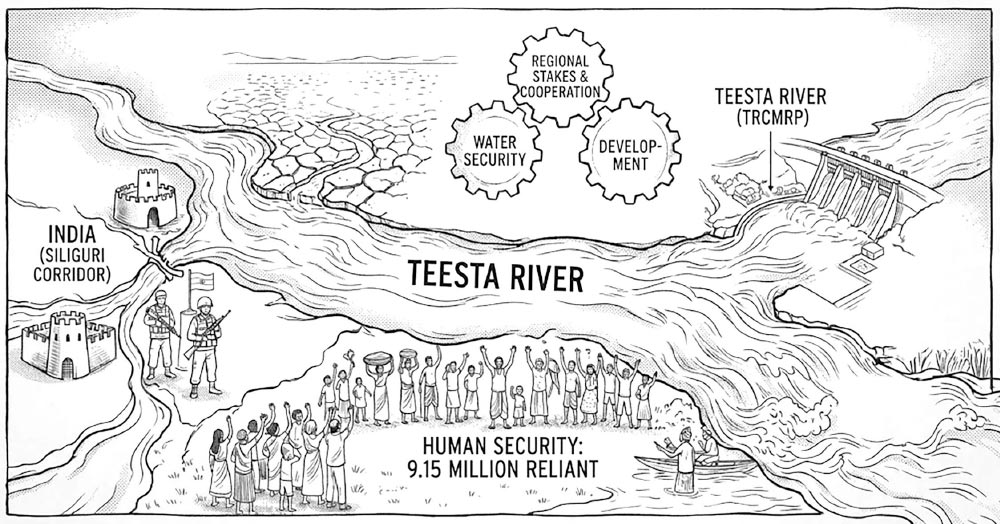 The Teesta is now a place where three states’ interests meet. For India, the project matters because of its closeness to the Siliguri Corridor, which links the mainland with the northeast. Chinese involvement may raise security concerns in New Delhi. For China, the project is a chance to deepen economic and strategic ties through infrastructure and water management in South Asia. For Bangladesh, it is about water security, development and strategic autonomy. The Teesta reflects Sino-Indian competition, and Bangladesh must pursue its own interests by balancing both powers. Still, it would be a mistake to think it as Bangladesh drifting into China's arms. Our foreign policy rests on “Friendship to all, malice towards none,” and Article 25 of the Constitution of Bangladesh ensures the commitment of the state to sovereignty, equality and peaceful dispute settlement. China offers a channel for development while India remains an indispensable neighbour with direct control over upstream flows.
The path has real risks. First of all, depending too much on any single partner may create new economic or strategic weaknesses. Secondly, the Teesta’s sensitivity forces Dhaka to balance cooperation with Beijing against its vital relationship with New Delhi. Lastly, large river-engineering projects bring environmental and technical uncertainties for ecosystems, agriculture and local communities. As India controls upstream flows and the 1996 Ganges Water Sharing Treaty expires in December 2026, continuing negotiation with India has become more important.
So, what should Bangladesh do? It needs a multi-partner, interest-based water diplomacy that protects its strategic autonomy. Firstly, it may engage India, China and other parties such as the World Bank, the Asian Development Bank and countries with advanced water-management expertise. Secondly, it may request India for a sustainable Teesta water-sharing arrangement, and use regional or international platforms to promote cooperative river management. Thirdly, major projects must be transparent with feasibility studies, environmental assessments and public disclosure before construction begins. Finally, the Teesta need to be treated as a water-management and human-security issue, not a stage for India-China rivalry.
The Teesta gives Bangladesh scope to manoeuvre rather than a reason to be dependent on anyone. If Dhaka uses that scope wisely (with transparency and sustained dialogue with all partners) it can turn an old grievance into a basis for balanced diplomacy. The measure of success won’t be in the number of rivalries won or alliances formed. It will be in whether the river continues to support the people who live along it.
The writer is a student in the Department of International Relations at University of Rajshahi

Loading...
Loading...
Also read



Editor : Iqbal Sobhan Chowdhury
Published by the Editor on behalf of the Observer Ltd. from Globe Printers, 24/A, New Eskaton Road, Ramna, Dhaka.
Editorial, News and Commercial Offices : Aziz Bhaban (2nd floor), 93, Motijheel C/A, Dhaka-1000.
Phone: PABX- 41053001-06; Advertisement: 41053012; 01793317829, 01550707291, 01550707296
E-mail: [email protected], [email protected]. [email protected], [email protected], [email protected], [email protected], Online-email: [email protected]


