



| HEADLINE |

|

Bangladesh needs $1.4bn for climate health adaptation plan


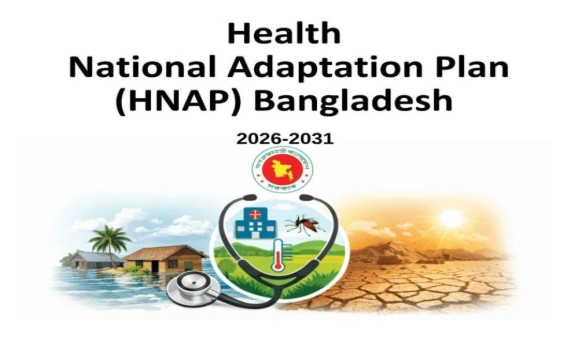
Bangladesh needs an estimated $1.4 billion to implement its five-year National Health Adaptation Plan (HNAP) for 2026-2031, as climate change increasingly threatens public health, healthcare infrastructure and essential services.
Three Bangladeshi civil society organisations have called for predictable, accessible and primarily grant-based international climate finance to help the country address these growing health risks.
The organisations have also urged major greenhouse gas emitters to make substantial and measurable emissions cuts before 2030 and publicly report their progress every year.
The demands were made at a joint press conference held on Saturday night on the sidelines of the ongoing COP31 climate conference in Antalya.
The event was organised by the Climate Justice Forum (CJF), the Organisation for Socio-Economic Development (AOSED) and the Centre for Climate Change and Environmental Research (C3ER) of Brac University.
The organisations said developed countries must ensure predictable and easily accessible funding for climate mitigation, adaptation and addressing loss and damage.
They also stressed the need to involve least developed countries, small island states and climate-vulnerable communities in climate planning, financial oversight and assessments of whether funding is reaching those most at risk.
According to a C3ER study, Bangladesh's HNAP 2026-2031 requires an estimated $1.4 billion to strengthen the country's health system against climate change.
The plan prioritises keeping healthcare facilities operational during floods, improving the early detection of climate-sensitive diseases and preparing health workers to respond to extreme heat.
Raufa Khanam, deputy director of C3ER, said Bangladesh could mobilise $740 million domestically through government budget allocations, health sector revenues and cross-sectoral investments in water, sanitation and a healthy environment.
However, international assistance would be essential to meet the remaining funding requirement.
C3ER also recommended forming a task force under the Ministry of Health, introducing climate risk assessments for new health projects and establishing separate budget codes to track climate-related and health-sector spending.
The organisations said adaptation financing would help Bangladesh strengthen its capacity to address existing health risks, but preventing those risks from worsening would require rapid emissions reductions by major polluting countries.
Md Salah Uddin, knowledge management team lead at AOSED, said major emitters must move beyond long-term net-zero pledges and deliver meaningful, measurable reductions in greenhouse gas emissions before 2030.
Emissions data should be publicly accessible and subject to independent review, they said.
The organisations also stressed that the energy transition must protect land rights, ensure decent employment and guarantee access to affordable energy.
The three organisations urged the COP31 final decisions to clearly outline what major emitters will do before 2030, how their progress will be independently assessed and when climate-vulnerable countries will receive the funding needed to implement priority plans such as Bangladesh's HNAP.






Published by the Editor on behalf of the Observer Ltd. from Globe Printers, 24/A, New Eskaton Road, Ramna, Dhaka.
Editorial, News and Commercial Offices : Aziz Bhaban (2nd floor), 93, Motijheel C/A, Dhaka-1000.
Phone: PABX- 41053001-06; Advertisement: 41053012; 01793317829, 01550707291, 01550707296
E-mail: [email protected], [email protected]. [email protected], [email protected], [email protected], [email protected], Online-email: [email protected]


