



| HEADLINE |

|

AI revolution
Millions of jobs at risk: Is Bangladesh ready for the future of work?
Published : Monday, 16 November, 2026 at 3:22 PM
Tanjeem


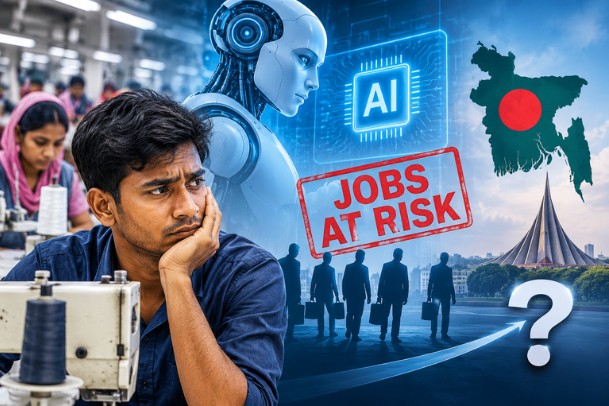
Will artificial intelligence take away human jobs? It is one of the most pressing questions confronting the global workforce as generative AI rapidly transforms industries, businesses and the nature of employment.
The question is not entirely new. Previous technological revolutions, from steam engines and electricity to the internet, have fundamentally changed how people work and how economies operate. However, the rise of generative AI represents a different kind of disruption because it is entering not only the domain of physical labour but also areas traditionally associated with human intelligence, reasoning and creativity.
This transformation is creating unprecedented opportunities for productivity and innovation while raising serious concerns about job security and economic inequality.
There are two competing views on AI's impact on employment. One warns that the technology will eliminate millions of jobs, while the other argues that technological progress has historically created new occupations and expanded economic opportunities.
Both arguments contain some truth, but neither fully captures the reality.
Research by international organisations highlights the scale of the coming transformation.
According to a 2024 analysis by the International Monetary Fund (IMF), nearly 40 per cent of jobs worldwide are exposed to AI, with the figure rising to around 60 per cent in advanced economies.
A separate study by the International Labour Organization (ILO) found that approximately one in four jobs worldwide is potentially exposed to generative AI.
However, exposure does not necessarily mean job losses. In most cases, AI is more likely to automate specific tasks within an occupation rather than eliminate the entire job.
Some responsibilities will become easier and faster, while others may require fewer workers. The ultimate impact will depend on the nature of the work, the level of automation and how organisations integrate the technology.
AI is also expected to generate substantial employment opportunities. According to estimates from the World Economic Forum, around 92 million jobs could be displaced by 2030, while approximately 170 million new jobs may emerge.
Demand for skills in data analytics, machine learning, cybersecurity, AI management and AI-powered software development is already increasing.
Many of tomorrow's occupations may not even exist today.
The challenge, therefore, is not simply a shortage of jobs but a growing mismatch between the skills employers need and those available in the workforce.
Jobs involving repetitive and predictable tasks are particularly vulnerable to automation because AI systems can often perform them faster and at a lower cost.
However, human creativity, critical thinking, emotional intelligence, complex decision-making and interpersonal communication remain important strengths that machines cannot easily replicate.
As a result, the future competition may not simply be between humans and machines. It could increasingly be between workers who know how to use AI effectively and those who do not.
A recent World Bank analysis indicates that job advertisements in occupations highly exposed to AI have declined by around 20 per cent compared with other occupations.
At the same time, demand for AI-related skills has increased significantly.
Between early 2023 and early 2025, the share of AI-related job postings in South Asia rose from 2.9 per cent to 6.5 per cent, according to the analysis.
The figures suggest that the labour market is undergoing a two-way transformation: traditional employment opportunities are coming under pressure, while demand for new technology-related skills is growing.
For South Asian countries, the challenge is to ensure that workers can adapt to these changes rather than being left behind.
AI could improve productivity, encourage entrepreneurship, reduce operational costs and help businesses accomplish more in less time.
However, inadequate preparation could put the livelihoods of a significant section of the country's workforce at risk.
Bangladesh continues to face gaps in areas such as digital infrastructure, human capital and policy preparedness, according to the IMF's AI Preparedness Index.
The ready-made garment (RMG) industry, which employs approximately four million people in Bangladesh, is among the sectors facing significant technological changes.
The use of robotics, AI-powered cutting systems, automated quality inspection and software-based production planning is gradually expanding across manufacturing operations.
Various studies and economic analyses have raised concerns that more than one million workers in Bangladesh's garment and manufacturing sectors could face displacement risks in the coming years due to automation and AI.
Workers engaged in labour-intensive and repetitive tasks may face greater pressure as factories increasingly adopt automated systems.
The potential impact on women workers is particularly concerning because women make up a substantial share of the garment industry's workforce.
Bangladesh's freelancing and outsourcing industry is another area undergoing rapid transformation.
The country has established itself as a major player in the global outsourcing market. However, many Bangladeshi freelancers work in areas such as data entry, web design, content writing, transcription and social media management.
AI tools can now perform many of these tasks quickly and at relatively low cost, putting pressure on demand for entry-level and lower-skilled freelance services in international markets.
This does not mean the end of freelancing in Bangladesh.
Workers who upgrade their skills and move towards AI integration, data analytics, advanced digital services and AI-powered software and application development could benefit from emerging opportunities.
The transformation is also becoming visible in Bangladesh's banking, telecommunications, e-commerce and corporate sectors.
Chatbots are increasingly handling customer queries, while software systems are automating parts of accounting, auditing and administrative operations.
Entry-level positions could face particular pressure.
Traditionally, young employees started their careers by performing basic administrative, research and operational tasks before gradually gaining professional experience.
As AI takes over some of these responsibilities, the traditional pathways through which young graduates entered the workforce may become narrower.
This is a significant concern for Bangladesh, where thousands of university graduates enter the job market every year.
Despite these challenges, the country's large young population represents one of its greatest opportunities.
If equipped with relevant skills, Bangladesh's young workforce could become a major driver of economic growth in the AI era.
However, without adequate investment in education and training, the same demographic advantage could turn into an employment challenge.
The priority must be to develop skills that are relevant to both domestic industries and the international labour market.
Preparing the workforce for the AI era must begin at the primary education level.
Bangladesh's education system remains heavily dependent on memorisation. Instead of focusing primarily on textbook-based learning, schools and universities need to place greater emphasis on critical thinking, problem-solving, questioning, information verification and the practical use of technology.
Digital literacy, analytical reasoning and the ability to work with emerging technologies should become essential components of education.
Equally important is the need to create opportunities for people already in employment to acquire new skills.
If factories introduce automated machinery and require fewer workers for certain tasks, affected employees should be offered training to take on alternative responsibilities wherever possible.
The same approach should apply across other industries experiencing technological disruption.
Bangladesh also needs a practical policy framework for AI adoption.
Regulations should encourage innovation and technological investment while ensuring that the benefits of AI are not concentrated among a small group of businesses or individuals.
Investment in local technology development, startups and innovation must also increase.
Expanding AI adoption should go hand in hand with creating new employment opportunities and ensuring that local workers can participate in the emerging digital economy.
Infrastructure development is equally important.
Reliable electricity, high-speed internet, affordable digital tools and access to cloud services must extend beyond major cities.
Individual preparation will also play a crucial role.
Rather than avoiding AI, workers need to learn how to use it effectively in their respective professions.
At the same time, they should develop capabilities that remain difficult for machines to replicate, including sound judgement, communication, leadership, accountability, practical experience and deep professional knowledge.
Artificial intelligence is neither an automatic blessing nor an inevitable disaster. It is a powerful technology created by humans, and its impact will largely depend on how societies choose to use and regulate it.
AI can support medical research, improve healthcare, increase industrial productivity and help solve complex problems. But without adequate preparation, effective policies and a fair distribution of opportunities, it could also widen income inequality and increase unemployment risks.
For Bangladesh, the message is clear: the country's traditional advantage of low-cost labour may no longer be enough to remain competitive in the global economy.
As automation advances, the demand for skilled workers, quality education and technological adaptability will become increasingly important.
The time to prepare is now.
AI will undoubtedly reshape the world of work, although the full extent of that transformation remains uncertain. Countries and workers that adapt to the changes will be better positioned to benefit from emerging opportunities, while those that ignore the shift may find themselves increasingly disadvantaged.
Preparing Bangladesh's young and working population for this transition is no longer simply an economic priority. It is an essential investment in the country's future.
The question is not entirely new. Previous technological revolutions, from steam engines and electricity to the internet, have fundamentally changed how people work and how economies operate. However, the rise of generative AI represents a different kind of disruption because it is entering not only the domain of physical labour but also areas traditionally associated with human intelligence, reasoning and creativity.
This transformation is creating unprecedented opportunities for productivity and innovation while raising serious concerns about job security and economic inequality.
There are two competing views on AI's impact on employment. One warns that the technology will eliminate millions of jobs, while the other argues that technological progress has historically created new occupations and expanded economic opportunities.
Both arguments contain some truth, but neither fully captures the reality.
AI is likely to eliminate certain jobs, reduce demand for others and fundamentally change many existing occupations. At the same time, it will create new roles and industries. The scale and distribution of these changes will depend largely on how businesses, governments and workers respond.
A global workforce facing major disruption
Research by international organisations highlights the scale of the coming transformation.
According to a 2024 analysis by the International Monetary Fund (IMF), nearly 40 per cent of jobs worldwide are exposed to AI, with the figure rising to around 60 per cent in advanced economies.
A separate study by the International Labour Organization (ILO) found that approximately one in four jobs worldwide is potentially exposed to generative AI.
However, exposure does not necessarily mean job losses. In most cases, AI is more likely to automate specific tasks within an occupation rather than eliminate the entire job.
Some responsibilities will become easier and faster, while others may require fewer workers. The ultimate impact will depend on the nature of the work, the level of automation and how organisations integrate the technology.
AI is also expected to generate substantial employment opportunities. According to estimates from the World Economic Forum, around 92 million jobs could be displaced by 2030, while approximately 170 million new jobs may emerge.
These figures represent projections rather than guaranteed outcomes. More importantly, the creation of new jobs does not automatically mean that workers displaced from existing occupations will have the skills required to fill them.
New skills, new occupations
Demand for skills in data analytics, machine learning, cybersecurity, AI management and AI-powered software development is already increasing.
Many of tomorrow's occupations may not even exist today.
The challenge, therefore, is not simply a shortage of jobs but a growing mismatch between the skills employers need and those available in the workforce.
Jobs involving repetitive and predictable tasks are particularly vulnerable to automation because AI systems can often perform them faster and at a lower cost.
However, human creativity, critical thinking, emotional intelligence, complex decision-making and interpersonal communication remain important strengths that machines cannot easily replicate.
As a result, the future competition may not simply be between humans and machines. It could increasingly be between workers who know how to use AI effectively and those who do not.
This transformation is already affecting labour markets in South Asia.
South Asia: Changing demand for skills
A recent World Bank analysis indicates that job advertisements in occupations highly exposed to AI have declined by around 20 per cent compared with other occupations.
At the same time, demand for AI-related skills has increased significantly.
Between early 2023 and early 2025, the share of AI-related job postings in South Asia rose from 2.9 per cent to 6.5 per cent, according to the analysis.
The figures suggest that the labour market is undergoing a two-way transformation: traditional employment opportunities are coming under pressure, while demand for new technology-related skills is growing.
For South Asian countries, the challenge is to ensure that workers can adapt to these changes rather than being left behind.
For Bangladesh, the stakes are particularly high.
Bangladesh faces both opportunities and risks
AI could improve productivity, encourage entrepreneurship, reduce operational costs and help businesses accomplish more in less time.
However, inadequate preparation could put the livelihoods of a significant section of the country's workforce at risk.
Bangladesh continues to face gaps in areas such as digital infrastructure, human capital and policy preparedness, according to the IMF's AI Preparedness Index.
Several key pillars of the country's economy, including the ready-made garment industry, services sector, freelancing and overseas employment, are already experiencing changes driven by automation and artificial intelligence.
Garment sector: Millions of workers face uncertainty
The ready-made garment (RMG) industry, which employs approximately four million people in Bangladesh, is among the sectors facing significant technological changes.
The use of robotics, AI-powered cutting systems, automated quality inspection and software-based production planning is gradually expanding across manufacturing operations.
Various studies and economic analyses have raised concerns that more than one million workers in Bangladesh's garment and manufacturing sectors could face displacement risks in the coming years due to automation and AI.
Workers engaged in labour-intensive and repetitive tasks may face greater pressure as factories increasingly adopt automated systems.
The potential impact on women workers is particularly concerning because women make up a substantial share of the garment industry's workforce.
Without adequate retraining and alternative employment opportunities, technological changes could deepen existing inequalities in the sector.
Freelancers face a changing global market
Bangladesh's freelancing and outsourcing industry is another area undergoing rapid transformation.
The country has established itself as a major player in the global outsourcing market. However, many Bangladeshi freelancers work in areas such as data entry, web design, content writing, transcription and social media management.
AI tools can now perform many of these tasks quickly and at relatively low cost, putting pressure on demand for entry-level and lower-skilled freelance services in international markets.
This does not mean the end of freelancing in Bangladesh.
Workers who upgrade their skills and move towards AI integration, data analytics, advanced digital services and AI-powered software and application development could benefit from emerging opportunities.
The challenge is to move beyond routine digital services towards more specialised and higher-value work.
Corporate jobs and entry-level employment under pressure
The transformation is also becoming visible in Bangladesh's banking, telecommunications, e-commerce and corporate sectors.
Chatbots are increasingly handling customer queries, while software systems are automating parts of accounting, auditing and administrative operations.
Entry-level positions could face particular pressure.
Traditionally, young employees started their careers by performing basic administrative, research and operational tasks before gradually gaining professional experience.
As AI takes over some of these responsibilities, the traditional pathways through which young graduates entered the workforce may become narrower.
This is a significant concern for Bangladesh, where thousands of university graduates enter the job market every year.
For them, AI is no longer simply a technological development. It is becoming a question of future employment and economic security.
Bangladesh's youth could be its biggest advantage
Despite these challenges, the country's large young population represents one of its greatest opportunities.
If equipped with relevant skills, Bangladesh's young workforce could become a major driver of economic growth in the AI era.
However, without adequate investment in education and training, the same demographic advantage could turn into an employment challenge.
The priority must be to develop skills that are relevant to both domestic industries and the international labour market.
Otherwise, Bangladeshi workers may struggle to compete with skilled professionals from countries that are investing more aggressively in technological education and workforce development.
Education must evolve with technology
Preparing the workforce for the AI era must begin at the primary education level.
Bangladesh's education system remains heavily dependent on memorisation. Instead of focusing primarily on textbook-based learning, schools and universities need to place greater emphasis on critical thinking, problem-solving, questioning, information verification and the practical use of technology.
Digital literacy, analytical reasoning and the ability to work with emerging technologies should become essential components of education.
Equally important is the need to create opportunities for people already in employment to acquire new skills.
If factories introduce automated machinery and require fewer workers for certain tasks, affected employees should be offered training to take on alternative responsibilities wherever possible.
The same approach should apply across other industries experiencing technological disruption.
Government agencies, employers and training institutions need to work together to make reskilling and professional development accessible to workers.
Policies and infrastructure will determine the outcome
Bangladesh also needs a practical policy framework for AI adoption.
Regulations should encourage innovation and technological investment while ensuring that the benefits of AI are not concentrated among a small group of businesses or individuals.
Investment in local technology development, startups and innovation must also increase.
Expanding AI adoption should go hand in hand with creating new employment opportunities and ensuring that local workers can participate in the emerging digital economy.
Infrastructure development is equally important.
Reliable electricity, high-speed internet, affordable digital tools and access to cloud services must extend beyond major cities.
If technological opportunities remain concentrated in urban areas, the digital divide between urban and rural communities could widen, creating further inequalities in access to future employment.
Workers must learn to work alongside AI
Individual preparation will also play a crucial role.
Rather than avoiding AI, workers need to learn how to use it effectively in their respective professions.
At the same time, they should develop capabilities that remain difficult for machines to replicate, including sound judgement, communication, leadership, accountability, practical experience and deep professional knowledge.
The ability to combine human expertise with AI-powered tools could become one of the most valuable advantages in the future workplace.
The future will depend on how Bangladesh prepares today
Artificial intelligence is neither an automatic blessing nor an inevitable disaster. It is a powerful technology created by humans, and its impact will largely depend on how societies choose to use and regulate it.
AI can support medical research, improve healthcare, increase industrial productivity and help solve complex problems. But without adequate preparation, effective policies and a fair distribution of opportunities, it could also widen income inequality and increase unemployment risks.
For Bangladesh, the message is clear: the country's traditional advantage of low-cost labour may no longer be enough to remain competitive in the global economy.
As automation advances, the demand for skilled workers, quality education and technological adaptability will become increasingly important.
The time to prepare is now.
AI will undoubtedly reshape the world of work, although the full extent of that transformation remains uncertain. Countries and workers that adapt to the changes will be better positioned to benefit from emerging opportunities, while those that ignore the shift may find themselves increasingly disadvantaged.
Preparing Bangladesh's young and working population for this transition is no longer simply an economic priority. It is an essential investment in the country's future.

Loading...
Loading...
Also read









Editor : Iqbal Sobhan Chowdhury
Published by the Editor on behalf of the Observer Ltd. from Globe Printers, 24/A, New Eskaton Road, Ramna, Dhaka.
Editorial, News and Commercial Offices : Aziz Bhaban (2nd floor), 93, Motijheel C/A, Dhaka-1000.
Phone: PABX- 41053001-06; Advertisement: 41053012; 01793317829, 01550707291, 01550707296
E-mail: [email protected], [email protected]. [email protected], [email protected], [email protected], [email protected], Online-email: [email protected]


