



| HEADLINE |

|

When cameras go dark, accountability fades
Police spent Tk 100 crore on 20,000 body cameras, but only 3,114 are used



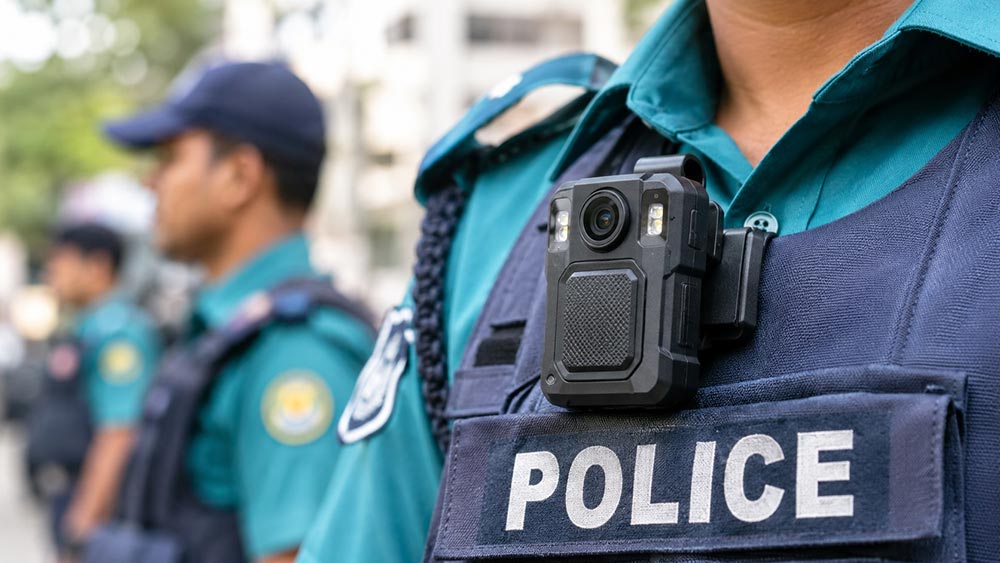 Police have invested Tk100 crore in body cameras meant to bring greater transparency to law enforcement, protect citizens and make officers more accountable. Yet, months after the purchase, thousands of the devices remain largely unused.
The scale of the underuse is striking. Police records show that the force has approximately 25,000 usable body cameras, including 20,000 newly purchased devices and 5,000 from existing stocks. However, only 3,114 cameras were reportedly used across the country between October 4 and 10.
Even among those in use, the number of cameras capable of transmitting footage in real time was remarkably low. Just 314 were internet-connected devices linked to a central monitoring system, while the remaining 2,800 were offline cameras whose recordings had to be uploaded later. The figures reveal a glaring disconnect between public investment and operational reality, turning a potentially important accountability initiative into a costly exercise whose effectiveness remains in doubt.
A PROCUREMENT PLAN TAKES A DIFFERENT ROUTE
The procurement was initially part of a plan to purchase 40,000 body cameras ahead of the 13th parliamentary election. In September 2025, former Finance Adviser Salehuddin Ahmed announced that the government would finance the purchase through the United Nations Development Programme (UNDP), an arrangement intended to ensure transparency and quality.
However, former Inspector General of Police Baharul Alam said UNDP could not take necessary steps within the required timeframe. Police headquarters subsequently allocated funds to district police superintendents and metropolitan police commissioners to procure the equipment.
Ultimately, 20,000 additional cameras were purchased at a reported cost of around Tk 100 crore.
The shift in procurement arrangements warrants scrutiny. Questions remain over how suppliers were selected, whether competitive tenders were invited, how unit prices were determined and what safeguards were in place to ensure transparency in spending public money.
A senior police headquarters official, speaking to The Daily Observer on condition of anonymity, offered a blunt assessment of the problem: "Our force does not want to be accountable."
He said repeated instructions from police headquarters had failed to ensure the regular use of the devices.
A senior police official also suggested that some officers were uncomfortable wearing cameras because recordings could expose allegations of bribery, misconduct and mistreatment of citizens.
If reluctance to be recorded is indeed a factor, it strikes at the very purpose of introducing body cameras. Equipment designed to strengthen accountability cannot fulfill that role if those responsible for using it resist the scrutiny it brings.
THE COST OF KEEPING CAMERAS RUNNING
Assistant Inspector General (Media) Kamarum Munira said each internet-connected camera requires approximately Tk1,000 a month for connectivity.
While connectivity costs may partly explain the limited use of online devices, they raise a more fundamental question: why were recurring expenses for internet access, maintenance and data storage not adequately factored into the planning before Tk 100 crore was spent on the equipment?
The government must explain whether the procurement was based on a comprehensive operational assessment or focused primarily on acquiring the devices within a deadline.
Police headquarters has introduced a standard operating procedure (SOP) requiring officers to wear body cameras during patrols, arrests, raids, searches, investigations, traffic management and public-order operations. A central data centre has also been established to monitor their use.
But rules and infrastructure alone cannot guarantee compliance. Without effective supervision, clear accountability and consequences for failing to activate cameras, the SOP risks remaining little more than a paper commitment.
ACCOUNTABILITY CANNOT REMAIN SWITCHED OFF
Body cameras can provide crucial evidence during confrontations between police and civilians. They can protect officers against false accusations while helping establish what actually happened during arrests, searches and other law enforcement operations. Their value, however, depends on consistent use, secure recording and independent access to footage. A camera that remains switched off offers neither protection nor accountability.
Authorities must also clarify who controls the recordings, how long footage is preserved, whether officers can delete or alter it and whether independent investigators can access the evidence when allegations of misconduct arise.
These are not secondary technical concerns. Without clear safeguards, body cameras could become instruments controlled by the very individuals whose conduct they are supposed to document.

Loading...
Loading...
Also read



Editor : Iqbal Sobhan Chowdhury
Published by the Editor on behalf of the Observer Ltd. from Globe Printers, 24/A, New Eskaton Road, Ramna, Dhaka.
Editorial, News and Commercial Offices : Aziz Bhaban (2nd floor), 93, Motijheel C/A, Dhaka-1000.
Phone: PABX- 41053001-06; Advertisement: 41053012; 01793317829, 01550707291, 01550707296
E-mail: [email protected], [email protected]. [email protected], [email protected], [email protected], [email protected], Online-email: [email protected]


