



| HEADLINE |

|

When literature speaks for workers, who stands beside them?
Published : Saturday, 21 November, 2026 at 12:00 AM
Sayma Sultana


 Literature has never been entirely indifferent to the struggles of the working class. From the industrial landscapes of Charles Dickens to the revolutionary imagination of Bertolt Brecht, writers have repeatedly engaged with the structures of power that determine who works, who profits and who remains dispossessed. The working class has occupied a significant place in literary imagination, not merely as a social category but as a subject of exploitation, alienation, resistance, dignity and human struggle.
The relationship between literature and class struggle is deeply rooted in modern literary criticism. Marxist literary criticism, in particular, examines how literature engages with the economic relations, material conditions and ideological structures of its time. It considers how class relations shape literary production, representation and interpretation. Rather than treating poverty as an isolated human misfortune, a Marxist reading may examine the economic arrangements that produce and sustain it. The question is not simply how a worker suffers, but what social relations make that suffering possible. Charles Dickens explored the human consequences of industrial capitalism in Hard Times. His fictional industrial town of Coketown represents a society in which human beings are increasingly reduced to economic functions. Workers become extensions of machines, while the language of efficiency, productivity and calculation displaces imagination and individuality. Dickens was not a Marxist, but his portrayal of industrial society offers a penetrating account of the dehumanising tendencies of industrial capitalism. Émile Zola's Germinal takes the confrontation further. Set among coal miners in nineteenth-century France, the novel examines the relationship between labour, ownership and collective resistance. Its workers are not simply unfortunate individuals waiting for sympathy. Their shared economic circumstances shape their relationships, conflicts and possibilities for collective action. Zola places the material conditions of working-class existence at the centre of his narrative, making the mine itself a site of both exploitation and resistance.
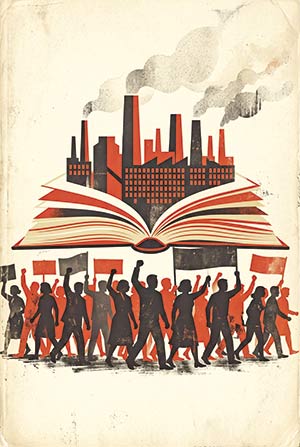
Bertolt Brecht offers another important perspective. His epic theatre challenged conventional dramatic forms and the passive consumption of theatrical experience. Through techniques such as alienation, or Verfremdungseffekt, Brecht sought to interrupt familiar ways of seeing social relations. His theatre did not simply present suffering for emotional consumption; it exposed the historical and social arrangements behind it. The audience was invited to examine circumstances that might otherwise appear natural or inevitable. The distinction matters because literary representation and political solidarity are not interchangeable. Literature can explore exploitation without becoming a political programme. A novel does not have to offer solutions to economic inequality, nor should its artistic value be measured by its capacity to produce political action. Its engagement with social reality can remain complex, contradictory and aesthetically autonomous. Nevertheless, the social questions raised by literary works do not cease to exist when the book is closed. Bengali literature has its own substantial tradition of engaging with labour, deprivation and class relations. Kazi Nazrul Islam's Kuli-Majur challenges the social hierarchy that celebrates wealth and privilege while overlooking the labour that sustains society. His poetic imagination repeatedly confronts the unequal distribution of dignity and recognition. Sukanta Bhattacharya, too, brought hunger, deprivation and working-class existence into the centre of his poetry. In Chharpatra, the imagination of a different world remains closely connected to the material conditions of ordinary people. These writers did not approach labour merely as an abstract theme; it was embedded in their literary engagement with the contradictions of their society.
These traditions provide a compelling context for examining contemporary Bangladesh. The country's economic growth, particularly its garment industry, is inseparable from the labour of more than four million workers, most of them women. Yet economic contribution and economic security do not necessarily go hand in hand. The people whose labour sustains an industry do not automatically share proportionately in the prosperity it generates. The garment workers' protests in October and November 2026 brought this contradiction into public view. Workers took to the streets demanding a monthly minimum wage of Tk 30,000, up from the existing Tk 12,500. Their demands emerged amid rising living costs, concerns over employment security and grievances surrounding working conditions. The unrest also involved factory closures, clashes with law enforcement and the death of a worker, Toufiq Hossain, on 3 November. The government subsequently formed a wage board to review the sector's minimum pay structure. These developments exposed the tensions between workers' demands, industrial interests, state intervention and the right to organise.
For readers familiar with Marx, Brecht, Dickens or Nazrul, the questions surrounding these events are not entirely unfamiliar. Who owns the means of production? Whose labour creates wealth? How are the benefits of production distributed? And why does economic growth not necessarily translate into dignity and security for those who sustain it? But perhaps the more uncomfortable question concerns the intellectual and cultural spaces in which these questions are discussed. What happens when the language of class solidarity remains confined to literary discussions, university seminars and theoretical debates? Can one consistently engage with Marxist literary criticism while remaining detached from contemporary labour struggles? Does an appreciation of revolutionary literature necessarily translate into an understanding of the material realities of workers? It would be simplistic to suggest that every leftist intellectual must participate in every street demonstration, or that physical presence at a protest is the only measure of solidarity. Engagement can take many forms, including research, journalism, legal advocacy, organising and public debate. Labour movements themselves are complex, and their demands, leadership and political circumstances deserve critical examination rather than automatic romanticisation.
Nevertheless, there is a meaningful distinction between discussing the working class as a literary subject and recognising workers as people with agency, demands and the right to negotiate the conditions of their lives. Workers should not have to become characters in a novel, symbols in a poem or metaphors in an academic argument before their struggles receive serious attention. Perhaps the contradiction is not within literature itself but within the culture of reading, interpretation and intellectual engagement that surrounds it. We can appreciate the representation of class struggle as an aesthetic or intellectual experience while remaining detached from its material realities. We can discuss exploitation as a literary theme without necessarily engaging with the conditions that sustain it. The working class has long occupied the pages of literature. Yet the people represented in those pages are not merely historical figures or fictional characters. They exist in contemporary factories, streets and everyday economies, negotiating the conditions of their survival and asserting their demands.
When literature depicts the struggles of workers, the question is not simply how those struggles are represented on the page, but how we, as readers and members of society, respond when similar struggles unfold beyond it.
The writer is a development communication professional

Loading...
Loading...



Editor : Iqbal Sobhan Chowdhury
Published by the Editor on behalf of the Observer Ltd. from Globe Printers, 24/A, New Eskaton Road, Ramna, Dhaka.
Editorial, News and Commercial Offices : Aziz Bhaban (2nd floor), 93, Motijheel C/A, Dhaka-1000.
Phone: PABX- 41053001-06; Advertisement: 41053012; 01793317829, 01550707291, 01550707296
E-mail: [email protected], [email protected]. [email protected], [email protected], [email protected], [email protected], Online-email: [email protected]


