



| HEADLINE |

|

Why do Gulistan footpath shops return ad infinitum?
Published : Tuesday, 24 November, 2026 at 12:00 AM
Tanvir Raihan


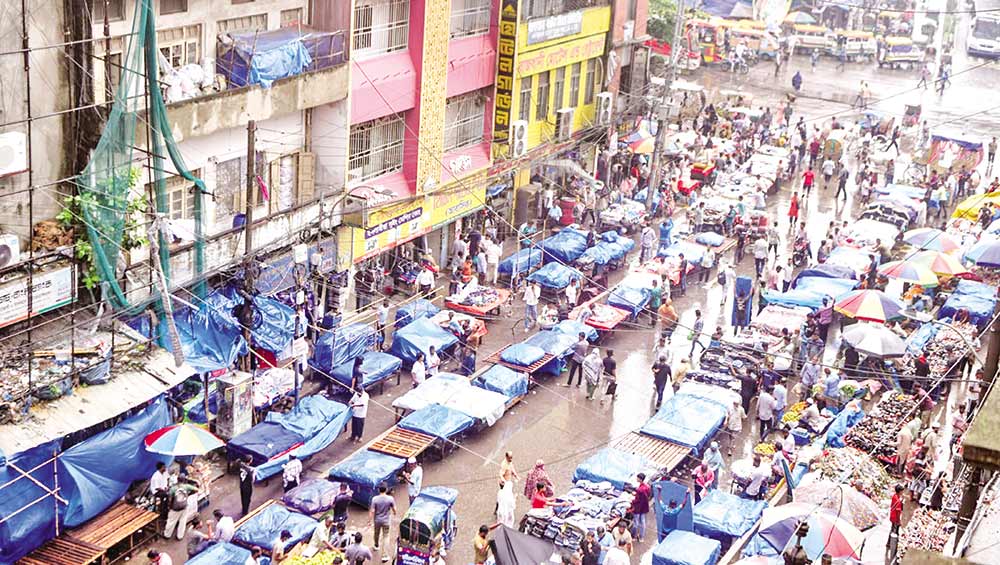 Public roads and footpaths in Dhaka’s busy Gulistan area have allegedly turned into lucrative sources of illegal income, with groups of politically influential individuals accused of collecting money from street vendors in exchange for allowing them to occupy public spaces.
Despite repeated eviction drives by Dhaka South City Corporation (DSCC), illegal shops and makeshift stalls continue to return to the same locations. Local residents and vendors allege that politically connected groups control different sections of the area, collecting daily payments and one-time fees for what they describe as trading positions.
According to vendors, securing a permanent position in certain locations costs between Tk 70,000 and Tk 1 lakh. In addition, vendors are reportedly required to pay daily charges ranging from Tk 50 to more than Tk 500, depending on the location and type of business. Busy intersections and areas near shopping centres reportedly command higher payments.
Local accounts suggest that the alleged collection networks operate through designated representatives, commonly known as line managers, who collect money from vendors and distribute it among different groups.
Several individuals allegedly associated with the BNP and its affiliated organisations have been named by local residents in connection with the collection networks. These allegations have not been independently verified.
Among those mentioned are Masud Rana and Imon, who allegedly use their identities as Jubo Dal activists. Residents claim they exert influence over vendors and different sections of Gulistan, with allegations that groups of people are used to intimidate traders who refuse to pay or challenge their control.
The names of Murshed, a former expelled leader of Ward 20 BNP, and Golam Nabi, president of the Belpatti unit BNP, have also surfaced in local allegations.
Residents further identified several alleged line managers, including Nabi, Babul, Harun and Saleh, reportedly associated with the Jatiyatabadi Hawkers' Dal. Nabi was specifically identified by some locals as a collector operating around Capital Hotel and Belt Goli.
Different individuals have reportedly been assigned to control separate locations, including areas around Gulistan Building, Trade Centre, Khaddar Market, Osmani Udyan, the stadium's southern gate, GPO and Fulbaria bus terminal.
Vendors allege that collectors regularly visit their designated areas and demand payments. Those who fail to pay on time may face threats of eviction, while some traders have also reported physical intimidation.
Several vendors said they had to make additional payments for electricity and other expenses while operating on the footpaths. Some also alleged that they had to maintain arrangements with influential local individuals and law enforcement personnel to continue their businesses. However, there is no independent confirmation of these claims.
Attempts were made to contact Masud Rana and alleged line manager Babul for their responses. However, they disconnected the calls after being informed of the journalists' identities and could not subsequently be reached.
The alleged occupation of public spaces has created serious problems for pedestrians, shoppers and commuters. With shops, carts and merchandise covering large sections of footpaths, pedestrians are often forced onto busy roads, increasing congestion and accident risks.
DSCC has conducted several eviction drives in the area but has struggled to prevent vendors from returning. The corporation has recently intensified its operations, removing illegal structures and confiscating goods and shop equipment placed on roads and footpaths.
DSCC Administrator Bir Muktijoddha Md Abdus Salam said the corporation was considering rehabilitation or alternative arrangements for street vendors.
"We want hawkers to have opportunities to conduct their businesses, but not by blocking roads and footpaths. Efforts are underway to manage the situation properly," he said.
He also warned that only the city corporation has the legal authority to conduct eviction operations.
Professor Dr Adil Muhammad Khan, executive director of the Institute for Planning and Development (IPD), said allegations of political involvement in occupying roads and footpaths had persisted across different administrations.
He said roads should account for around 25 per cent of a city's total area, whereas Dhaka has only around 7 to 8 per cent. Encroachment further reduces the space available for public movement.
He called for a zero-tolerance approach against illegal occupation, arguing that action should not be limited to removing street vendors while ignoring those allegedly facilitating and benefiting from the occupation.
He also stressed that police and city corporation officials must perform their duties independently of political affiliations.
Identifying the groups controlling different areas, publishing relevant information and taking action against those responsible are essential, he said.
The deteriorating situation in Gulistan highlights a broader challenge for Dhaka: clearing footpaths alone may not solve the problem unless the alleged financial networks and influential groups behind illegal occupation are also addressed.

Loading...
Loading...
Also read



Editor : Iqbal Sobhan Chowdhury
Published by the Editor on behalf of the Observer Ltd. from Globe Printers, 24/A, New Eskaton Road, Ramna, Dhaka.
Editorial, News and Commercial Offices : Aziz Bhaban (2nd floor), 93, Motijheel C/A, Dhaka-1000.
Phone: PABX- 41053001-06; Advertisement: 41053012; 01793317829, 01550707291, 01550707296
E-mail: [email protected], [email protected]. [email protected], [email protected], [email protected], [email protected], Online-email: [email protected]


