



| HEADLINE |

|

Pakistan sends first astronaut Zeeshan Ali aboard China spacecraft
Published : Wednesday, 25 November, 2026 at 11:34 AM
Observer Online Report


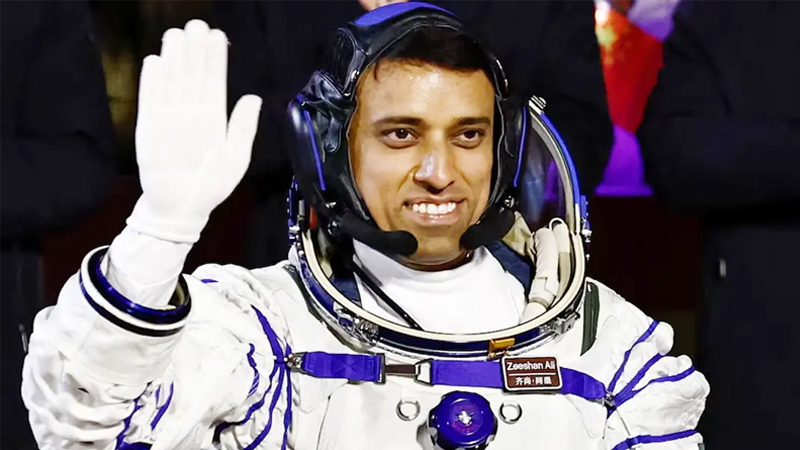
Collected Photo
Pakistan sent its first astronaut, Zeeshan Ali, into space aboard China's Shenzhou-24 spacecraft alongside two Chinese crew members early Wednesday (November 25).
The spacecraft lifted off at 8:18AM local time (6:18AM Bangladesh Standard Time) from the Jiuquan Satellite Launch Centre in northwestern China, heading toward the Tiangong space station. State broadcaster CCTV aired the launch live.
Ali is travelling with Chinese commander Tang Hongbo and flight engineer Wu Yi. According to CCTV, Ali will serve as a payload specialist on the mission, conducting scientific experiments aboard the space station over a five-to-10-day stay.
A 40-year-old pilot by profession, Ali underwent seven months of intensive training in Beijing ahead of the mission. During his preparation, he studied Mandarin, learned to sing Chinese songs and recite poetry, practised calligraphy, and took part in indoor sports such as table tennis.
Minutes after liftoff, live CCTV footage showed the three astronauts reviewing an instruction manual inside the capsule, with the broadcaster reporting that all crew members were in good health.
Speaking to reporters on Tuesday prior to departure, Ali said, "I am not going to space for myself; I am going for my country. I carry Pakistan's name on my shoulders."
Pakistani Prime Minister Shehbaz Sharif hailed the launch as "historic." In a post on social media platform X on Tuesday thanking Chinese President Xi Jinping, Sharif wrote, "Pakistan-China friendship has risen higher than the Himalayas and is now advancing into space."
Although Ali's five-to-10-day stay is brief compared to the standard six-month rotation of Chinese astronauts, analysts view the mission as a major milestone for Islamabad. Blaine Curcio, founder of Hong Kong-based Orbital Gateway Consulting, noted that the mission brings prestige to Pakistan, creates opportunities to gain key scientific and technological expertise, and deepens bilateral cooperation and diplomatic goodwill with China.
Space cooperation between Beijing and Islamabad dates back to the early 1990s. China has previously launched Pakistani satellites, and the two nations have also signed an agreement to send a Pakistani-built rover aboard a Chinese lunar mission around 2028.
-EM

Loading...
Loading...
Also read








Editor : Iqbal Sobhan Chowdhury
Published by the Editor on behalf of the Observer Ltd. from Globe Printers, 24/A, New Eskaton Road, Ramna, Dhaka.
Editorial, News and Commercial Offices : Aziz Bhaban (2nd floor), 93, Motijheel C/A, Dhaka-1000.
Phone: PABX- 41053001-06; Advertisement: 41053012; 01793317829, 01550707291, 01550707296
E-mail: [email protected], [email protected]. [email protected], [email protected], [email protected], [email protected], Online-email: [email protected]


