



| HEADLINE |

|

Nationwide family planning campaign to begin on Dec 13


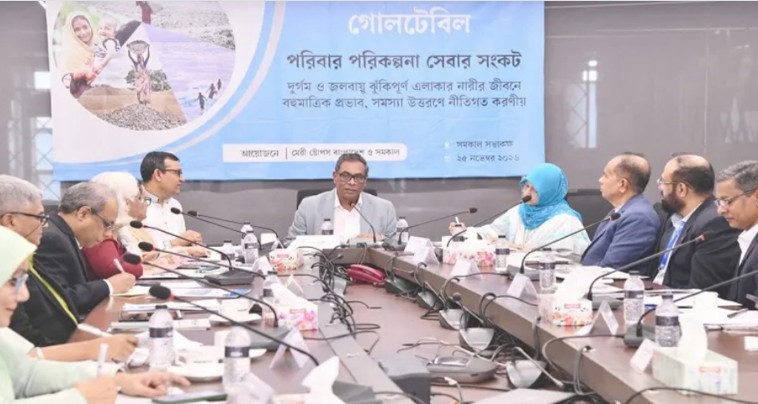
A nationwide family planning campaign will begin on December 13, with President scheduled to formally inaugurate the year-long programme, State Minister for Health and Family Welfare Dr MA Muhith has said.
He disclosed the information while addressing a roundtable discussion at the office of Daily Samakal on Wednesday.
The discussion, titled ‘Family Planning Service Crisis: Multidimensional Impacts on Women in Remote and Climate-vulnerable Areas and Policy Measures to Address the Challenges’, was jointly organised by Marie Stopes Bangladesh and Samakal.
The state minister said several decades of progress in the country's family planning and immunisation programmes had been affected by what he described as policy mistakes by the previous interim government.
He said the closure of the sector programme without alternative guidelines had disrupted salaries for field-level workers and the supply system.
The present government has given the sector the highest priority since taking office, he added. Emergency tenders have been invited, and essential family planning supplies have already reached depots in seven divisions.
Speaking about recruitment and the use of technology in healthcare, Muhith said the government was working to recruit 100,000 healthcare workers in line with its election manifesto.
Around 40,000 existing field-level workers would also be brought under an integrated workforce. They would be equipped with tablets and artificial intelligence-based information to improve service delivery and monitoring.
Highlighting the health challenges faced by women in remote areas, he said the haor, char, hill and coastal regions had different healthcare needs.
Poor and women with disabilities were particularly vulnerable during floods, he said, adding that national averages alone could not reflect the actual challenges faced by these communities. Their experiences must be considered when developing an effective healthcare system.
The state minister also stressed the need to expand family planning services into a broader reproductive healthcare programme.
Pointing out that the country has specialised institutions for child health and heart diseases but lacks a dedicated institution serving the healthcare needs of a large number of women, he called for establishing a women's health institute.
He also called for removing social taboos surrounding emergency contraception and strengthening public-private partnerships in the sector.
Professor Dr Ainun Nahar of the Department of Anthropology at Jahangirnagar University presented the research findings at the discussion.
Director General of the Directorate General of Family Planning Dr Zinat Ara, Marie Stopes Bangladesh Chairperson Dr Yasmin Ahmed, Ipas Country Director Dr Rubaiyat, University of Dhaka Department of Population Sciences Professor Mainul Islam, reproductive health specialist Halida Hanum Akhter and officials from the United Nations Population Fund (UNFPA) also took part in the discussion.
sks








Published by the Editor on behalf of the Observer Ltd. from Globe Printers, 24/A, New Eskaton Road, Ramna, Dhaka.
Editorial, News and Commercial Offices : Aziz Bhaban (2nd floor), 93, Motijheel C/A, Dhaka-1000.
Phone: PABX- 41053001-06; Advertisement: 41053012; 01793317829, 01550707291, 01550707296
E-mail: [email protected], [email protected]. [email protected], [email protected], [email protected], [email protected], Online-email: [email protected]


