



| HEADLINE |

|

Modi slams opposition over quota row, constitutional amendments
Published : Thursday, 26 November, 2026 at 10:57 AM
Observer Online Report


Collected Photo
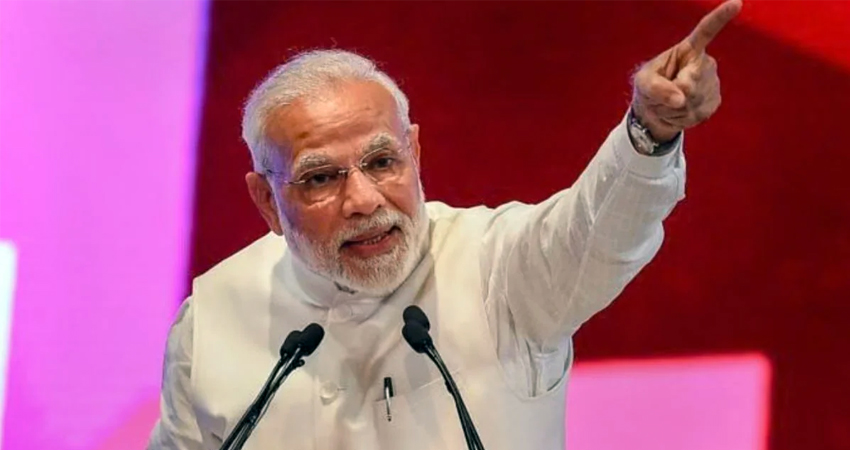
Indian Prime Minister Narendra Modi has accused opposition parties of attempting to introduce quotas for Muslims by cutting reservations meant for Other Backward Classes (OBCs), making the allegation in an essay published on his website to mark Constitution Day.
In the essay released on Thursday (November 26), Modi described such moves by the opposition as highly condemnable and asserted that the architects of India's Constitution, particularly B.R. Ambedkar, had opposed such arrangements.
Although Modi did not name any party, Indian broadcaster NDTV reported that his remarks appeared aimed at the Congress.
The Prime Minister also criticized the parliamentary conduct of opposition parties, saying they had turned into a disruptive force rather than offering constructive opposition. Disrupting democratic proceedings, he argued, cannot be a substitute for fulfilling constitutional duties.
Modi pointed to the failure of the women's reservation bill to pass Parliament earlier this year, alleging that the same opposition blocked the legislation and showed disregard for constitutional values. The constitutional amendment bill seeking 33 per cent seat reservation for women in the Lok Sabha and state legislative assemblies failed to pass in April after falling short of the required two-thirds majority.
Opposition leaders, however, had objected to linking the bill with delimitation—the redrawing of electoral constituencies—with Congress leader Shashi Tharoor characterizing the move at the time as an attempt to alter political power.
Modi also targeted the opposition over the history of constitutional amendments, alleging that those who governed India for nearly five decades weakened the Constitution. He noted the 75th anniversary of the first constitutional amendment in 1951 and the 50th anniversary of the 42nd amendment enacted during the Emergency in 1976.
According to Modi, the first amendment sought to curb fundamental freedoms and stifle dissent against the government. He urged young people to learn about the 38th and 39th constitutional amendments as well, calling them examples of what power-hungry and anti-constitutional leadership can do.
The Prime Minister further highlighted the use of Article 356 of the Constitution to dismiss elected state governments, claiming one party misused the provision around 100 times and that a single former prime minister did so 50 times.
Touching upon Articles 370 and 35A concerning Jammu and Kashmir, Modi claimed those provisions deprived Scheduled Castes, Scheduled Tribes, OBCs, and women in the region of full constitutional rights until 2019.
While describing the end of Maoism this year as a relief, Modi warned against "urban Naxals" or "intellectual Naxals" whom he accused of trying to obstruct development.
Sharing reflections from his childhood and personal background, Modi said circumstances of birth no longer limit a person's future. Describing the Constitution as an integral part of people's lives, he paid tribute to constituent assembly figures including Rajendra Prasad and B.R. Ambedkar.
Citing a World Bank report, Modi also claimed that around 500 million people in India have lifted themselves out of poverty, pointing to welfare initiatives run by his government such as the Pradhan Mantri Awas Yojana, Ujjwala Yojana, and Ayushman Bharat.
-EM

Loading...
Loading...
Also read








Editor : Iqbal Sobhan Chowdhury
Published by the Editor on behalf of the Observer Ltd. from Globe Printers, 24/A, New Eskaton Road, Ramna, Dhaka.
Editorial, News and Commercial Offices : Aziz Bhaban (2nd floor), 93, Motijheel C/A, Dhaka-1000.
Phone: PABX- 41053001-06; Advertisement: 41053012; 01793317829, 01550707291, 01550707296
E-mail: [email protected], [email protected]. [email protected], [email protected], [email protected], [email protected], Online-email: [email protected]


