



| HEADLINE |

|

What does ‘1 trillion dollar wiped out’ actually mean
Published : Friday, 27 November, 2026 at 3:28 PM
Shahman Abir


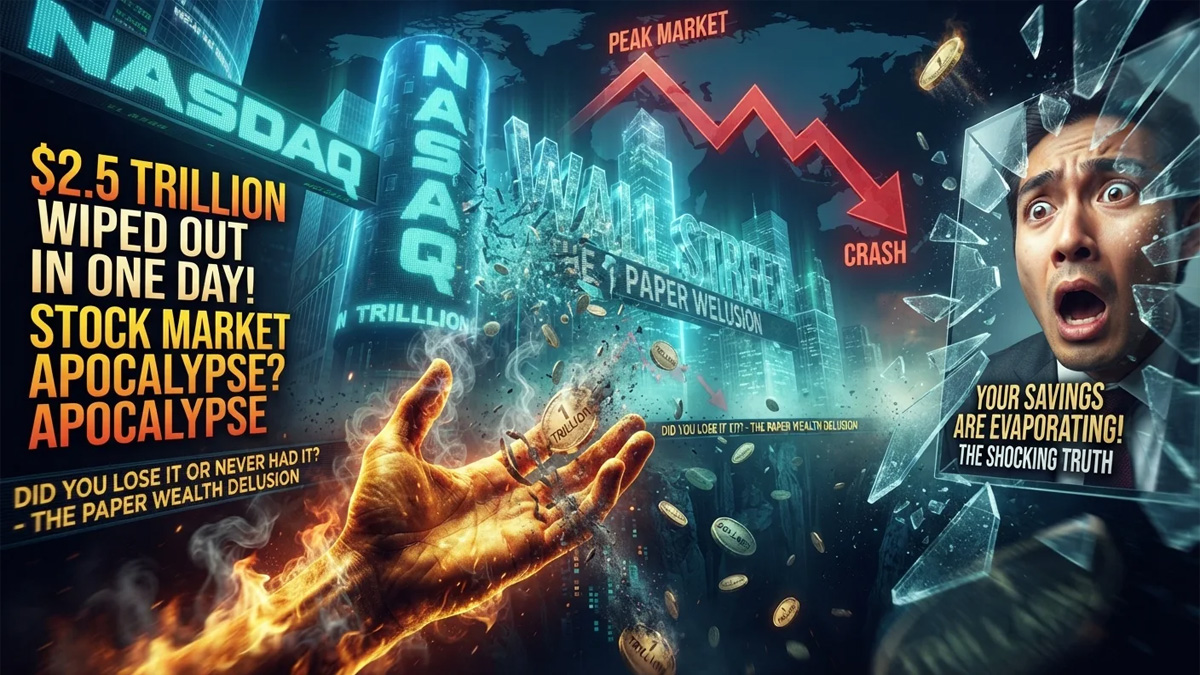
AI Illustration
Imagine buying a house for, let’s say, Tk 100. The land is positioned around the outskirts of the town, and price only increases.
Then, flood came. Infrastructure got damaged, Connectivity–not so connected. Valuation of your home, stood around Tk 1,000 before the flood. Now it’s Tk 50.
Now, the real question arises. Did you lose Tk 50? Or Tk 950? Which one is correct?
Your real loss? Tk 50. And the loss only counts if you sell the house. Other Tk 900, was a gain that only existed in paper and never reached your pockets.
This little story tells how stock markets lose billions, or trillions of dollars on paper, which, in reality, probably did not exist.
However, stock market crash does not mean money is vanishing out in the thin air. Rather its value is measured at the last traded price.
Welcome to the delusion of ‘paper wealth,’ which gives you a fake sense of financial safety without even owning a single dime.
Recent major stock fallout
This is not just a theory. Trillion-dollar "wipeouts" have become common headlines in 2026. In early February, more than $1 trillion was erased from the Nasdaq-100 in about a week, after the Federal Reserve signaled it was reluctant to cut interest rates again soon.
In June, a strong jobs report triggered a sell-off that erased roughly $1.4 trillion from S&P 500 companies in a single Friday. By October, more than $2 trillion in Nasdaq-100 value had evaporated over the month, including $500 billion lost by Alphabet in one session.
Then on November 5, fears of a slowdown in AI investment reportedly wiped out about $2.5 trillion in US market value, with the Nasdaq Composite suffering its worst single-day fall since April 2025.
Is it really "fake" money?
Not quite, and the "paper wealth" idea needs some care. The value is real, until people stops trading at those prices. Shareholders do own something, namely their shares. The actual illusion is the profit, because you can only gain it by selling the shares.
Ironic enough, a paper loss can still hurt in real life. Investors who borrowed money against their shares can be forced to sell at the lower price, which locks in the loss.
Pension and retirement funds hold stocks, so ordinary people's savings fall. People who feel poorer tend to spend less, which can slow the wider economy. Companies with lower share prices also find it harder to raise money or to pay staff in shares.
So for the next trillion dollar headline, you know what actually happened.

Loading...
Loading...
Also read









Editor : Iqbal Sobhan Chowdhury
Published by the Editor on behalf of the Observer Ltd. from Globe Printers, 24/A, New Eskaton Road, Ramna, Dhaka.
Editorial, News and Commercial Offices : Aziz Bhaban (2nd floor), 93, Motijheel C/A, Dhaka-1000.
Phone: PABX- 41053001-06; Advertisement: 41053012; 01793317829, 01550707291, 01550707296
E-mail: [email protected], [email protected]. [email protected], [email protected], [email protected], [email protected], Online-email: [email protected]


