



| HEADLINE |

|

KNF regroups across border for fresh strikes in CHT
Published : Saturday, 28 November, 2026 at 12:00 AM
Mamunur Rashid back from CHT


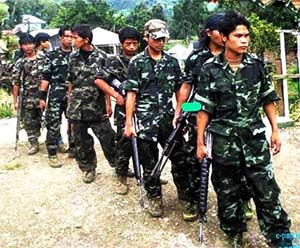 The Kuki-Chin National Front (KNF), weakened by sustained military operations in Bangladesh’s Chittagong Hill Tracts (CHT), is reportedly trying to rebuild its armed network in neighbouring Mizoram and Myanmar’s Chin State with alleged support from other regional armed groups, including the United People’s Democratic Front (UPDF).
Security sources and local residents say the KNF’s armed wing, the Kuki-Chin National Army (KNA), is exploring ways to re-enter Bangladesh and launch surprise attacks on Army camps and patrol teams. The reported regrouping has prompted increased surveillance, patrols and security measures in Bandarban and adjoining areas.
A four-day field investigation in remote parts of Bandarban and Rangamati from November 23 to 26 found that although the KNF has lost much of its operational strength inside Bangladesh, concerns persist over its alleged cross-border links and efforts to reorganise.
Interviews with former KNA members, residents from the Bawm and other communities, and security officials suggest that Mizoram has become a refuge for some KNF members who fled following military operations.
People familiar with the security situation said members moved between hideouts in Mizoram, Myanmar’s Chin State and areas along the Bangladesh border. Security personnel said technological surveillance had detected movements consistent with such cross-border activities.
More concerning are allegations of support from armed groups operating in the region. Some sources claimed that sections of the Bawm community in Myanmar’s Chin State were assisting KNF members in Mizoram. They also alleged that the Arakan Army, an armed organisation based in Myanmar’s Rakhine State, was supplying weapons and training to facilitate possible attacks on Bangladeshi security forces.
Alleged involvement of the UPDF and the Parbatya Chattogram Jana Samhati Samiti (JSS), led by Santu Larma, has added another dimension to the security concerns. Local sources laim that despite their rivalry over territorial influence and extortion, the organisations sometimes share interests in challenging government authority and security operations.
Major Niamul Nasir Siddiqui, deputy commander of the Army’s Ruma Zone under the Bandarban Region, said the 36 Bir Unit had conducted around 150 special operations against the KNA and other armed groups since taking responsibility for the area.
He said the organisations were involved in extortion, armed activities and intimidation of residents in remote hill communities.
“Our operations are primarily aimed at preventing these activities and ensuring the security of local people,” he said.
The investigation also found that some former KNA members were leaving the organisation and returning to civilian life with Army assistance.
At Munnampara in Ruma Zone, this correspondent spoke to a 35-year-old Bawm man who had returned from Mizoram after leaving the armed group. He requested anonymity for security reasons.
He said he had seen more than 500 trainees at the Paindujhiri (Kuttajhiri) camp while receiving weapons training. Intensified security operations later forced members to flee to Mizoram.
After spending several months there, he said, separation from his family and community made him reconsider his involvement. He eventually contacted a local Army camp through members of his community and returned to Bangladesh after receiving assurances of assistance.
The Army gave him several goats to start a livestock farm, along with cash and construction materials to build a house.
“I repeatedly questioned why we had taken up arms against our own country. I realised that this was not the life I wanted. I want to live peacefully,” he said.
Another former KNA member, who returned about three months ago, said his involvement had separated him from his wife and children.
Under Bawm community customs, couples separated for more than three years must undergo traditional and religious ceremonies before resuming married life. The process involves expenses that he is now trying to meet through hard work. He also said the Army had helped him establish a farm and provided materials to build a house.
A former KNF vice-president, now living in Durnibarpara of Rowangchhari, blamed longstanding political and social inequalities for the emergence of armed organisations in the hills.
He claimed to have severed ties with the KNF in 2022, before its armed activities began, and denied any involvement with its military wing.
He accused the JSS of failing to adequately represent smaller ethnic communities beyond the Chakma and Marma populations, saying remote communities had remained neglected for decades. Unequal access to government opportunities, services and political representation, he argued, had created grievances that armed organisations exploited.
Local residents said rivalry between the JSS and UPDF over territorial control, extortion and influence continued to fuel violence across Bandarban, Rangamati and Khagrachhari. They also voiced concern over alleged cooperation among armed groups when their interests converged.
For ordinary residents, however, the continuing armed rivalry has brought insecurity, displacement and economic hardship.
Lal Lung Thang Bawm, a resident of Bethelpara in Ruma, said people associated with the KNF had become increasingly isolated from their own community.
“Their activities have also put us at risk. Weapons cannot bring peace; they only bring destruction. We want peace,” he said.

Loading...
Loading...
Also read



Editor : Iqbal Sobhan Chowdhury
Published by the Editor on behalf of the Observer Ltd. from Globe Printers, 24/A, New Eskaton Road, Ramna, Dhaka.
Editorial, News and Commercial Offices : Aziz Bhaban (2nd floor), 93, Motijheel C/A, Dhaka-1000.
Phone: PABX- 41053001-06; Advertisement: 41053012; 01793317829, 01550707291, 01550707296
E-mail: [email protected], [email protected]. [email protected], [email protected], [email protected], [email protected], Online-email: [email protected]


