



| HEADLINE |

|

PM calls for job-oriented overhaul of higher edu
Published : Saturday, 28 November, 2026 at 1:00 PM
Staff Correspondent


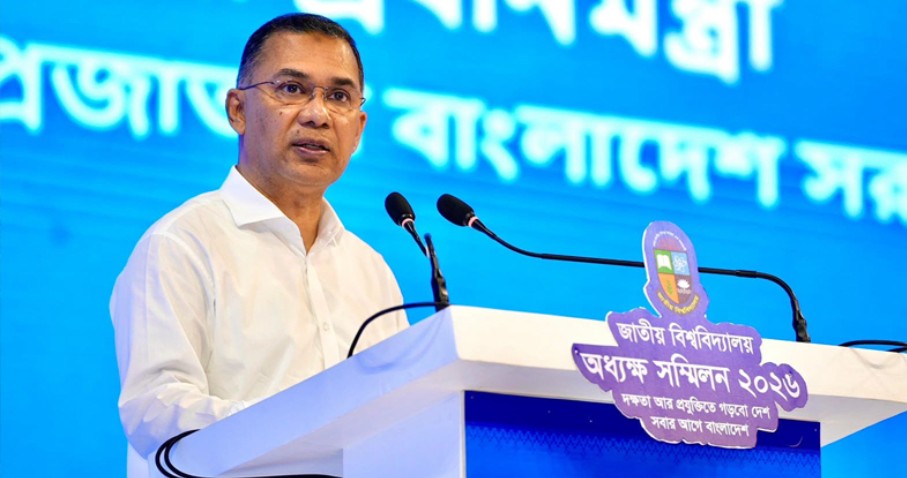
Prime Minister Tarique Rahman has called for a major transformation of the country's higher education system, urging institutions to move beyond traditional teaching methods and focus on technology, innovation, practical skills and employability.
He stressed the need to strengthen students' technical and practical skills, expand partnerships between educational institutions and industries, introduce more internship and apprenticeship opportunities, and create scope for learning multiple foreign languages.
Simply increasing the number of graduates with academic certificates would not reduce unemployment, the prime minister said, emphasising that knowledge must be translated into skills relevant to the job market.
He was speaking at the National University Principals' Conference 2026 at the National Stadium in Mirpur, Dhaka, on Saturday (November 28).
Addressing principals from more than 2,300 colleges affiliated with the National University, Tarique said a principal was not merely the administrative head of an institution but also its leader, moral guide and academic mentor.
The future prospects of students largely depend on the intelligence, competence, decisions, judgement and vision of their college principals, he said.
The prime minister recalled that former prime minister Khaleda Zia established the National University on October 21, 1992, to ensure access to higher education for people in both urban and rural areas.
The university now has nearly 2,500 affiliated colleges. Although the number of colleges and students has increased significantly since its establishment, questions remain over whether the quality of education has improved at the same pace, he observed.
Alleging that the education system, like other key sectors, had been systematically damaged during the fascist regime, Tarique said the country now needed to rebuild its education system through an inclusive approach.
The government has taken initiatives to modernise education and make it relevant to contemporary needs, but college principals must lead the implementation process, he added.
Technology-driven education and teacher training
The prime minister said teacher training had become essential to align educators with modern, technology-driven teaching methods.
He called for a shift from traditional teacher-centred instruction to student-centred and research-based learning, suggesting that a "train the trainer" programme could play an effective role.
Without adapting to modern educational technologies, the country would continue producing more certificate-holders every year without making meaningful progress in reducing unemployment, he warned.
One of the major reasons for higher unemployment among educated people, he said, was their lack of practical and technical knowledge alongside academic qualifications.
Highlighting the challenges of the Fourth Industrial Revolution, Tarique observed that nearly half of the world's population had yet to enjoy the full benefits of the Third Industrial Revolution, while the world had already entered a new technological era.
He urged higher education institutions to abandon conventional approaches and develop technology-driven, innovation-oriented and skills-based programmes tailored to employment opportunities.
Artificial intelligence, robotics, big data, the Internet of Things, blockchain, automation, genetic engineering, biotechnology, cybersecurity and fifth-generation wireless technology are rapidly transforming the future workplace, he said.
While these technologies are making some traditional professions obsolete and contributing to unemployment, they are also creating new industries and job opportunities.
"Education gives people strength, while a clear goal turns that strength into success. Education without a goal is like a journey without direction," the prime minister said.
He stressed that effective industry-academia collaboration was essential to transform acquired knowledge into workplace skills.
Over 1,500 MoUs with industries
Explaining his vision for closer cooperation between educational institutions and industries, Tarique said academic institutions should build the foundation of knowledge, industries should convert that knowledge into practical skills, and students should emerge as future innovators, entrepreneurs and drivers of economic growth.
Classrooms should become centres of knowledge creation and innovation, laboratories should open up new possibilities, and industries should serve as practical learning grounds, he said.
The government has already taken steps to expand apprenticeships, internships and industry-academia partnerships, he added.
According to the prime minister, the process of finalising more than 1,500 memorandums of understanding between universities and industrial establishments has been completed over the past few months.
He described the participation of industrial entrepreneurs and representatives of employers at the conference as a reflection of these initiatives.
Tarique said students who acquired market-oriented skills and practical experience while still studying would be better positioned to become entrepreneurs after graduation rather than simply waiting for jobs.
Such entrepreneurship could also enable them to create employment opportunities for others, he added.
Multilingual education and career counselling
The prime minister also emphasised the importance of combining technical education with humanities and broader intellectual development.
He said an employment-oriented education system must also nurture ethical values, creativity, critical thinking and leadership qualities through the study of literature, philosophy, history, science, sociology and culture.
He urged colleges to expand opportunities for learning foreign languages alongside English.
Arabic, Mandarin, Japanese, Korean, French, German and Italian, among other internationally востребed languages, could open new opportunities for students in the global job market, he said.
He called on every National University-affiliated college to strengthen career counselling, internship opportunities, skills development programmes and language clubs, while creating more avenues for entrepreneurship.
Calls for filling teacher vacancies
Tarique said the government was also concerned about protecting the interests of educational institutions and teachers while modernising the education system.
He called for a college-wise assessment of teacher shortages, filling vacant positions, recruiting and posting teachers where necessary, and expanding professional training and skills development.
He urged the Ministry of Education to coordinate with the Directorate of Secondary and Higher Education, the Non-Government Teachers' Registration and Certification Authority (NTRCA) and the National University to take effective measures.
Protecting the interests of educational institutions and teachers was essential to achieving the desired goals, he said.
Solar power for colleges
The prime minister also called for greater use of renewable energy in educational institutions, particularly rooftop solar power.
He said the government was prioritising rooftop solar installations and urged the National University and other colleges with suitable rooftops to take initiatives to install solar systems.
He also called on teachers and students to maintain cleanliness in their educational institutions, homes and surrounding areas.
Colleges must remain free of factionalism
Emphasising discipline and a healthy academic environment, Tarique urged educational institutions to remain above political factionalism, group rivalries, personal conflicts and unnecessary disputes.
He acknowledged that differences in political opinions and beliefs were natural in a democratic society, but warned that such differences must not disrupt teaching, administrative discipline or student safety.
He also called on college authorities to adopt a supportive approach towards financially disadvantaged students, marginalised communities and students with special needs.
The government wants to build a Bangladesh that is rich in knowledge, economically self-reliant, humane in values and respected on the global stage, he said.
The prime minister also wished success for the National University's "One Student, One Tree" initiative, part of its tree-planting programme.
He concluded his address by expressing his appreciation and respect for the teachers attending the conference.
JB

Loading...
Loading...
Also read





Editor : Iqbal Sobhan Chowdhury
Published by the Editor on behalf of the Observer Ltd. from Globe Printers, 24/A, New Eskaton Road, Ramna, Dhaka.
Editorial, News and Commercial Offices : Aziz Bhaban (2nd floor), 93, Motijheel C/A, Dhaka-1000.
Phone: PABX- 41053001-06; Advertisement: 41053012; 01793317829, 01550707291, 01550707296
E-mail: [email protected], [email protected]. [email protected], [email protected], [email protected], [email protected], Online-email: [email protected]


