



| HEADLINE |

|

Paddy Gleaners: Surviving on rats’ hidden harvest
Published : Monday, 30 November, 2026 at 12:00 AM
Wahiduzzaman Tuhin from Kurigram


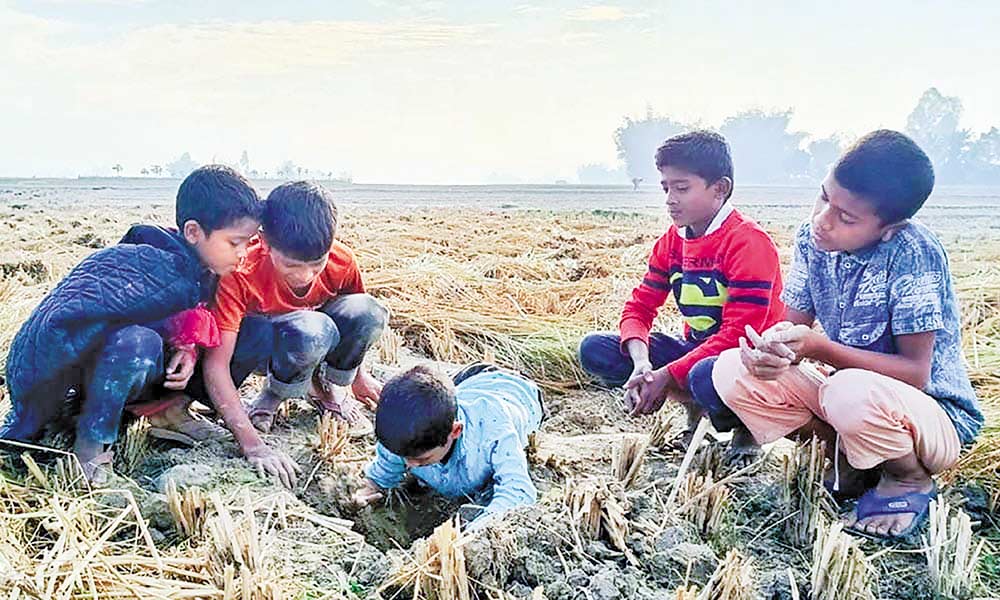 With no land to call their own and poverty leaving little room for choice, landless women in Kurigram dig through rat holes in paddy fields to find grains that may keep their families fed for months.
The golden Aman fields of northern Bangladesh are alive with the sounds of harvest. Farmers cut ripened paddy from the land they own or cultivate. But for some impoverished women, the season is a reminder of what they lack: farmland, a crop to harvest and enough food to feed their families.
While others gather paddy with sickles, these women search for rat holes and dig into the earth to recover grains that rodents have carried underground and stored. Known locally as Indur Dhan (rat-stored paddy), the grain can provide food for two or three months.
Munni Begum, 58, of Chakirposhar Taluk village in Rajarhat upazila, knows this struggle well. After her husband died, she had to raise five daughters without farmland or a secure source of income. Every Aman harvest season, she searches the fields for rat holes and collects whatever grain she can find.
Despite the uncertainty and hard work, Munni gathers more than four maunds a year, enough to feed her family for nearly two months.
“We are poor, so we dig up the rats’ burrows and collect the grain. We have become paddy gatherers. Rat-stored paddy is all we have to rely on,” she says in her local dialect.
Shefali Begum, 45, of Hemerkuti village in Kurigram Sadar upazila, also searches for the hidden harvest. Excavating a single rat hole can take two to three hours, and she often works from morning until evening. The work is risky, too, as snakes sometimes emerge from the burrows. But poverty leaves her little choice.
Taslim Begum, 47, from the Bachhra Bazar area of Rajarhat, collected nearly nine maunds of paddy last year with her daughter-in-law. This season, she hopes to gather six to seven maunds.
“We have no land to grow paddy. We dig up rat holes and collect whatever grain we can find. It keeps our household going for two or three months,” she says.
According to Taslim, digging 25 to 30 burrows over 10 to 12 days can yield three to four maunds. The grain is either used to feed the family or sold to buy other essentials.
The irony is that rats, which destroy farmers’ crops, also leave behind something that helps the landless survive. Farmers generally do not object to the women digging up burrows, as the disturbance can drive rodents away and may reduce crop damage.
Ahsan Habib, 30, a farmer in the area, says the practice can benefit cultivators by forcing rats out of their fields.
Collecting rat-stored paddy has been part of rural agricultural life in Bangladesh for generations. As Aman rice ripens, rats carry grains into underground burrows. During harvest, poor and landless people, particularly women and children, search for these hidden stocks. For them, even grain stored by rodents can become a source of food.
The damage rats cause to agriculture remains substantial. According to the Ministry of Agriculture, rodents destroy crops worth around Tk500 crore in Bangladesh every year.
A 2010 study by the United States Department of Agriculture identified the Ganges-Brahmaputra basin, including Bangladesh, as one of the world's major rodent-infested breeding regions.
A 2013 study by the International Rice Research Institute estimated that rodents destroy enough rice and paddy across Asia each year to feed 180 million people. In Bangladesh, the losses are equivalent to the annual food requirements of 5 million to 5.4 million people.
Abu Fattah Md Rowshan Kabir, deputy director of the Department of Agricultural Extension in Kurigram, says paddy gleaners appear in the fields mainly during the Aman harvest season.
“Collecting rat-stored paddy is part of Bengal's age-old agricultural culture,” he says.
For farmers, rats are a persistent threat to their harvest. For Munni, Shefali, Taslim and countless other landless women, however, their underground burrows offer a slim chance of survival. What they recover may be only a few handfuls of grain, but it can keep their families fed for another day.
It is a harvest born not of prosperity, but of deprivation-a handful of hope gathered from beneath the soil.

Loading...
Loading...

Also read



Editor : Iqbal Sobhan Chowdhury
Published by the Editor on behalf of the Observer Ltd. from Globe Printers, 24/A, New Eskaton Road, Ramna, Dhaka.
Editorial, News and Commercial Offices : Aziz Bhaban (2nd floor), 93, Motijheel C/A, Dhaka-1000.
Phone: PABX- 41053001-06; Advertisement: 41053012; 01793317829, 01550707291, 01550707296
E-mail: [email protected], [email protected]. [email protected], [email protected], [email protected], [email protected], Online-email: [email protected]


