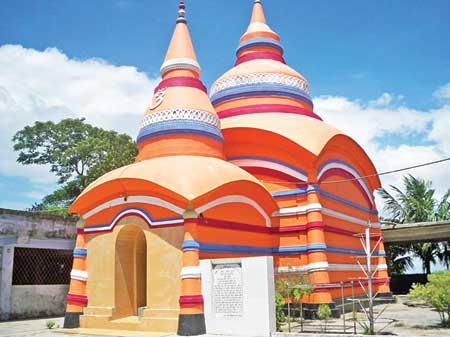
Comilla hosts Samatata and Mynamati, two ancient regions dimpled with red hills, and more than 50 ancient sites dating between the eighth and twelfth century. Among them one of the spectacular sites is Chandimura Temple, located on the summit of the Lalmai Hill in Barura Upazila of Comilla.
Chandimura temple has been established in the 7th century by Provabati Debi, wife of the Buddhist king Devkharag. Originally, it has two temples: one for Lord Shiva and another for Goddess Chandi. It is also known as Chandi Mura Shebasram.
Most of the tourist spots are somewhere around the other side of Shalbon Bihar of Comilla but this small temple is quite separated from those places. This is at the southern end of the Lalmai Hill.
The temple consists of an inner sanctum, the garbha griha or womb-chamber, where the primary Murti or the image of a deity is kept. The garbhagriha is crowned by a tower-like Shikhara, also called the Vimana. The architecture includes an ambulatory for parikrama (circumambulation), a congregation hall, and an antechamber and porch.
For Hindu community, the temple is a place for tirtha or pilgrimage and they flock there in different parts of the year. Equally, for visitors of any creed, the temple can enchant and enrich historical knowledge along with its spectacular architecture. The Hindu culture has encouraged aesthetic independence to its temple builders, and its architects have sometimes exercised considerable flexibility in creative expression by adopting other perfect geometries and mathematical principles in mandir construction to express the Hindu way of life. That is why Chandimura temple experienced some architectural difference with such other kinds of temples in the same region.
On the entrance, the temple appears as a square-shaped structure with a number of graduated projections in the middle of each side giving a cruciform shape with a number of re-entrant angles on each side. In elevation, a Shikhara or tower gradually inclines inwards in a convex curve, using a concentric rotating-squares and circles principle.
The brick sanctuary, typically in the form of a tower with garbahgriha used to host the murti of deity. A mandapa or entry hallway is connected with the sanctuary. There is also a kosagrha or fire-house which is a temple construction typically with a saddle-shaped roof, used to house the valuables belonging to the deity or to cook for the deity. These building types are typical for Hindu temples in general; the classification is valid not only for the architecture of Chandimura temple, but also for other architectural traditions of across the Indian subcontinent.
The temple is surrounded by crowns of tropical trees, which can really give an eye-soothing experience to the visitors. To reach the top of the hillock where the temple lies, visitors are required to climb up stairs with precaution since some may find looking at the ground a dizzying experience. But to their benefit, the stair is guarded with carefully strewn hedgerows and small trees.
While the entire Comilla is bestowed with many historical sites, Chandimura temple is a special attraction. Located at the top of a hillock, the temple gives visitors a feeling of being with history and that can surely turn out to be pleasant for them.





