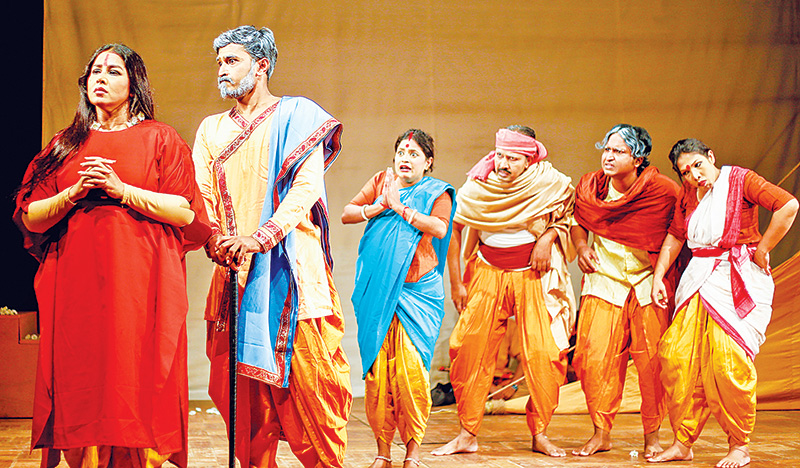
Imagine sitting in the gallery with a large stage and waiting for a much awaited show by one of your favourite playwrights to begin. Recently, a play called Bratto Ami Montrohin, written by Sadhana Ahmed and performed by Bibartan Jessore, was staged at the Experimental Theatre hall of Bangladesh Shilpakala Academy.
Rabindranath Tagore, throughout his life, had searched for a way to the ultimate 'truth'. That path is the way of simplicity, humility and a feeling of perception. However, according to Rabindranath, it is us who have clouded the path towards the 'truth' through various worldly conflicts.
Rabindranath had, in so many ways, searched for the jewel called 'human being', so says the storyline of the play. The play revolves around two characters, Khyapa and Boshtomi. Boshtomi, a beggar in Shilaidoho area, loves the landlord there and secretly puts flowers in his path whenever he is about to leave the house.
She loves him so much that she is even willing to eat the leftovers from his plate. And, the only person she can share this to is Khyapa, another beggar from the same area.
The twist in this is that Khyapa is in love with Boshtomi and it is this truth that puts a fleeting sensation of misery in Boshtomi much later in the play. Throughout the play, a reflective flashback keeps on coming in and out of the context, where the life of a girl named Anondi is depicted. The story of Anondi timeslides in between the story of Boshtomi.
In the meantime, Anondi gets married and gives birth to a son and a few years later, her son drowns in waves of the lake close to her house on a stormy day. From there, her life spirals in a downward whirlpool, sucking away all her happiness in life along with her sanity.
Her husband brings home a religious guru to console her. The guru then goes on preaching about how life goes on even when it is seemingly gone from this world. Anondi finds consolation in his deceptive words.
Later on, we find that he was trying to exploit her mental instability. The barbaric part of this story is that her husband also consents to this exploitation as meeting the demands of the religious guru is the sole purpose of his life, or so he says.
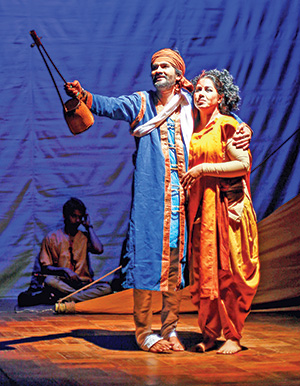
However, Anondi denies all the so-called duties and pseudo-obligations and leaves her husband. Right after this scene in the play, a shift is noticed where both Anondi and Boshtomi are together on stage, suggesting that Anondi from the past is the present day Boshtomi.
Coming to the present, Boshtomi has been driven away from the village because she had apparently committed sacrilege by eating the leftovers from the food that had been made by a Muslim cook. As such, the village elders gather and decide to throw her out of the village and stop give her alms.
On the other hand, Khyapa meets the landlord at his house and they exchange words about the truth of human nature. Also, Khyapa tells him about Boshtomi's love. After this, both of them come into an agreement and switch places. The shift in character bewilders Boshtomi. She feels that she had actually been in love with Khyapa all along and begins to doubt her love.
Rabindranath, in his story titled 'Boshtomi', said that, "After so many days when I have removed the ego from my sight could I see the truth in the eyes of this woman." What was it that Rabindranath had seen in the eyes of this woman? Also, Boshtomi used to call Rabindranath 'Gouroshundar', how was there relationship?
Rabindranath, despite being from a family of repute had imagined himself in the clothes of Khyapa. How was the mentality of the baul Rabindranath? Was it religious institutional, if so, then how much humane havethe thousands of institutions teaching religion made people?
Finally, where is the liberation in the love between a man and a woman? These are the prime questions that have been asked in this play.





