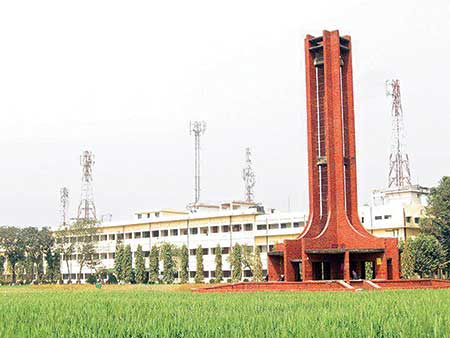
Bengal Agricultural Institute, precursor of now Sher-e-Bangla Agricultural University (SAU), was the first agricultural institution in South Asia. It was established in 1938, aiming to modernize agriculture and mechanization. Later on in 2001, the institute was given the present form-- a full-fledged university. The university has stepped in its 18 years of glorious journey, which has a great historical background.
In the subcontinent, then British royal rulers felt the absence of agricultural education. In 1888, Bengal Veterinary College was established in Belgaashia, Kolkata, to ensure the well-being of the cavalry of British Royal Army. In 1895-96, agricultural courses were introduced at the degree level in Engineering College, Shibpur, Kolkata. After an incident, the British ruler ceased the course later.
On the other hand, they have been pressurizing the farmers of this country to cultivate indigo, cotton, jute, silk and tobacco. In the middle of the 1877 to 1900, there were 6 famines in the subcontinent that claimed thousands of lives. That is why the British agreed to the recommendations of the Royal Commission to the peasants. In 1919, an agricultural college was set up in Sabur, Bihar, but in 1921 it was closed which was a mock to the Bengalis.
For the development of agriculture, on 11 December 1938, then first Chief Minister of undivided Bengal, Sher-e-Bangla AK Fazlul Huq, laid the foundation of Bengal Agricultural Institute. That year, budget Tk.0.15 million was allocated for construction of the institution over 300 acres of land. According to the agricultural syllabus of the University of Redding in England, academic activities of the institute started in 1941. Under Dhaka University, BSC in Agriculture courses were started with 10 Muslims and 10 Hindu students. They came out as the first agricultural graduates of Bengal in 1943. MS courses were launched in 1951 in the institution.
After the partition of the subcontinent, the name of this institution was kept as East Pakistan Agricultural Institute. After the independent of Bangladesh in 1971, EPAI was named as Bangladesh Agricultural Institute. This institution played the pioneering role in the expansion of agriculture, agricultural research for the country's famine-stricken people. But instead of converting it into a university, Bangladesh Agricultural University was established in Mymensingh. Later, this institution was affiliated to the university. On January 6, 2001, at the Diamond Jubilee of the Bangladesh Agricultural Institute (BAI), the Prime Minister Sheikh Hasina announced BAI as a university and passed the law on July 9. On July 15 of the same year, the Prime Minister laid the foundation stone of Sher-e-Bangla Agricultural University and Professor Md Shadat ullah was appointed as the first Vice-Chancellor.
Contribution
From history, it can be said that graduates from this institution has taken the agriculture of the country to an astonishing altitude. Besides, the participation of teachers, students, officers and employees of the institution in the language movement of 52, 6th round of 66, mass uprising in 69 and liberation war in 1971 was spontaneous. It is known that during that time, the student leaders of Dhaka used to take shelter in the hall of the institution to stay safe from police harassment; Bangabandhu Sheikh Mujibur Rahman also held a meeting in Sher-e-Bangla Hall.
At present, there are 35 departments under the faculty of agriculture, animal science and veterinary faculty, and the faculty of agribusiness management, fisheries and aquaculture. Currently, 3570 students are studying in the university, including the foreign students at post-graduate level. The number of teachers in the university is 226. There are five halls-- 3 for boys and 2 for girls. Besides, there are also residential arrangement for teachers and staffs. In addition to education, there are 5 farms for research. Moreover, for the development of the university, a project of Taka 352 millions is going on from the current fiscal.
Teachers, researchers and students of SAU are inventing new varieties at the Central Laboratory of the Research System (SAURS) and Dr Wazed Miah Central Research Centre ( WMCRC), and the Agricultural extension department is working to reach the agricultural technology to the doorsteps of the farmers. Among the innovative technologies, the success of developing HY variety including SAU Sarisha-1, SAU Sarisha-2, SAU Saurisha-3, country's weather adapted seeds of potato and onion, tomatoes, tomattilo, jamarasan radish, white maize is noteworthy. Besides, the high yielding rice variety named as BR-3, BR-4, BR-10, BR-11, BR-14, BR-19, BR-23 are not only recognized in neighboring countries but have also been introduced in India, Nepal, Myanmar, Vietnam and West Africa. Kazi guava inventor Kazi Badruddoza was the scholar of this university. A group of researchers in this fraternity was able to do artificial breeding of bee, turkey and vegetable without sunlight. The extensive research on roof gardening is underway.
Besides, for the contribution in agriculture, the pupils of the university received various medals including Swadhinata Padak, President Award, Science Academic Gold Medal and Sher-e-Bangla medal. At the time of born of Bangladesh, there were 7 crore people, but now it has increased to nearly 17 crore but the cultivable land has decreased. Despite the enormous food demand of the large population, the country today is self-sufficient in food because of the biggest contribution of the country's agriculturalists.
Labyrinth
The SAU still faces many obstacles. The shabby academic building is not capable of holding such huge students. The research standard and academic syllabus are also not up-to-date. Low quality research facilities are a big obstacle on the way to produce world standard agriculturists. Recently, the water shortage for fifteen days in female student hall has caused the suspension of final exam, which reveals the infirmity of the institution's administrative system. The virtual system is also vulnerable due to the lack of proper maintenance.
On the 18th anniversary of SAU, we hope the university, known as the small village of the capital, will take the country's agriculture sector to a unique height by expanding its research, education, and development activities as it did in the past.





