



| HEADLINE |

|
Fragments of Reality
Some thoughts about book and book fair
Published : Thursday, 7 February, 2019 at 12:00 AM
Dr Kanan Purkayastha


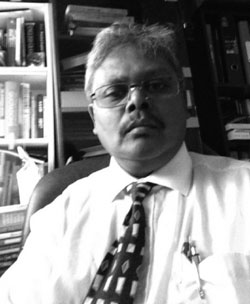
Dr Kanan Purkayastha
It connects authors, publishers, booksellers and readers. A book fair can circulate old books such as Charles Dickens' The Chimes or The Haunted Man. These books failed to ignite the public imagination in the same way Dickens other books. Does this mean that they were not as good? Or these have not been tested in time. A book fair can play its part to bring those books alive and engage them with readers for interaction at different space and time.
A longest book fair in the world known as Amar Ekushey Book fair has a different politico-socio-economic character in comparison to London or Frankfurt Book Fair. One cannot purchase books but can exchange publishing rights in Frankfurt or London Book Fair, whereas a book fair in Bangladesh one can purchase book. Book is a common denominator within the relationship between author, publisher, bookseller and a reader. What a book promise to a reader? Portuguese author Jose Jorge Letria wrote some playful prose in his book,
If I were a Book as follows-
"If I were a Book, I'd share my deepest secrets with my readers.
If I were a Book, I'd like to have my own magical places in every child's imagination.
If I were a Book, I'd be your best friend.
If I were a Book, I'd be full of knowledge.
If I were a Book, I'd be one skyscraper in the city of words.
If I were a Book, I'd sweep away ignorance.
If I were a Book, I'd crush violence with knowledge."
Books inspired warriors. For example, Alexander the great always carried three objects and put under his pillow every night throughout his military campaign. These are dagger, a box and inside the box, he placed a copy of his favourite text, the Iliad. Alexander kept dagger because he wanted to escape his father's fate, who was assassinated. The box he had seized from Darius, his Persian opponent and the Iliad, because as Puchner puts it in his book The Written World, 'it was the story through which he saw his campaign and life, a foundational text that captured the mind of a prince who would go on to conquer the world.'
Books also become important to powerful. Peter Burke, in his book, Social history of knowledge, informed that for the library of France, Napoleon's army carried off around 1500 manuscripts from the Austrian lowlands and another 1500 manuscripts from Bologna and Vatican.
Where the books come from? Some of the earliest books found in Southern Iraq from 4000 BC, was used to record horoscopes. Archaeologists have also found Chinese writing on fifty thousand tortoise shells, called oracle bones. If we consider past thousand years we will see tales of writing on stone tablets, ivory, tree bark and palm leaves. Historians have discovered copies of the Iliad and the Odyssey written on the dried skins of serpents. Ancient Romans used the bark of trees to write on, a peel called 'liber', which in turn became the Latin word 'libri', meaning book and subsequently 'libre', 'libro' and 'library'. The ancient Greeks wrote on parchment, the Egyptians on papyrus and the Chinese invention of papers.
In 1450, Johann Gutenberg developed a moving printing press in Germany that enabled book to be published faster and more cheaply, but there was a protest for it, because the book would no longer be written by hand. Famous book seller in Florence named Vespasiano da Bisticci closed his bookshop on protest because he thought that this was the death of the book industry.
History suggests that in ancient time, books were read out in public by 'would be writers'. If an audience approved, it was likely that a patron would pay to have the authors work copied out. Roman authors believed that their influence depended on the public access to their intellectual production. Alberto Manguel, in his book A History of Reading, wrote, 'From roughly the end of the twelfth century, books became recognized as items of trade, and in Europe the commercial value of books was sufficiently established for money lenders to accept them as collateral..'
The history of bookshops is not like history of library. Former need private entrepreneurial response, whereas later get institutional support. A bookshop distributes but a library preserve. As an analogy one can say, bookshop is like liquid but library is like a stable solid form. Sometime, we compare a bookshop with an archaeological site, where a reader excavates an object, which is in fact his desired book but it requires patience like an archaeologist.
How a bookshop supports author or author support a bookshop? Bookshop named 'Shakespeare and Company' in Paris is a great example. In 1917 an American woman named Sylvia Beach came to Paris to study French literature. She was then inspired by a French poet and publisher Adrienne Monnier to open her own bookshop. Sylvia started a bookshop, named Shakespeare and Company, where her aim was to make her bookshop a space for writers to come, congregate and spent time. Authors such as Hemingway, T.S.Eliot, Ezara Pound, Fitzgerald and James Joyce were the regular visitors. Joyce book Ulysses was turned down by American publishers on the ground of obscenity but Shakespeare and Company first published the book in lieu of 25 Franck.
There is an uncertainty attached to publishing a book. In his Letter on the Book Trade, Denis Diderot, French philosopher, art critic and writer, wrote, ' A man recognises his genius only upon putting it to the test�.When an author composes a first work, he does not know what it is worth, nor does the bookseller. If the bookseller pays us as he wishes, we in turn sell him what we are pleased to sell him. It is success that instructs the merchant and the man of letters.'
Plato wrote, "Books give a soul to the universe, wings to the mind, flight to the imagination, and life to everything." A Publisher has a very important role to play in this soul searching mission. Booksellers need to bridge the gap between publishers and readers and a book fair can be a platform which hold together all concerned.
Dr Kanan Purkayastha is an Environmentalist, Academics, Columnist and Author, who lives in UK
Loading...
Loading...
Also read


Editor : Iqbal Sobhan Chowdhury
Published by the Editor on behalf of the Observer Ltd. from Globe Printers, 24/A, New Eskaton Road, Ramna, Dhaka.
Editorial, News and Commercial Offices : Aziz Bhaban (2nd floor), 93, Motijheel C/A, Dhaka-1000.
Phone: PABX- 41053001-06; Advertisement: 41053012; 01793317829, 01550707291, E-mail: [email protected], [email protected] Online: email: [email protected] 41053014; 01550707297 Advertisement: 01550707296
Published by the Editor on behalf of the Observer Ltd. from Globe Printers, 24/A, New Eskaton Road, Ramna, Dhaka.
Editorial, News and Commercial Offices : Aziz Bhaban (2nd floor), 93, Motijheel C/A, Dhaka-1000.
Phone: PABX- 41053001-06; Advertisement: 41053012; 01793317829, 01550707291, E-mail: [email protected], [email protected] Online: email: [email protected] 41053014; 01550707297 Advertisement: 01550707296


