



| HEADLINE |

|
Ranjit's scrutinisation of socio-economic and political trauma
The painter turns 63
Published : Sunday, 3 March, 2019 at 12:00 AM
Takir Hossain


 Society
plays a significant role in human life. It has been established with
elements of varied social, cultural and political aspects, but not
ineluctably. Society is continuously changing in all its spheres. The
alterations have been hugely influencing people from all walks of life
for centuries. The people who cultivate the fields of creativity,
originality and ingenuity are prominent among those receiving the
impact. Ever since the birth of civilisation this fact has been proved
time and again. During the classical era, in the aftermath of the rise
of Christianity, post-crusade Europe, Europe after the French
revolution, colonial expansions, industrial revolution, and during the
hollowness that swept the world after the two world wars, the artistic
and literary world responded promptly. In Bangladesh, the same has also
been witnessed after the establishment of the British colonial
administration, 20th century alienation, partition of the sub-continent
and before and after the Liberation War and Language Movement. But the
effect society as a section lost in flux has left on its people was
never felt as much deeply as it has been felt in the 21st century.
Society
plays a significant role in human life. It has been established with
elements of varied social, cultural and political aspects, but not
ineluctably. Society is continuously changing in all its spheres. The
alterations have been hugely influencing people from all walks of life
for centuries. The people who cultivate the fields of creativity,
originality and ingenuity are prominent among those receiving the
impact. Ever since the birth of civilisation this fact has been proved
time and again. During the classical era, in the aftermath of the rise
of Christianity, post-crusade Europe, Europe after the French
revolution, colonial expansions, industrial revolution, and during the
hollowness that swept the world after the two world wars, the artistic
and literary world responded promptly. In Bangladesh, the same has also
been witnessed after the establishment of the British colonial
administration, 20th century alienation, partition of the sub-continent
and before and after the Liberation War and Language Movement. But the
effect society as a section lost in flux has left on its people was
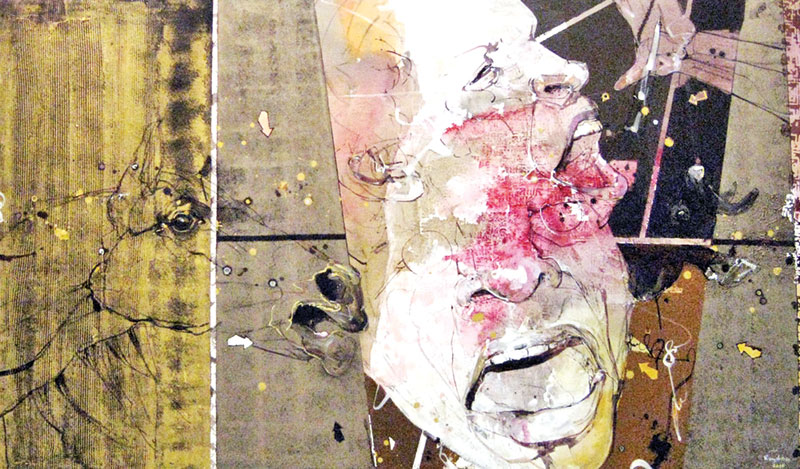
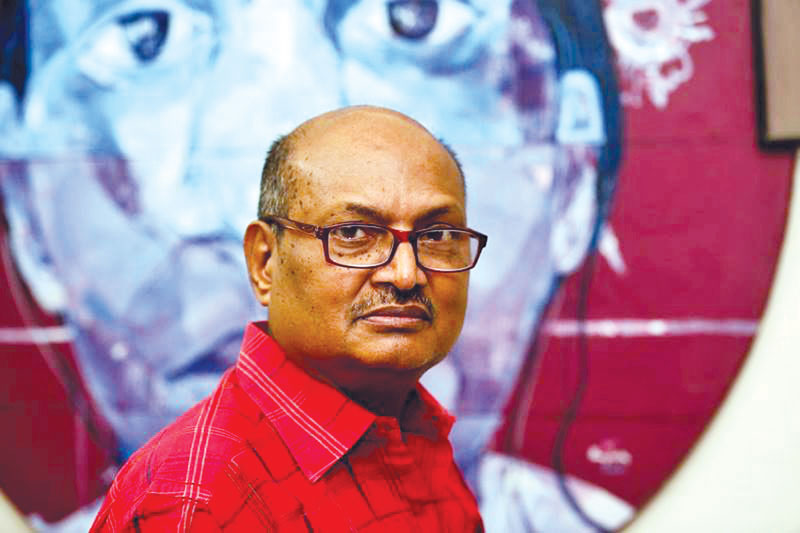
never felt as much deeply as it has been felt in the 21st century.Ranjit Das is among the group of painters known for reflecting the said 21st century dilemmas in the context of changing and traditional Bangladeshi societies. Distinguished for his distinctive figurative style and incisive observations of the society where he finds subjects to limn. The artist has been playing a vital role to enhance the contemporary and cerebral approach to modern Bangladeshi art for a long time. It can be unquestionably stated that he is one of the most versatile Bangladeshi painters, equally adept in portraits, landscapes, visual rendering of socio-political and economic issues and other topics of the society. As an exponent of modernism, Ranjit gives a critical view to the society, first by highlighting the people and their struggle for originality and then by uttering discontentment pervading the social atmosphere as well as divulging the human dilemma in our society.
Ranjit always presents himself in front of us with a novel look. For his unique characteristic, the painter has gone through various phases of experimentation and each process visualises an idiosyncratic artistic view. It can be purely called an intense journey through experimentation. He is constantly looking for new theme but the producing works has a superb correlation between each and other which is very much obvious in his paintings. It has been very noticeable that his use of colours is more vibrant and lively from his previous works. Ranjit used bright colours long time ago and again he has started to paint vibrantly for satisfying his creative instinct. His painting methods, particularly the use of colours, have a profound influence and a logical explanation for his thinking process which is very much connected to our society.
For Ranjit, paintings seem to him a barren land where he cultivates tenaciously for producing reaps and he always tries to produce the best harvest. For conveying a remarkable aspect to his works, the painter lends from a number of isms like realism, semi-realism, expressionism and abstract expressionism. His ability to draw mass, volume and texture and to create sensitive compositions is remarkable. His paintings are fresh, mind-boggling and provide the spectators a sense of pleasure. His figurative and composition based paintings are lively and have the right kind of restraint. He knows where to stop which proves his skill and expertise.
 For
a long time, Ranjit has been using intentionally varied kinds of motifs
and tiny forms for bringing a unique look to his paintings. Those uses
of motifs also carries his brave and experimental nature. Scribbles,
blotches, horizontal or vertical broad lines, arrows, broken lines,
loops as well as curls, squares, oval and other forms are recurring
features in his works and the hallmarks make him peerless in our art
milieu. A noticeable feature of the paintings is the intimate
relationship between the figures and his personally created motifs. His
hallmark style is distinguished by concentration on a particular limb or
fraction of the human form. He builds up layers of texture and the
texture seems to us as a soothing milieu. Sometimes his texture
demonstrates rough and bumpy surface.
For
a long time, Ranjit has been using intentionally varied kinds of motifs
and tiny forms for bringing a unique look to his paintings. Those uses
of motifs also carries his brave and experimental nature. Scribbles,
blotches, horizontal or vertical broad lines, arrows, broken lines,
loops as well as curls, squares, oval and other forms are recurring
features in his works and the hallmarks make him peerless in our art
milieu. A noticeable feature of the paintings is the intimate
relationship between the figures and his personally created motifs. His
hallmark style is distinguished by concentration on a particular limb or
fraction of the human form. He builds up layers of texture and the
texture seems to us as a soothing milieu. Sometimes his texture
demonstrates rough and bumpy surface. It has been deeply detected that Ranjit's figures articulate many moods where melancholy, bliss, rage, sympathetic and unstable emotional state are frequently immersed. He has always an attempt to provide an emotional delineation in his paintings and he wants to produce paintings that not only describe how we look physically but also capture mental, emotional and spiritual states. Previously he brought many animal forms with figural expression that conveys many symbolic expressions. Symbolist painters believed that art should reflect an emotion or idea rather than represent the natural world in the objective, quasi-scientific manner embodied by realism and impressionism. In painting, symbolism represents a synthesis of form and feeling, of reality and the artist's inner subjectivity. Connections between art and the functions of the mind are the ways in which artists express their own thoughts, feelings, and anguish. It has also been observed that the painter's figurative works have a touch of realism but few of them have a bit of a distorted look. Some of his paintings carry a number of figures simultaneously which engage with diverse moods. Shadowy figures, hazy visages, birds and many realistically drawn objects also have been placed in different parts of the canvas. He also frequently searches the boundaries of expressions with diverse geometric and architectural shapes. Skilled applications of light and shades are apparent in many of his paintings. The treatment of lines is varied in his paintings and he has also used blurred lines and tiny amorphous objects for adding new dimensions to his creations.
Loading...
Loading...
Also read





Editor : Iqbal Sobhan Chowdhury
Published by the Editor on behalf of the Observer Ltd. from Globe Printers, 24/A, New Eskaton Road, Ramna, Dhaka.
Editorial, News and Commercial Offices : Aziz Bhaban (2nd floor), 93, Motijheel C/A, Dhaka-1000.
Phone: PABX- 41053001-06; Advertisement: 41053012; 01793317829, 01550707291, E-mail: [email protected], [email protected] Online: email: [email protected] 41053014; 01550707297 Advertisement: 01550707296
Published by the Editor on behalf of the Observer Ltd. from Globe Printers, 24/A, New Eskaton Road, Ramna, Dhaka.
Editorial, News and Commercial Offices : Aziz Bhaban (2nd floor), 93, Motijheel C/A, Dhaka-1000.
Phone: PABX- 41053001-06; Advertisement: 41053012; 01793317829, 01550707291, E-mail: [email protected], [email protected] Online: email: [email protected] 41053014; 01550707297 Advertisement: 01550707296


