



| HEADLINE |

|
Operation Barbarrosa
The biggest military gamble ever
Published : Saturday, 22 June, 2019 at 12:00 AM
Shahriar Feroze


 The month of June marks the two most momentous dates in the history of warfare--June 6 and June 22--the former is almost repeatedly observed with much fanfare and pomp since it marks the D-Day, otherwise the joint allied invasion of Western Europe. The latter rests in oblivion. And it's this marked difference in observing the two dates that has often strike me on the definition of writing history. The notion that history is often believed to be written by the victors appears to be true, despite the fact of being biased. Today is one such date resting in oblivion.
 You may test any military aficionado or history student around you about the most consequential military operation of all times--almost all of them may know about the German invasion of the once Soviet Union--but many of them don't know that it was the biggest as of today.
Inspired by the legend of the most prominent holy German emperor of the Middle Ages, King Frederick the 1st--Operation Barbarossa is the Nazi codename for the axis invasion of the former Soviet Union. The day marks the 78th anniversary of the biggest military invasion in the history of mankind involving more than 3 million Axis troops, over 3,500 tanks, thousands of aircrafts and thousands of military vehicles of various types.
Over the course of the operation, about three million personnel of the Axis powers--the largest invasion force in the history of warfare--invaded the western Soviet Union along a 2,900-kilometre front. Complementing its troops, Wehrmacht (the German army known at that time) deployed some 600,000 motor vehicles, and between 600,000 and 700,000 horses for non-combat operations.
The grand Nazi offensive not only marked the pinnacle of escalation of World War II, but also decided the forming of geographical allied coalition. However, since Operation Barbarossa ultimately failed to realise its ultimate goal of the complete capitulation of the former Soviet Union by the Nazis, today it's largely forgotten. Interestingly, this single most important Nazi military campaign had led to subsequent German failures to achieve Hitler's ultimate objectives of world domination. And even more is that Operation Barbarossa had radically changed the political landscape of Europe dividing it into Eastern and Western blocs.
The political vacuum left in the eastern half of the continent was filled by the USSR when Stalin secured his territorial prizes of 1944-1945 and firmly placed his Red Army in Bulgaria, Romania, Hungary, Poland, Czechoslovakia, and the eastern half of Germany. Stalin's fear of any resurgence of German power and his distrust in the former allied powers contributed to Soviet pan-Slavic initiatives and a subsequent alliance of Slavic states. The biggest military campaign in history therefore went on to influence subsequent Soviet leaders in establishing the Warsaw Pact.
In an era of political ironies and contradictions of the post--war Europe, a collective defence treaty was signed between the then Soviet leadership and seven of its eastern bloc satellite states of eastern and central Europe in the Polish capital of Warsaw in the month of May in 1955. Barely 14 years earlier, at least six of these satellite states had adhered to the Nazi cause and had actively contributed to the Nazi military juggernaut to occupy the then USSR .
The next question in line arises involuntarily, what would have happened if Operation Barbarossa succeeded? The geopolitical world order would have been differently defined.
Nevertheless, history remains history and facts as facts. The Nazis were defeated but as the former Soviet Union emerged victorious establishing a large communist empire lasting for nearly five decades, the Soviet rulers had never actually recovered from the overall effects of the German invasion of 1941. The Nazi-Soviet war or the Great Patriotic War, as the Russians termed it, had commenced with Operation Barbarossa lasted for 1, 418 days claiming as many as 27 million Russian lives and properties worth $ trillions in today's value.
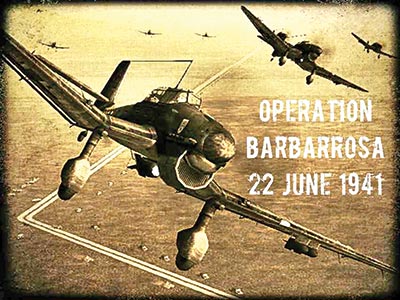 Had this gigantic military operation been conducted thousands of miles away with the purpose to invade the USA, whether it failed or succeeded, would have been remembered with much fanfare. Always remember, even though it appears as a single entity, allied forces during the Second World War always remained resentfully divided between the soviets and the western powers. Stalin was never much of an anti--Hitler until his country had been invaded. And the West was ecstatic to have found a new ally in defeating Hitler.
 On the topic of Operation Barbarossa, for decades, strengths and weaknesses, flaws and errors, of the massive Nazi military campaign were deeply studied and some of its features were even applied by military strategists in formulating military strategies. Dozens of books and military research papers relating to launching and failure of the German invasion of USSR had been prepared to shape and influence future military strategies.
Rather despondently, today few of us are actually aware of the far reaching impacts of the biggest military campaign ever to have launched. Not to forget, The D-Day's goal was to liberate the Nazi occupied West Europe, UK and USA's ally nations for that matter, but never to aid the Soviet war machine in its lone military campaign against the Nazis. Political rivalry between capitalism and communism had erupted a lot earlier. And if Germany hadn't declared war on the United States following the Pearl Harbour attack on December 7, American engagement in the D--Day would have been differently written in the history books. Following Operation Barbarossa, Hitler had also declared a two front war against both capitalism and communism. It's quite a whimsical political war.
The point, however, it's not about who won and who lost in the German invasion of the former Soviet Union or Operation Barbarossa, but what was learnt from the biggest military invasion in the history of mankind. Very little was actually learnt by today's militarily supreme state USA, otherwise, the superpower wouldn't have miserably failed, in Vietnam, Iraq and Afghanistan. And Afghanistan had manifestly turned into another Vietnam for the soviets.
The Nazis had actually stood up against a much formidable foe, but the Western powers including the former USSR were markedly defeated by smaller and weaker nations all across the globe. The last point is the most noteworthy, the legacy of Operation Barbarossa: you may be in possession of the world's mightiest military power, but unless you get the timing, strategies and a long term vision in place, you will never win a war.
Hitler's military strategies to conquer the former Soviet Union were correct. His army was within miles of Kremlin but the timing and to block soviet supplies from as far as Soviet - Mongol borders was missing. The bitter Russian winter had squeezed the best out of the Wehrmacht. Moreover, a long term vision to rule over the vast Soviet Union was inconsistent and contradictory because of Hitler's erratic military decisions. Therefore, Operation Barbarossa was lost. Yet, the long lasting military and geopolitical impacts of the mankind's biggest military adventure yet remain an overwhelming silent event.
As I mentioned before--history is most often composed by the victors in the most predisposed manner--where the end result of a great event matters the most.
Both the Nazis and the Soviets are history today, but their bitter battles to conquer and rule each other, ranging over thousands of miles lasting for decades had collapsed. Hitler is reported to have said, "When Barbarossa begins, the world will hold its breath". The world did hold its breath, and with the largest, best equipped, best trained, most motivated army in the world, it seemed like it might just work out. Extreme conviction of sure success can be deceptive, and the legacy of Operation Barbarossa, on that note, should never be elapsed.
The writer is editor-in-charge of the editorial section, The Daily Observer
Loading...
Loading...
Also read






Editor : Iqbal Sobhan Chowdhury
Published by the Editor on behalf of the Observer Ltd. from Globe Printers, 24/A, New Eskaton Road, Ramna, Dhaka.
Editorial, News and Commercial Offices : Aziz Bhaban (2nd floor), 93, Motijheel C/A, Dhaka-1000.
Phone: PABX- 41053001-06; Advertisement: 41053012; 01793317829, 01550707291, E-mail: [email protected], [email protected] Online: email: [email protected] 41053014; 01550707297 Advertisement: 01550707296
Published by the Editor on behalf of the Observer Ltd. from Globe Printers, 24/A, New Eskaton Road, Ramna, Dhaka.
Editorial, News and Commercial Offices : Aziz Bhaban (2nd floor), 93, Motijheel C/A, Dhaka-1000.
Phone: PABX- 41053001-06; Advertisement: 41053012; 01793317829, 01550707291, E-mail: [email protected], [email protected] Online: email: [email protected] 41053014; 01550707297 Advertisement: 01550707296


