



| HEADLINE |

|
Anukul mingles understanding, reminiscence and turmoil
Published : Sunday, 8 September, 2019 at 12:00 AM
Takir Hossain


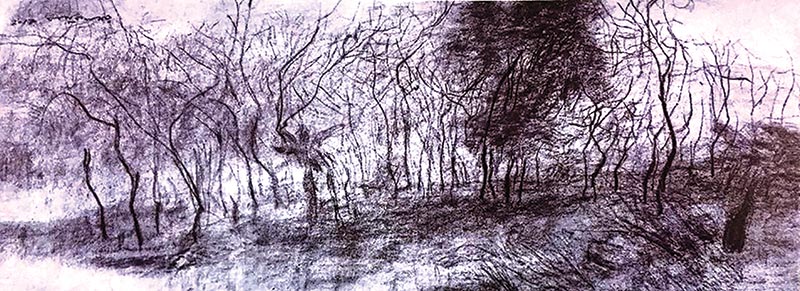 Anukul Chandra Majumder is recognised for portraying inner conflict through his remarkable paintings. The central theme of his work often focuses on facial expressions and the human body. His latest paintings depict motherhood, the six seasons and their impact on nature, childhood and rustic ambiance. The forte of Anukul's paintings is an in-depth observation of rural Bengal- simple harmonic patterns, pastoral motifs, a tranquil atmosphere and childhood nostalgia.
By assembling memory image, Anukul sets the tone of his language. The gestural aspect that he brings into play is what makes his works look more like homage to an era irreversibly lost to stupor, which can only be recalled through fragments and wreckages best exemplified by the accented lines and resonating surfaces the artist puts to use.
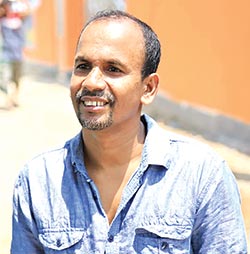
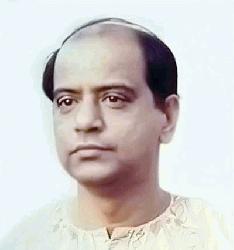
Anukul Chandra Majumder
Anukul's paintings are accentuated with lots of curves and twisted lines, often featuring bold, brutal and horrifying imagery. He does not hesitate to draw what is conventionally considered 'ugly'. Unattractive appearance, obese figures, languid eyes and unshapely forms feature heavily in his paintings. People running towards an unknown destination, embracing figures, sleeping women, awe-inspiring forms, nature in an unadulterated state, broken rickshaw, and foliage in abandon are his recurring subjects. He roots for the life force and power in the abstract. His images are prominent, determined, and capture forceful motion -- almost in its rawness -- and at times are unmindful of directions. His desires, emotions, hopes and aspirations are strongly allied with the masses of our country. He wants to focus especially on masses' strengths, their love for the country.
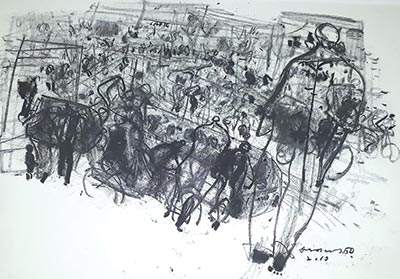 Anukul perpetually focuses on the strength and power of the human being. His canvas is not quiet or tranquil, rather it appears very bold and projects an impudent look. His works depict contemporary life and times. His creations inspire us to love the motherland and pay homage to it. He tries to highlight the rural people and their genuine patriotism. He not only portrays their images, but also pours into them human feelings, emotions and inner expressions. His skilled hands can capture any kind of struggle, pain and passion. He paints twisted figures and their movements.
 His figures are very stimulating and at the same time thought provoking. He uses space to increasingly interact with figures. His space is very open and broad so that he can easily communicate between his themes and space. The effective and aesthetic use of space brings about a sense of serenity in his works.
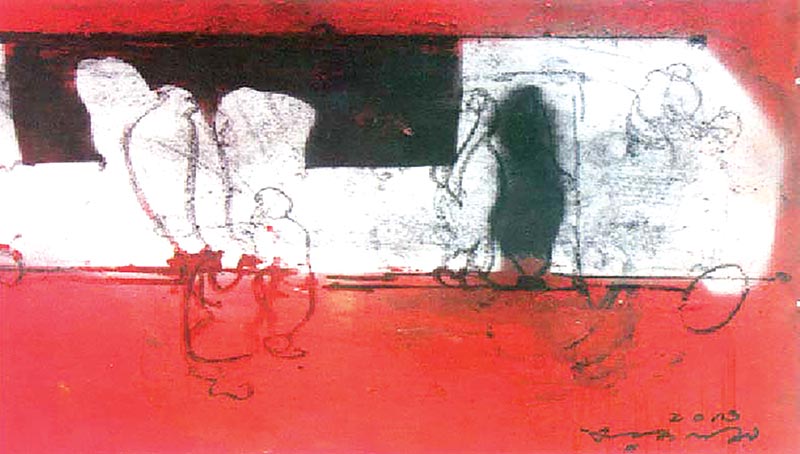
A number of his paintings depict detailed visages of women. One such work also features smooth ground and carries varied tones on different parts of the canvas. The painter has taken considerable time to create the foundation of this piece. Again one of his pet paintings reveals twisted figures in black. One part of the painting is elaborate with numerous curves and blurred shapes. Appearing in motion, his subjects have a realistic attachment with lines -- articulating sorrow and profound romanticism.
Following his M.F.A. in 1996, from the Institute of Fine Art (now, the Faculty of Fine Art, University of Dhaka), he embarked on a series that excavated some of the structural aspects of the Jataka tales, of which there are consummate interpretations on the walls of Buddhist monasteries of bygone eras. At present his works are more nuanced, and also engaged with the pictorial quality they externalize a tendency to revitalize the linear aspect of his image with the contemporary techniques of surface painting.
Loading...
Loading...
Also read






Editor : Iqbal Sobhan Chowdhury
Published by the Editor on behalf of the Observer Ltd. from Globe Printers, 24/A, New Eskaton Road, Ramna, Dhaka.
Editorial, News and Commercial Offices : Aziz Bhaban (2nd floor), 93, Motijheel C/A, Dhaka-1000.
Phone: PABX- 41053001-06; Advertisement: 41053012; 01793317829, 01550707291, E-mail: [email protected], [email protected] Online: email: [email protected] 41053014; 01550707297 Advertisement: 01550707296
Published by the Editor on behalf of the Observer Ltd. from Globe Printers, 24/A, New Eskaton Road, Ramna, Dhaka.
Editorial, News and Commercial Offices : Aziz Bhaban (2nd floor), 93, Motijheel C/A, Dhaka-1000.
Phone: PABX- 41053001-06; Advertisement: 41053012; 01793317829, 01550707291, E-mail: [email protected], [email protected] Online: email: [email protected] 41053014; 01550707297 Advertisement: 01550707296


