



| HEADLINE |

|
Gambia for interim measures to stop Rohingya genocide
Published : Wednesday, 11 December, 2019 at 12:00 AM
Shahnaj Begum


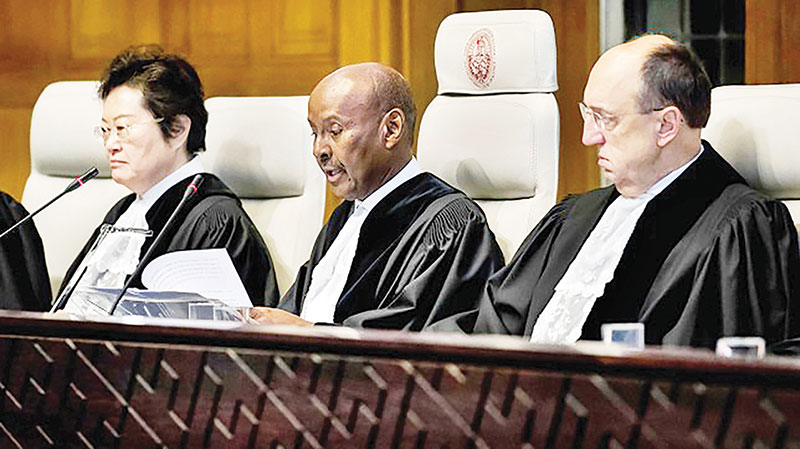 Gambia asked the International Court of Justice (ICJ) to impose provisional measures to protect the Rohingyas from further harm by ordering Myanmar to immediately stop a genocide there.
Abubacarr Marie Tambadou, Attorney General and Justice Minister of Gambia and a former prosecutor at the Tribunal into the Rwanda's 1994
genocide, made the plea before the ICJ court on Tuesday during the first round of oral observations of Gambia.
"All that Gambia asks you (ICJ) is to tell Myanmar to stop these senseless
killings, to stop these acts of barbarity that continue to shock our collective conscience, to stop this genocide of its own people," Tambadou said.
"Bangladesh is watching the case very carefully, as the Rohingyas are staying in sprawling camps. We send our two senior Secretaries there to help Gambia like Canada and Netherlands, however, we are observing the situation," State Minister for Foreign Affairs Shahriar Alam told the Daily Observer.
The ICJ in The Hague of the Netherlands has started the three-day hearing on Rohingya genocide at 3:00 pm (BST) on Tuesday with Gambia being the complainant on behalf of the Organisation of Islamic Cooperation (OIC).
Meanwhile, huge numbers of Bangladeshi were also observing the case proceedings at live telecast by the social media with the other people across the globe.
During his written submission, Tambadou said Myanmar's military operation involved "mass murder, mass rape and mass torture, children being burned alive in their homes and places of worship."
Suu Kyi is set to speak at the first round of oral observations today (Wednesday) in defence of Myanmar's military. She is expected
to argue that Myanmar was conducting legitimate operations against Rohingya
militants and that the ICJ has no jurisdiction in the case. Suu Kyi won the Nobel in 1991 for her resistance to Myanmar's brutal junta.
Meanwhile, Nobel Peace laureates have demanded that Myanmar's State Counsellor Aung San Suu Kyi, along with her army commanders, be held criminally accountable for crimes committed.
Rights groups have criticised her decision to represent Myanmar at the ICJ against accusations by the West African state of Gambia that it has breached the 1948 Genocide Convention.
"As Nobel Peace laureates, we call on Aung San Suu Kyi, a Nobel Peace Prize recipient, to publicly acknowledge the crimes, including genocide, committed against the Rohingyas," said the Nobel Peace laureates in a joint statement.
Before starting her submission, some activists have started heinous propaganda against the proceedings, the UN Special Rapporteur on Myanmar Yanghee Lee has condemned these online threats against activists campaigning for justice and accountability, urging the government and social media firms to do more to protect campaigners.
She called on each and every organ of the Myanmar State to ensure that absolutely no reprisals are taken against any group or individual that is advocating for justice and accountability in Myanmar, according to a message received from Geneva.
"The online threats, including those targeting prominent activists Dr Maung Zarni and Nay Say Lwin of the Free Rohingya Coalition are deeply concerning," Lee said.
However, Minister Abubacarr Tambadou told the judges of the court that, 'this is very much a dispute between Gambia and Myanmar.'
Myanmar, however, faces a number of legal challenges over the fate of the Rohingyas, including a probe by the International Criminal Court - a separate war crimes tribunal in The Hague - and a lawsuit in Argentina.
The Gambian and the Myanmar sides would present their second round of oral observations respectively in the morning and in the afternoon on Thursday.
In another development on November 14, the International Criminal Court (ICC), based in The Hague as well, authorised its prosecutor office to launch an investigation into the 'situation in Bangladesh and Myanmar.'
According to legal experts and diplomats ICJ is entrusted with the task of settling disputes among countries while ICC could expose persons concerned to punitive actions.
The ICC judges' authorization came as its prosecution office, in July this year, sought permission to open a formal investigation to expose to justice Myanmar generals and others concerned for committing crimes against humanity as its ICC deputy prosecutor James Stewart visited Bangladesh.
ICC Prosecutor Fatou Bensouda in a statement at that time said the ICC judges feared that Myanmar may have 'state policy' to attack its minority Rohingya population in Rakhine.
Loading...
Loading...
Also read



Editor : Iqbal Sobhan Chowdhury
Published by the Editor on behalf of the Observer Ltd. from Globe Printers, 24/A, New Eskaton Road, Ramna, Dhaka.
Editorial, News and Commercial Offices : Aziz Bhaban (2nd floor), 93, Motijheel C/A, Dhaka-1000.
Phone: PABX- 41053001-06; Advertisement: 41053012; 01793317829, 01550707291, E-mail: [email protected], [email protected] Online: email: [email protected] 41053014; 01550707297 Advertisement: 01550707296
Published by the Editor on behalf of the Observer Ltd. from Globe Printers, 24/A, New Eskaton Road, Ramna, Dhaka.
Editorial, News and Commercial Offices : Aziz Bhaban (2nd floor), 93, Motijheel C/A, Dhaka-1000.
Phone: PABX- 41053001-06; Advertisement: 41053012; 01793317829, 01550707291, E-mail: [email protected], [email protected] Online: email: [email protected] 41053014; 01550707297 Advertisement: 01550707296


