



| HEADLINE |

|
Coldest reaction in the known Universe
Published : Tuesday, 31 December, 2019 at 12:00 AM
Eduvista Desk


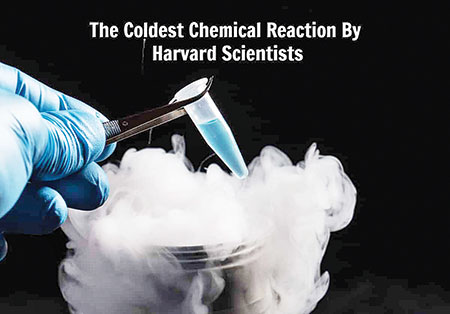 The coldest chemical reaction in the known universe took place in what appears to be a chaotic mess of lasers. The appearance deceives: Deep within that painstakingly organized chaos, in temperatures millions of times colder than interstellar space, Kang-Kuen Ni achieved a feat of precision. Forcing two ultra cold molecules to meet and react, she broke and formed the coldest bonds in the history of molecular couplings.
"Probably in the next couple of years, we are the only lab that can do this," said Ming-Guang Hu, a postdoctoral scholar in the Ni lab, Harvard University. Five years ago, Ni, the Morris Kahn Associate Professor of Chemistry and Chemical Biology and a pioneer of ultra cold chemistry, set out to build a new apparatus that could achieve the lowest temperature chemical reactions of any currently available technology. But they couldn't be sure their intricate engineering would work.
Now they discovered their new apparatus can do something even they did not predict. In such intense cold "500 nanokelvin or just a few millionths of a degree above absolute zero" their molecules slowed to such glacial speeds, Ni and her team could see something no one has been able to see before: the moment when two molecules meet to form two new molecules. In essence, they captured a chemical reaction in its most critical and elusive act.
Chemical reactions occur in just millionths of a billionth of a second, better known in the scientific world as femtoseconds. Even today's most sophisticated technology can't capture something so short-lived, though some come close. In the last twenty years, scientists have used ultra-fast lasers like fast-action cameras, snapping rapid images of reactions as they occur. But they can't capture the whole picture. "Most of the time," Ni said, "you just see that the reactants disappear and the products appear in a time that you can measure. There was no direct measurement of what actually happened in these chemical reactions." until now. Ni's ultra cold temperatures force reactions to a comparatively numbed speed. "Because the molecules are so cold" With this intimate vision, Ni said she and her team can test theories that predict what happens in a reaction's black hole to confirm if they got it right. Then, her team can craft new theories, using actual data to more precisely predict what happens during other chemical reactions, even those that take place in the mysterious quantum realm.
Already, the team is exploring what else they can learn in their ultra cold test bed. Next, for example, they could manipulate the reactants, exciting them before they react to see how their heightened energy impacts the outcome. Or, they could even influence the reaction as it occurs, nudging one molecule or the other. "With our controllability, this time window is long enough, we can probe," Hu said. "Now, with this apparatus, we can think about this. Without this technique, without this paper, we cannot even think about this."
Source: Harvard.edu
Loading...
Loading...
Also read








Editor : Iqbal Sobhan Chowdhury
Published by the Editor on behalf of the Observer Ltd. from Globe Printers, 24/A, New Eskaton Road, Ramna, Dhaka.
Editorial, News and Commercial Offices : Aziz Bhaban (2nd floor), 93, Motijheel C/A, Dhaka-1000.
Phone: PABX- 41053001-06; Advertisement: 41053012; 01793317829, 01550707291, E-mail: [email protected], [email protected] Online: email: [email protected] 41053014; 01550707297 Advertisement: 01550707296
Published by the Editor on behalf of the Observer Ltd. from Globe Printers, 24/A, New Eskaton Road, Ramna, Dhaka.
Editorial, News and Commercial Offices : Aziz Bhaban (2nd floor), 93, Motijheel C/A, Dhaka-1000.
Phone: PABX- 41053001-06; Advertisement: 41053012; 01793317829, 01550707291, E-mail: [email protected], [email protected] Online: email: [email protected] 41053014; 01550707297 Advertisement: 01550707296


