



| HEADLINE |

|
Raihan Siddiqui
Chhoto Meye Pipreti (The little girl ant)
Raihan\'s quest to revive short stories in children’s literature...
Published : Saturday, 25 September, 2021 at 12:00 AM
Reviewed by Shahriar Feroze


Raihan's quest to revive short stories in children�s literature...
 Up until couple of decades ago, Bengali prose and short stories played a key role in shaping the young mind of a boy or a girl in our schools. These simple written stories for children in our school textbooks largely determined their reading and writing habits. More to it, these stories instilled ethical and realistic teachings in them. Their psychological impact was such overwhelming that in most cases they could be compared with fables.
Raihan Siddiqui has aptly responded to that prolonged drought in our children's literature with a collection of 13 Bengali short stories. Ranging from comedy, tragedy, practical lessons to conveying morale to fantasy to adventure - the writer seemed to have picked up the missing elements in our children's literature - not merely out of moral scruples, but of a personal obligation.
However, as a reviewer going through the 13 short stories opened up a completely new avenue for me. Chhoto Meye Pipreti (The little girl ant) suddenly stirred and awoke my sleeping juvenile mind to pull out those dusty prose and short story books out of my shelves.
Re-reading those books as an adult is a completely different experience from reading them as a child, since we see things from a different perspective and a varied point of view. And with nearly two decades into the journalism profession, now I understand how they profoundly impacted me in penning my opinions in later years.
Nevertheless, I would specifically mention five stories in this short anthology. First in line is "Rangin Pakha" - a lovely fairytale like story ending with a tragedy, but not devoid of realism. Second in line is "Dahuker Basha" (Dahuk's nest), the shortest of all stories and perhaps the most difficult to have penned. This tightly-knit and coherent story depicts anthropogenic destruction of nature and life.
The third story in line, this reviewer believes is a must read for all ages "Amader Gacch" (Our trees). This story is all about what we must know to conserve our local vegetation and what harms foreign plants and trees can cause to our health and environment because of our basic botanical lack of knowledge.
All that glitters is not gold, and indiscriminate planting of foreign plants and trees invites serious health and environmental repercussions because of hostile soil and climactic conditions.
The fourth story based on the book's title, "Chhoto Meye Pipreti" (The little girl ant) reminded me of the famed Oprah Winfrey saying - "Turn your wounds into wisdom". It is also a story about the value of unity, patience and perseverance. If not mistaken, the story also conveys a subtle political message.
The fifth and final in my list is the last story "Rangan". It is about a juvenile's unending passion for plants. The story, however, reconfirms the soundness of the age-old saying - Where there is a will, there is a way.
What's fascinating of all Raihan's stories is that they are all linked with a common knotted thread - passion with practicality. All 13 protagonists of his stories are equipped with this uniquely blended characteristic. Whether it is a butterfly, ant, a little girl or a boy, the bottom-line is simple; Raihan manifestly attempts to encourage young minds to mature in the light of these two matching characteristics.
Then again which 'P' dominates over the other 'P' depends on how Raihan's young readers respond to his stories. But passion surely drives you to a purpose, but without a practical approach that purpose is empty.
Written in simple Bengali all 13 stories are likely to be an enjoyable read, at least for our Bengali reading school children. I will use the personal term '3S' describing Raihan Siddiqui's storytelling ability - Simple, Swift and Spontaneous.
Last but not least, it is imperative to get these short stories translated into English for a wider international readership. Other than promoting the writer, the English version would also promote quality of children's literature composed in today's Bangladesh.
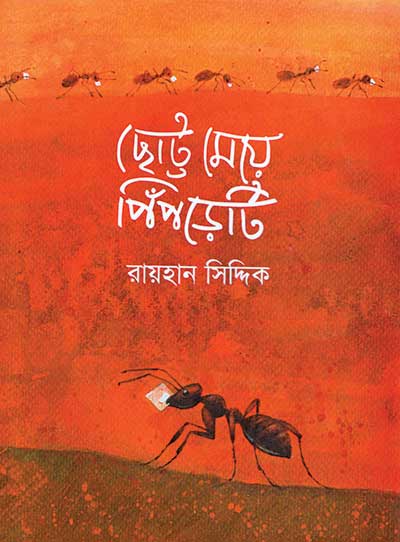
The cover page design is bright in colour and eye-catching, but solely focuses the subject on one single story. An abstract image would have served the purpose better.
The reviewer is assistant editor, The Daily Observer
Up until couple of decades ago, Bengali prose and short stories played a key role in shaping the young mind of a boy or a girl in our schools. These simple written stories for children in our school textbooks largely determined their reading and writing habits. More to it, these stories instilled ethical and realistic teachings in them. Their psychological impact was such overwhelming that in most cases they could be compared with fables. Raihan Siddiqui has aptly responded to that prolonged drought in our children's literature with a collection of 13 Bengali short stories. Ranging from comedy, tragedy, practical lessons to conveying morale to fantasy to adventure - the writer seemed to have picked up the missing elements in our children's literature - not merely out of moral scruples, but of a personal obligation.
However, as a reviewer going through the 13 short stories opened up a completely new avenue for me. Chhoto Meye Pipreti (The little girl ant) suddenly stirred and awoke my sleeping juvenile mind to pull out those dusty prose and short story books out of my shelves.
Re-reading those books as an adult is a completely different experience from reading them as a child, since we see things from a different perspective and a varied point of view. And with nearly two decades into the journalism profession, now I understand how they profoundly impacted me in penning my opinions in later years.
Nevertheless, I would specifically mention five stories in this short anthology. First in line is "Rangin Pakha" - a lovely fairytale like story ending with a tragedy, but not devoid of realism. Second in line is "Dahuker Basha" (Dahuk's nest), the shortest of all stories and perhaps the most difficult to have penned. This tightly-knit and coherent story depicts anthropogenic destruction of nature and life.
The third story in line, this reviewer believes is a must read for all ages "Amader Gacch" (Our trees). This story is all about what we must know to conserve our local vegetation and what harms foreign plants and trees can cause to our health and environment because of our basic botanical lack of knowledge.
All that glitters is not gold, and indiscriminate planting of foreign plants and trees invites serious health and environmental repercussions because of hostile soil and climactic conditions.
The fourth story based on the book's title, "Chhoto Meye Pipreti" (The little girl ant) reminded me of the famed Oprah Winfrey saying - "Turn your wounds into wisdom". It is also a story about the value of unity, patience and perseverance. If not mistaken, the story also conveys a subtle political message.
The fifth and final in my list is the last story "Rangan". It is about a juvenile's unending passion for plants. The story, however, reconfirms the soundness of the age-old saying - Where there is a will, there is a way.
What's fascinating of all Raihan's stories is that they are all linked with a common knotted thread - passion with practicality. All 13 protagonists of his stories are equipped with this uniquely blended characteristic. Whether it is a butterfly, ant, a little girl or a boy, the bottom-line is simple; Raihan manifestly attempts to encourage young minds to mature in the light of these two matching characteristics.
Then again which 'P' dominates over the other 'P' depends on how Raihan's young readers respond to his stories. But passion surely drives you to a purpose, but without a practical approach that purpose is empty.
Written in simple Bengali all 13 stories are likely to be an enjoyable read, at least for our Bengali reading school children. I will use the personal term '3S' describing Raihan Siddiqui's storytelling ability - Simple, Swift and Spontaneous.
Last but not least, it is imperative to get these short stories translated into English for a wider international readership. Other than promoting the writer, the English version would also promote quality of children's literature composed in today's Bangladesh.
The cover page design is bright in colour and eye-catching, but solely focuses the subject on one single story. An abstract image would have served the purpose better.
The reviewer is assistant editor, The Daily Observer
Loading...
Loading...
Also read



Editor : Iqbal Sobhan Chowdhury
Published by the Editor on behalf of the Observer Ltd. from Globe Printers, 24/A, New Eskaton Road, Ramna, Dhaka.
Editorial, News and Commercial Offices : Aziz Bhaban (2nd floor), 93, Motijheel C/A, Dhaka-1000.
Phone: PABX- 41053001-06; Advertisement: 41053012; 01793317829, 01550707291, E-mail: [email protected], [email protected] Online: email: [email protected] 41053014; 01550707297 Advertisement: 01550707296
Published by the Editor on behalf of the Observer Ltd. from Globe Printers, 24/A, New Eskaton Road, Ramna, Dhaka.
Editorial, News and Commercial Offices : Aziz Bhaban (2nd floor), 93, Motijheel C/A, Dhaka-1000.
Phone: PABX- 41053001-06; Advertisement: 41053012; 01793317829, 01550707291, E-mail: [email protected], [email protected] Online: email: [email protected] 41053014; 01550707297 Advertisement: 01550707296


