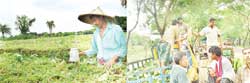
The twelve-year long successful cultivation of insecticide-free vegetables in Magura, Jessore and Jhenidah districts may die down soon as it makes a little impact on consumers due to lack of separate marketing facility for the hygienic and environment-friendly agricultural produces.
While buying different kinds of vegetables, wholesale traders do not make any difference between toxicity-free items and those produced by using harmful chemical pesticides, farmers said.
As the two categories of the produces are sold in markets without any discrimination, buyers are left with hardly any opportunity to choose the hygienic ones. Thus the laudable efforts to contribute to human health and environment have been spoiled, the farmers complained.
If there would have separate markets for toxicity-free vegetables, consumers would have shown more interest in buying those, said Lakkhan Chandra Mondal, a producer of insecticide-free vegetables at Gaidghat village in Bagharpara upazila of Jessore district.
And this would also inspire more farmers to engage themselves in producing vegetables without use of harmful pesticides, Lakkhan opined.
There should be specific places in vegetable markets or different vegetable markets in relevant areas for marketing their produces separately, he said.
After being organised under an organisation styled Krishi Projukti Bastobayan Kendro (KPBK) with cooperation of BARI (Bangladesh Agricultural Research Institute), farmers in the three districts started large-scale cultivation of vegetables without harmful pesticides in 2004.
Instead of harmful pesticides, to check pest attack, they began to use 'pheromone trap' introduced by BARI and bio-agent (beneficial insects) produced in the laboratory of Safe Agriculture Bangladesh Limited (SABL) and other companies like Ispahani Agro-Biotech Limited.
Pheromone trap is a chemical capsule that is kept in a plastic bottle half-filled with water. But it wonders when insects are seen to flock to the bottle to drown, field sources said.
Farmers who earlier used to apply heavy doses of pesticide in their vegetable fields, now needs this wonder capsule they call 'tabiz' (talisman) along with some beneficial insects.
Scientists call the principal ingredient used in checking pest attack as 'pheromone'-the female sex hormone of insects - that attracts male and those are drowned into the water kept in the bottle of the 'pheromone' trap.
However, to destroy the harmful-power of the female insects, apart from pheromone trap, the farmers also have to use some beneficial insects like Bracon, Habator, Trichogramma, Chilonis and Chrysopa, some experts said.
At least five thousand acres of land in 62 villages of three districts are now being used in producing toxic-element free vegetables, according to sources in KPBK. In the ongoing season, they are growing vegetables like cauliflower, turnip, kidney-bean, gourd and brinjal.
This correspondent visited Piarpur, Tilkhari, Kushkhali, Ramkantapur, Harishpur, Aruakandi, Gopalgram, Singra and Dhaneswargati villages in Shalikha upazila of Magura district, Gaidghat, Sikandarpur, Premchara and Nagorpur villages under Bandobila union in Bagherpara upazila of Jessore and talked to farmers.
Abu Zafar Biswas in Piarpur village, who has been producing vegetables without using harmful pesticide for the last ten years, while talking to this correspondent said, "I feel pain as I face lack of marketing facility in selling my toxicity-free produce and see to mix my produce with toxic ones as I went for producing those not only for my own profit but also for contributing to human health and."
Sushil Gayeen, a farmer of Singra village in Dhaneswargati union while talking to this correspondent, said, "Earlier, in the year 2006 NGOs like Jubak, Safe Agriculture Bangladesh Limited (SABL), used to buy vegetables from us, but no organistion or businessman came here in that purpose latter."
Sharif Mohammad Gausul Azam, secretary to ESDEP (Economical, Social Development and Ecological Programme) Concern Foundation, an NGO in Magura working on insecticide-free vegetable cultivation, while talking to this correspondent, said, "If government patronisation is available, only then, it's possible to provide the farmers engaged in toxicity-free vegetables with marketing facility to inspire them as they are contributing to human health as well as environment."
When contacted, Chief Scientific Officer (CSO) of BARI's Entomology Division Dr. Syed Nurul Alam told The Daily Observer that they were planning to take up special programme to facilitate the farmers in marketing their non-toxic produce.
"We have already talked to some privately-run institutions and organisations to make them interested in buying toxicity-free vegetables from farmers and supplying those to consumers", the CSO added.
BARI in 2003, took up Integrated Pest Management (IPM) programme to discourage farmers in using harmful pesticide and to inspire them in producing toxic-element free vegetables.
The programme assisted by DFID, UK achieved a great success in last twelve years. The National Resources Institute (NRI), UK, Asian Vegetable Research and Development Centre (AVRDC), Taiwan and multinational company Syngenta cooperated in the research, official sources said.





