



| HEADLINE |

|
Focus on sending more female workers abroad
Published : Wednesday, 10 January, 2024 at 12:00 AM
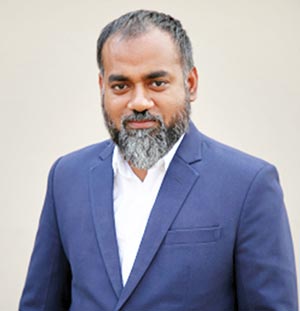
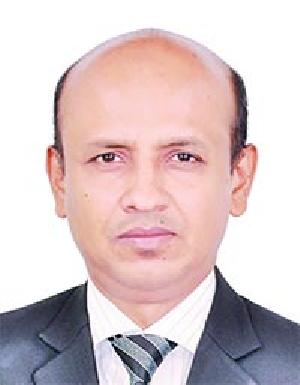
Waliullah Bhuiyan


 Adult aging in developed nations is the key driver for global care economy growth and Bangladeshi skilled female migrant workers can earn billions every year.
 Despite sending large number of migrant workers abroad and many initiatives like incentives for their sending money by a minimum of 5 percent, the yearly remittance is declining day by day. According to Bangladesh Bank source, remittance was $21.75 billion in 2020, $22.21 billion in 2021, $21.50 billion in 2022 and $21.05 billion as of December 2023.
About 11.37 lakh workers went abroad in FY23, but only 1.2 lakh of them receive training under short courses of technical training centers the same year, according to the Bureau of Manpower, Employment and Training (BMET). Thats the reason why the average monthly remittance sent by a Bangladeshi expat is only $203.33 while it is $564.1 for a worker from Philippines. Interestingly, 70% of the remittance sent by Filipino worker is related to service, especially the care economy. And it is dominated by female skilled workers.
No wonder that of the estimated 1.96 million Overseas Filipino Workers (OFW) in 2022, 57.8% were females, while 42.2% were males. The picture of Bangladeshi migrant worker is completely opposite - only 12% of all migrants are female based on data available till 2017. But there is a sharp increase of female migrant between 2004 and 2013 which is up from only 4% to almost 19% in 2015.
The major destinations for female migrants are Saudi Arabia, United Arab Emirates (UAE), Jordan, Lebanon, Oman and Quatar - all Middle East countries. They mainly work as domestic worker, helper, maid - low-skilled jobs, whereas the Filipino Female Migrants work as skilled caregiver, babysitter, nanny, and nurses. Thats the primary reason why Filipino workers send 2.5 times more remittance back to their home compared to Bangladeshi worker. Interestingly, study findings reveal that even low-skilled female workers remit between 70 to 80 per cent of their income to their families, much more than men do. A Bangladeshi woman working in the Middle East on average sends 77 per cent of her income back home.
In summary, it is evident that if Bangladesh can send skilled female workers for care economy, the country can receive the highest amount of remittance. The female workers with necessary skill and experience in caregiving will be the biggest asset to earn foreign remittance.
Capturing the Global Care Economy Market: Global Care Economy is massive. Global childcare market is $520 Billion in 2022, Daycare service market expected to grow $415 Billion by 2025.
Global Health Caregiving industry is expected to hit $200 Billion by 2024, a majority of it is old age caregiving. The developed nations are already in severe crisis of skilled caregivers. For example, Canada is opening its door to take hundreds of thousands skilled caregivers around the world.
However, Bangladesh has yet to capitalize on this market, facing obstacles that hinder its potential for growth. The primary reasons include the lack of language skills and the absence of both caregiving skill training and relevant job experience.
52% of the Bangladeshi migrant workers reported that the top reason for their low earning is the local language skill. Filipino workers dominate the skilled caregiving market due to their linguistic proficiency and diverse skill set. Although Bangladeshi workers are seen as law abiding, hard-working, and adaptive to new culture, due to above key reasons, we are unable to ready a strong pool of trained female candidates who are skilled and experienced in caregiving. Rather we are sending unskilled maid to Middle East countries.
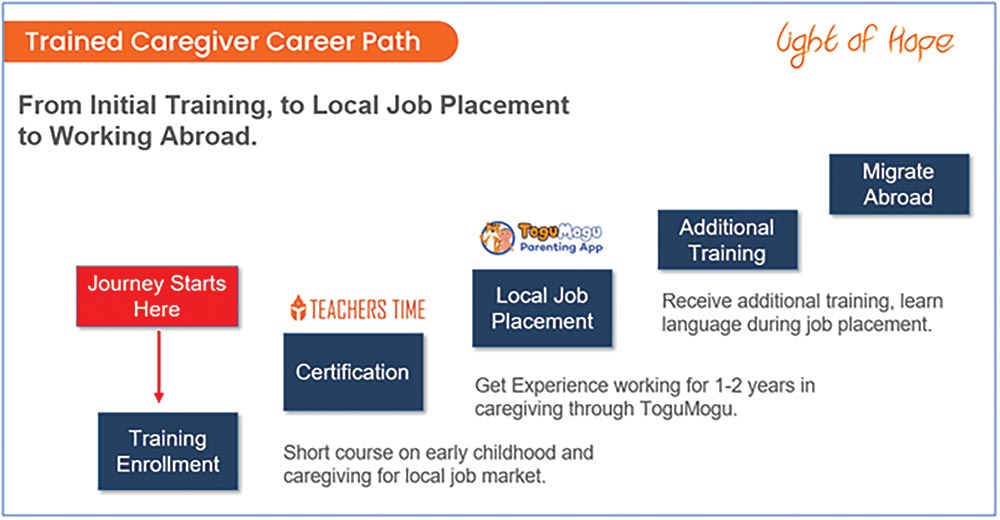
The Solution: Training, Local Job Placement & Skill Migration:Addressing the existing gaps in the caregiving ecosystem, Light of Hope Ltd. has meticulously planned the journey from unskilled young females to skilled migrant workers. The comprehensive solution includes short courses on early childhood education and child behavior management, eligibility for caregiving roles, job placement through partnerships with organizations like ToguMogu, career counseling, language courses, and additional online courses offered by international partners. The solution aims to prepare skilled caregivers who can meet global demands. The presented model addresses the challenges of language proficiency, societal perceptions of caregiving roles, and the lack of job experience. By providing a one-stop solution, this initiative seeks to bridge the gap and create a skilled workforce ready for migration.
The Urgent Need for Collaboration : While the solution appears complex, it is imperative to address the challenges to unlock the potential of the global care economy for Bangladesh. Collaboration between government bodies, non-governmental organizations, and private companies is essential to make this solution effective and scalable. The female participation rate in formal job sector has been stagnant for a while in Bangladesh. In order to become a developed country, we need to make sure higher female participation in the workforce.
The global care economy, particularly in caregiving, presents an unprecedented opportunity for Bangladesh. By training and empowering skilled female caregivers, the nation can position itself as a significant player in the global market, contributing to economic growth and creating a pathway for sustainable development. The time is now to transform challenges into opportunities and lead Bangladesh towards becoming a developed nation through the strength and resilience of its female workforce.
The writer is Co-founder & CEO, Light of Hope Ltd.
Loading...
Loading...
Also read





Editor : Iqbal Sobhan Chowdhury
Published by the Editor on behalf of the Observer Ltd. from Globe Printers, 24/A, New Eskaton Road, Ramna, Dhaka.
Editorial, News and Commercial Offices : Aziz Bhaban (2nd floor), 93, Motijheel C/A, Dhaka-1000.
Phone: PABX- 41053001-06; Advertisement: 41053012; 01793317829, 01550707291, E-mail: [email protected], [email protected] Online: email: [email protected] 41053014; 01550707297 Advertisement: 01550707296
Published by the Editor on behalf of the Observer Ltd. from Globe Printers, 24/A, New Eskaton Road, Ramna, Dhaka.
Editorial, News and Commercial Offices : Aziz Bhaban (2nd floor), 93, Motijheel C/A, Dhaka-1000.
Phone: PABX- 41053001-06; Advertisement: 41053012; 01793317829, 01550707291, E-mail: [email protected], [email protected] Online: email: [email protected] 41053014; 01550707297 Advertisement: 01550707296


