



| HEADLINE |

|
Rising Nitrogen Dioxide Level In Dhaka
A threat to environment, public health defying global trends
Published : Friday, 23 February, 2024 at 12:00 AM
Shahnaj Begum


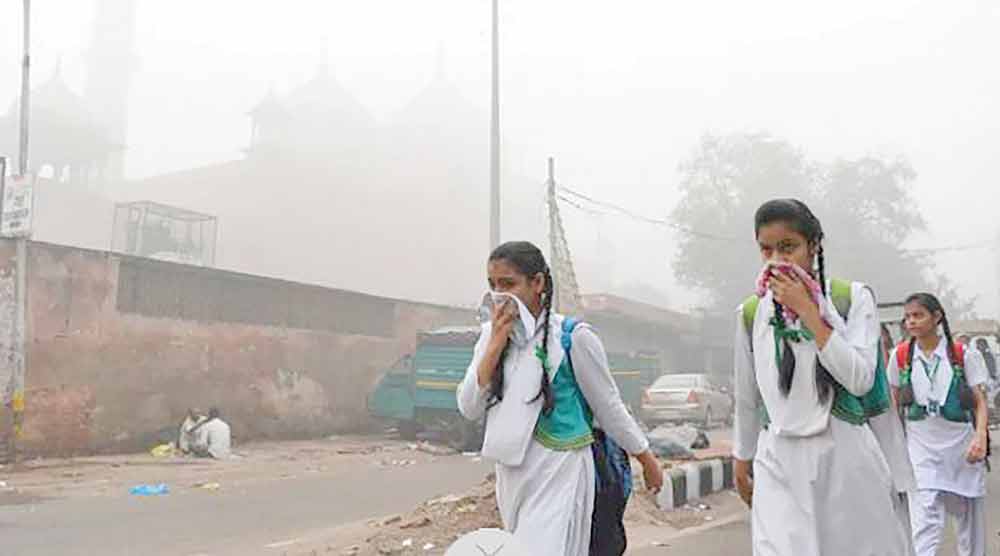 The presence of nitrogen dioxide (NO2) in Dhakas air raises serious health concerns. It aggravates existing respiratory diseases, increases the risk of asthma in children, and increases the frequency and severity of asthma symptoms in both children and adults.
The government lacks precise data on the number of "respiratory diseases" caused by air pollution. However, Abul Bashar Mohammad Khurshid Alam, a senior official of Bangladeshs Directorate General of Health Services, stated that heavy metals carried by the air mix with blood and cause various communicable diseases. He further emphasized that air pollution undeniably reduces life expectancy.
"The number of patients suffering from poor air quality is increasing," he said. Children and older adults are most affected by respiratory problems. "Poor people without access to hospitals and clinics come to us for treatment. We provide them with medications like Monas and cough syrups," said Deepak Kumar Bonik, owner of Moon Medicine Store in Rayerbazar Chancha Bazaar.
"Children accompanied by their parents visit us with severe cough and cold allergies. We treat them using nebulizers. However, sales of such respiratory medications drop by 60 per cent when the rainy season begins," he added.
Professor Abdus Salam, an atmospheric chemistry expert at the University of Dhaka, identifies aging vehicles as a major contributor to Bangladeshs poor air quality. Incomplete fuel combustion, prevalent in older vehicles, releases the harmful air pollutant nitrogen dioxide (NO2).
He further highlights the significant impact of construction activities on air quality. Megaprojects and private construction projects across Dhaka often leave exposed areas during construction, contributing to dust pollution.
"Most roads in Dhaka are currently dug up due to metro rail and elevated expressway construction," he explains.
"Authorities should ensure these areas are covered to prevent dust from spreading as vehicles pass by."
A senior official from the Ministry of Environment, Forest and Climate Change, who preferred anonymity, expressed concerns regarding the governments decision in August 2023 to scrap the regulation limiting the lifespan of commercial buses and trucks to 20 and 25 years, respectively. This decision raises questions about the continued presence of decades-old vehicles on Bangladeshs roads and their potential contribution to air pollution.
Data from the Bangladesh Road Transport Authority reveals a concerning trend: the number of vehicles on the road without a road fitness certificate is steadily increasing. As of April, approximately 568,000 registered vehicles lacked fitness certificates, representing a 60,000 increase compared to January 2022.
The Department of Environment (DoE) operates three continuous air monitoring stations (CAMs) in Dhaka to assess air quality. These stations, located in Sher-e-Bangla Nagar, Farmgate, and Darus Salam, monitor the concentration levels of various pollutants, including carbon monoxide, lead, nitrogen oxide, sulfur dioxide, and PM 10 and PM 2.5 (particulate matter with diameters of 10 and 2.5 micrometers, respectively). However, the CAMs do not differentiate between specific pollutants when reporting the Air Quality Index (AQI).
Despite the presence of other pollutants, PM 10 and PM 2.5 pose the most significant threats to air quality in Dhaka, particularly during the dry season, according to Ziaul Haque, a DoE director. He identifies brick kiln emissions and vehicle emissions as the primary sources of these pollutants.
"Curbing pollution from these two sources would significantly improve air quality during the dry season," Haque emphasizes. He further acknowledges the role of rain in washing away pollutants, particularly particulate matter, and consequently improving air quality.
The World Banks preliminary findings from its "Unlocking Opportunities for Clean and Resilient Growth" report estimate the health burden of air pollution caused by PM 2.5 in urban areas to be USD 1.93 billion, representing 1 per cent of Bangladeshs GDP. Additionally, indoor PM 2.5 pollution contributes an estimated USD 1.11 billion to the national health burden, equivalent to 0.6 per cent of GDP.
The report also identifies brick kilns (38 per cent), motor vehicles (19 per cent), and road dust (18 per cent ) as the major contributors to PM 2.5 pollution in Dhaka. Soil dust and pollution from metal smelters contribute 9 per cent and 7 per cent, respectively. Furthermore, the report highlights the worsening of air quality in Dhaka during the dry season due to increased brick kiln activity.
According to the latest World Health Organization (WHO) report, air pollution claims the lives of approximately 82,000 people in Bangladesh annually, with children and elderly individuals disproportionately affected. A World Vision study indicates a significant rise in air pollution-related deaths in recent years, with the number reaching 173,500 in 2019, a 50,000 increase compared to 2017.
Air pollution remains a major environmental challenge in Bangladesh, with Dhaka consistently ranking among the cities with the worst air quality globally. As of today, Dhaka holds the top or second position on the list of cities with the worst air quality, with an AQI score of 297.
Loading...
Loading...
Also read



Editor : Iqbal Sobhan Chowdhury
Published by the Editor on behalf of the Observer Ltd. from Globe Printers, 24/A, New Eskaton Road, Ramna, Dhaka.
Editorial, News and Commercial Offices : Aziz Bhaban (2nd floor), 93, Motijheel C/A, Dhaka-1000.
Phone: PABX- 41053001-06; Advertisement: 41053012; 01793317829, 01550707291, E-mail: [email protected], [email protected] Online: email: [email protected] 41053014; 01550707297 Advertisement: 01550707296
Published by the Editor on behalf of the Observer Ltd. from Globe Printers, 24/A, New Eskaton Road, Ramna, Dhaka.
Editorial, News and Commercial Offices : Aziz Bhaban (2nd floor), 93, Motijheel C/A, Dhaka-1000.
Phone: PABX- 41053001-06; Advertisement: 41053012; 01793317829, 01550707291, E-mail: [email protected], [email protected] Online: email: [email protected] 41053014; 01550707297 Advertisement: 01550707296


